
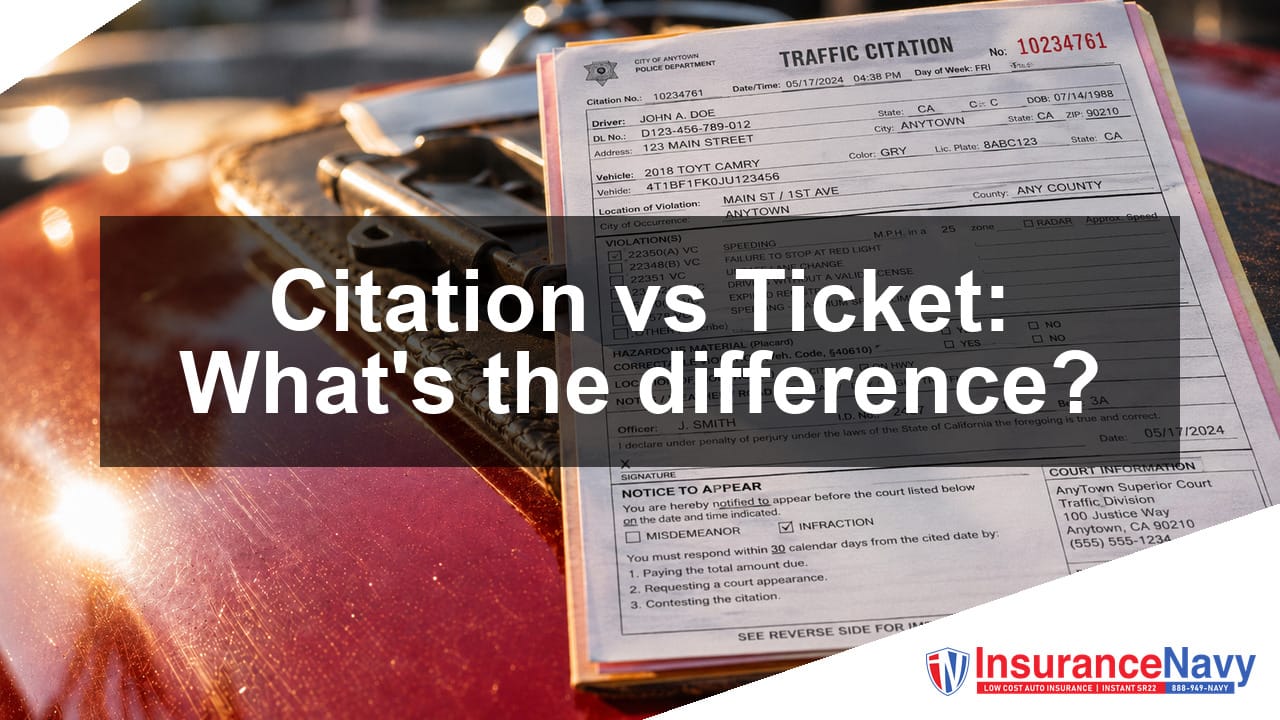
A citation and a ticket are the same document. A citation is the official legal name for the document. A ticket is the common name that drivers use for the same document. Law enforcement issues a citation when a driver commits a traffic violation, such as speeding, running a stop sign, or running a red light. A citation charges the driver and the vehicle with the violation. A citation lists the driver's name, the driver's license number, the law enforcement officer's name, the traffic violation, and the citation number. Traffic violations split into two categories: moving violations and non-moving violations. A traffic citation affects the driver's motor vehicle record, adds driver's license points, and increases car insurance rates. A speeding ticket raises insurance rates by 35%. A DUI raises insurance rates by 132%. A driver can resolve a citation by paying the fine, attending traffic school, or contesting the citation in court.
Table of contents
- What is the Difference Between Citation vs. Ticket?
- Does a Citation Go on Your Record?
- Do Citations Show Up on Background Checks?
- What Types of Violations Are Citations and Tickets Issued For?
- Types of Moving Violations
- Types of Non-Moving Violations
- Citation vs. Warning: What's the Difference?
- What Are Penalties For Citations?
- How Do You Resolve or Contest a Ticket?
- Option 1: Pay the Fine
- Option 2: Fight the Ticket
- What Happens If You Ignore a Citation?
- How Do Citations and Tickets Affect Your Car Insurance Rates?
- What is Ticket Forgiveness in Car Insurance?
- How do Tickets Affect Your Drivers License Points?
- How Can I Lower My Car Insurance Rates after Receiving a Ticket?
- What Should I Do If My Car Insurance Is Canceled After a Moving Violation?
- Frequently Asked Questions
- Why Do Some Officers or Courts Use the Term Citation Instead of Ticket?
- Is a Citation the Same as a Ticket or a Warning?
- Do Citations and Tickets Affect My Driving Record and Insurance Record Differently?
- How Long Does a Citation Stay on My Driving Record?
- Frequently Asked Questions
- Why Do Some Officers or Courts Use the Term Citation Instead of Ticket?
- Is a Citation the Same as a Ticket or a Warning?
- Do Citations and Tickets Affect My Driving Record and Insurance Record Differently?
- How Long Does a Citation Stay on My Driving Record?
- Do Non-Traffic Citations (Court or Civil Citations) Go on Your Record?
It may seem insignificant, but which is the correct terminology? Is it called a ticket or a citation? Both answers are accurate; the document received is both a citation and a ticket.
Citation is the fancy, official legal name for them. At the same time, drivers have long called them tickets and the colloquialism has stuck. A ticket and a citation are the same, even consequence-wise.
What is the Difference Between Citation vs. Ticket?
In most of the United States, being issued a citation or ticket is the same thing.
Wherein a traffic violation has occurred, a document will be issued charging the driver and the vehicle with the said violation. This can be an offense like speeding past a stop sign or a red light.
Despite a ticket and citation being the same thing, a few jurisdictions use tickets to assign fines before issuing a citation for a certain number of traffic violations.
In everyday use, a citation and a ticket are identical. A few jurisdictions reserve the term "citation" for violations that require a court appearance. For most drivers, the document and the consequences are the same.
A citation will have the driver's name, license number, law enforcement officer's name, traffic violation, and citation number in the top right-hand corner of the slip. Fines can typically be paid online or in person.
Does a Citation Go on Your Record?
Yes. A traffic citation for a moving violation goes on your driving record after you pay the fine or are convicted. Your state's DMV records the violation on your motor vehicle record (MVR). Insurers can see the MVR, and in most states the violation adds license points.
Which record matters:
Driving record (MVR): Moving violations go on the MVR and typically stay 3 to 5 years, depending on the state. Insurers check the MVR when pricing a policy.
Criminal record: Ordinary citations are civil infractions and do not create a criminal record. Criminal traffic offenses like DUI, reckless driving, and driving on a suspended license create a criminal record and stay permanently unless expunged.
Non-moving violations: Parking tickets and other non-moving violations generally do not go on the driving record and do not add points. Non-moving violations carry fines only.
Written warnings go on neither record.
Do Citations Show Up on Background Checks?
Whether a citation shows up on a background check depends on the type of check. A standard criminal background check does not show ordinary traffic citations, because ordinary citations are civil infractions. An MVR check shows citations, points, and suspensions. Employers run MVR checks for driving jobs. Criminal traffic offenses like DUI and reckless driving appear on both checks.
What Types of Violations Are Citations and Tickets Issued For?
Citations are issued for many common traffic violations and are grouped into two categories. They refer to if the car was moving or stationary at the time of the violation:
Moving violation - When the vehicle is in motion, and the driver breaks the law. As long as the speedometer reads more than zero at the time of the violation, it's a moving violation.
Non-moving violations - A car isn't moving when parked, so non-moving violations usually happen in parking lots. In some states, running a red light is often treated as a non-moving citation.
Traffic violations are typically categorized into moving violations and non-moving violations. Knowing the difference can help you avoid fines, keep a clean record, and safely drive.
Types of Moving Violations
Moving violations occur when your vehicle is in motion and you don't follow traffic laws. This type of traffic citation can result in fines, points on your record, higher insurance rates, and even license suspension or jail time.
Speeding - Going over the posted speed limit can get you speeding tickets. Speeding tickets can be fined, get points on your record, get higher insurance rates, and possibly get a license suspension or jail time for extreme cases.
Running a Red Light or Stop Sign -Not stopping at a traffic signal or stop sign can result in penalties that vary by state, including fines, points, and possible suspension of license if repeated.
Driving Under the Influence (DUI/DWI) - Driving a vehicle while under the influence of alcohol or drugs is a serious offense that can get you fined, suspended, jailed, and long-term legal consequences on your record.
Reckless Driving - Engaging in dangerous driving behavior like excessive speeding, street racing, tailgating, or weaving through traffic can result in fines, suspension, and possible jail time.
Failure to Signal- Not using your turn signal when changing lanes or turning can result in a ticket, fine, and points on your record.
Types of Non-Moving Violations
Non-moving violations occur when your vehicle is stationary, or the infraction doesn't involve unsafe driving behavior. These types of citations are usually fined only, not points on your record.
Parking Violations - Parking in restricted areas, blocking fire hydrants, overstaying metered parking, and parking in no-parking zones can result in a parking ticket.
Expired Registration or Tags- Driving with an expired vehicle registration or license plate tag can result in a fine, vehicle impoundment, or even suspension.
Equipment Violations - Issues like broken headlights, malfunctioning turn signals, or an excessively loud exhaust system can get you ticketed and require repair.
Failure to Provide Proof of Insurance - Not carrying valid proof of auto insurance can get you fined, suspended, and even impounded.
Seatbelt Violations - Not wearing a seatbelt or not buckling up passengers can get you ticketed, especially in states with primary seatbelt laws.
Tinted Windows Violations - Some states regulate how dark window tint can be, and violating those can result in a fine and a requirement to adjust the tint.
When a police officer gives you a ticket, they will explain the violation and give you the ticket and options. Getting a ticket doesn't mean you're guilty.
You can pay the fine, attend traffic school (if eligible) to reduce points, or contest the ticket in court.
Citation vs. Warning: What's the Difference?
A written warning is a formal notice from law enforcement on a piece of paper for a petty traffic violation. It is not a citation or ticket.
Unlike a citation, a written warning has no fines, penalties, or points on your license and does not go on your DMV record.
It's a reminder to drivers to let them know they committed an infraction and to remind them to obey the law. While a written warning has no immediate consequences, multiple warnings can lead to future enforcement if the same violations continue.
What Are Penalties For Citations?
A citation's penalties range from a warning to fines, license points, and higher insurance rates. Criminal violations add license suspension or jail. The penalty depends on the severity of the traffic offense.
Some examples of Penalties for a Citation are listed below.
Warning - Nothing more than a warning will usually be given to drivers who have a first-time moving violation. There's no fine or record for the warning after the fact, as it's assumed the driver will be more careful next time. Drivers with regular violations won't be issued a warning.
Fines and insurance rate increase - When a citation is issued, a fine will always be paid, whether moving or non-moving. We'll use running through a red light as an example since it's not the kind of offense that would lead to jail time or license suspension. In addition to the fine, the citation will also increase insurance rates.
Misdemeanor/ felony violations-Traffic violations like driving under the influence, reckless driving, and even driving without insurance or a driver's license can lead to severe consequences like jail time and the loss of driving privileges. The citations issued for these tend to carry hefty fines. Naturally, insurance rates will increase severely, too.
How Do You Resolve or Contest a Ticket?
You have 3 options after a citation: pay the fine, negotiate in a mitigation hearing, or contest the citation in court.
Option 1: Pay the Fine
If you decide to take the ticket and pay the fine, the fine will be on the citation. Credit cards, money orders or checks are usually accepted. Most local governments offer payment plans if you can't pay in full.
Option 2: Fight the Ticket
If you think the ticket was unfair or you want to reduce the penalties you can fight the ticket. This can be done at different stages:
During the Traffic Stop, Stay calm and be respectful. You may be able to explain why you think the ticket is not justified before the officer gives it to you. This doesn't guarantee dismissal but some officers may reconsider.
Before the Court Date (Mitigation Hearing) - Many jurisdictions allow drivers to negotiate a settlement before trial. In a mitigation hearing, you acknowledge the violation but provide reasons for leniency. This can result in a reduced fine or an alternative resolution, like a defensive driving course instead of a fine.
In Court - If you plead not guilty, you'll get to present your case to a judge. If you admit the traffic violation, you can apologize to the judge, explain the circumstances, and ask for reduced fines or points on your license.
Whether you pay or fight the ticket, a traffic or criminal defense attorney can be helpful. They can guide you through the process, evaluate the evidence against you, and determine the best approach to minimize the penalties.
While a traffic ticket is not a criminal offense, the impact on your driving record and insurance rates can be significant.
What Happens If You Ignore a Citation?
Ignoring a citation increases the penalties on a predictable schedule. Late fees stack onto the original fine. A missed court date leads many states to charge failure to appear. Failure to appear is a separate offense that can bring a bench warrant. The state can also suspend your license for non-payment. Some states escalate an ignored citation to a misdemeanor. If you cannot pay the fine, ask the court for a payment plan before the payment deadline.
How Do Citations and Tickets Affect Your Car Insurance Rates?
After a traffic violation, your state's Department of Motor Vehicles (DMV) updates your motor vehicle record to include the violation. Your insurer prices your next renewal from that record.
Minor traffic violations will typically stay on your driving record for three to five years. A significant violation like a DUI can remain on a record for 10 years or more, and in some states a DUI never comes off the record.
A way to remember is that insurance rates will increase by 35% for something like a speeding ticket and 132% for a DUI. Your insurance provider can access your driving record and typically looks for accidents within the last seven to 10 years.
The more tickets on your record, the higher your car insurance premiums because you are seen as a high-risk driver. A history of reckless or intoxicated driving can result in the insurance company dropping your coverage altogether.
Here are some numbers to give you an idea of how much citations can genuinely do to your insurance premiums:
Basic auto coverage - A single speeding citation can raise your car insurance rates from $545 to $674 annually. In contrast, an accident or collision raises your car insurance costs to $784.
Full auto coverage - A speeding citation can raise your car insurance rates from $1,555 annually to $1,865. In contrast, an accident or collision can raise your rates to $2,090.
What is Ticket Forgiveness in Car Insurance?
Ticket forgiveness is an insurance policy endorsement that will not increase your rates after your first minor ticket. This differs from accident forgiveness, which will waive the surcharge after your first at-fault accident.
Some insurance policies bundle ticket forgiveness with accident forgiveness, but in most cases, they are separate options.
With ticket forgiveness, the insurer will forgive a minor infraction, like a speeding ticket, for driving a few miles over the speed limit, so it doesn't increase the rate.
This benefit is usually available to drivers with a clean driving record for at least 3 years to reward good driving and encourage traffic law compliance.
However, not all insurers offer ticket forgiveness, and it's not allowed in some states like California. Check with your insurer to see if this is in your policy.
How do Tickets Affect Your Drivers License Points?
Driver's license points are tied directly to your motor vehicle record (MVR).
Most states add points to your driving record after a traffic conviction. Some states do not use points. Texas repealed its driver-point system in 2019, and a few other states track violations without points. Drivers License points typically stay on your driving record for three to five years.
You want to keep the number of driver's license points low. Consequences of too many points can result in a driver's license suspension. Each state handles its license point system differently.
Point values vary by state. Running a red light is 3 points in New York. California assigns 1 point to most violations. California assigns 2 points only to major offenses like DUI and reckless driving, under the CA DMV's Negligent Operator Treatment System. In California, most points clear after about 3 years, but major 2-point offenses like DUI stay on the record for 13 years. In Georgia, speeding 15 to 18 mph over the limit is 2 points on the GA DDS points schedule, and speeding 34 or more mph over rises to 6 points.
Your points are also visible to your auto insurance company, so more points mean higher insurance rates.
How Can I Lower My Car Insurance Rates after Receiving a Ticket?
You can remove a ticket from your driving record and lower your car insurance rates in 3 ways:
Driving courses - Drivers with citations often take a defensive driving course for leniency. It shows auto insurance providers that you're taking steps to become a safer driver. This may also keep your insurance rates as high as they would be after a ticket.
Ask for leniency when pleading guilty - Major citations will require you to appear in court, especially if it's a felony or misdemeanor. Coming clean and asking for leniency can help lessen penalties, but usually, when it is your first offense.
Contest it in court - While in court, you also have the option to contest the charge altogether. This is often easier said than done, as you must be sure the citation or ticket was legally unwarranted and have a good lawyer. If all goes well, the penalties may be dropped.
What Should I Do If My Car Insurance Is Canceled After a Moving Violation?
If your auto insurer drops your coverage because you are too high-risk to drive, it's a priority to become a safe driver and find a new insurance company to cover you.
It can be challenging for high-risk drivers to get an affordable car insurance quote as they are naturally quoted higher than the average driver. However, some insurance providers specialize in providing coverage to high-risk drivers.
Shopping for insurance is a comparative process. You should check out local and national names and inquire about their high-risk driver policies. It's always possible to find cheap car insurance.
Looking for Affordable Car Insurance After a Citation or Ticket? Insurance Navy is here to help you find the lowest rates!
Get a Free Car Insurance Quote Online or Call one of our insurance experts at 888-949-6289 for Affordable Car Insurance Today!
Frequently Asked Questions
Why Do Some Officers or Courts Use the Term Citation Instead of Ticket?
Law enforcement and courts use the term "citation" to emphasize the legal document. It's an official record of a traffic violation that needs to be addressed. While "ticket" is more commonly used by the public, both are interchangeable and refer to the same thing.
Is a Citation the Same as a Ticket or a Warning?
A citation and a ticket mean the same thing, a document issued by law enforcement accusing a driver of a traffic violation like speeding or running a red light.
Ignoring a citation will get you in more trouble. A warning is a less severe notice, usually verbal or written, that's a reminder to follow traffic laws but doesn't go on your record.
Do Citations and Tickets Affect My Driving Record and Insurance Record Differently?
No, the impact on your driving record and insurance rates is the same whether it's a citation or a ticket. What matters more is the type of violation and how you handle it.
Pay the fine, contest the charge, or take a traffic course (if applicable), which will determine the violation's long-term consequences.
How Long Does a Citation Stay on My Driving Record?
The length of time a citation stays on your driving record depends on state laws and the severity of the violation.
Minor infractions like speeding will remain on record for 3 years or more and affect your insurance rates. However, serious violations like DUIs may never be removed depending on state laws.