
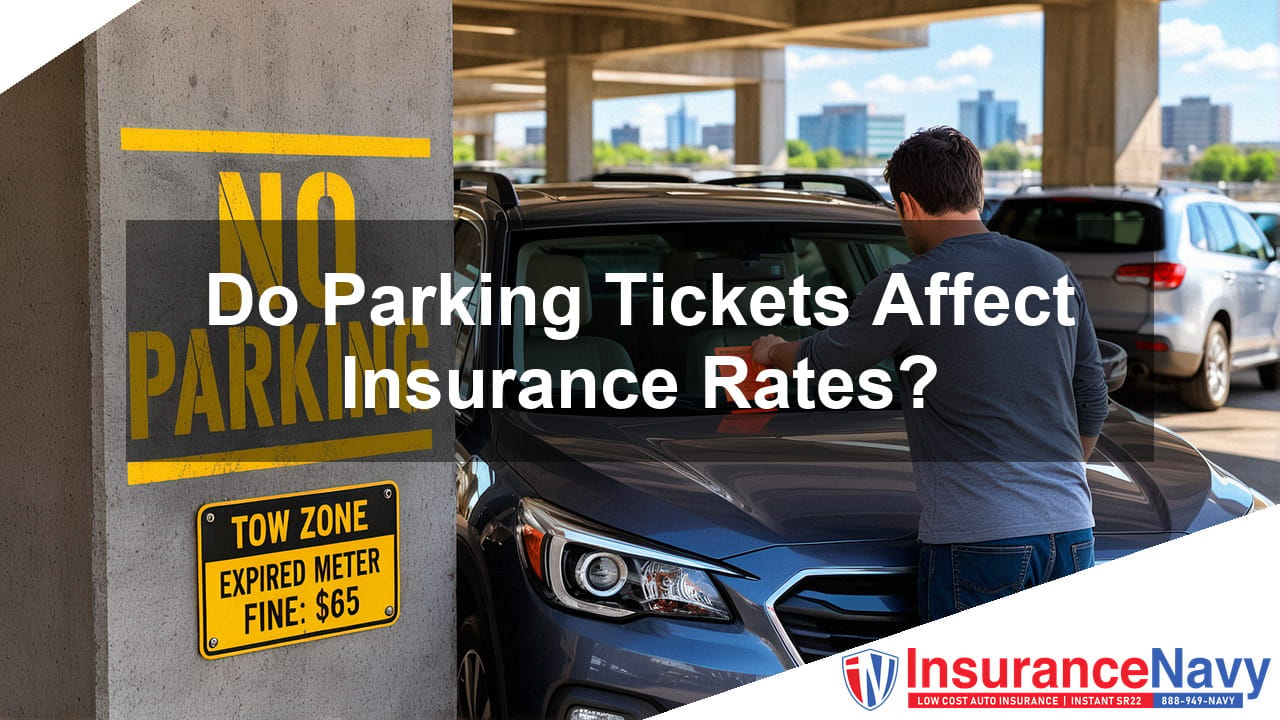
Parking tickets are non-moving violations that municipalities issue for illegal parking. Common parking tickets include expired meters, illegal parking, double parking, and handicap-spot violations. Unpaid parking tickets create three financial risks: collections debt, lower credit scores, and suspended registration. According to Bankrate, drivers with poor credit pay $4,644 per year for full coverage car insurance in 2025. That premium equals $2,006 more than drivers with good credit pay annually. Insurance Navy helps drivers find affordable car insurance across the United States. This guide explains how parking tickets affect insurance rates, credit scores, vehicle registration, and premium costs.
Table of contents
- Moving and Non-Moving Violations: Will They Increase Your Insurance Rates?
- Do Parking Tickets Go on Your Driving Record?
- Moving Violations
- Non-Moving Violations
- What Are the Consequences of Ignored Parking Infractions?
- Unpaid Parking Tickets Hurt Your Credit Score
- Unpaid Tickets May Invalidate Your Cars Registration
- How to Keep a Parking Ticket From Raising Your Insurance
- Pay Before the Ticket Reaches Collections
- Research Types of Insurance Coverage in Your Area
- Frequently Asked Questions
- Can You Reverse a Parking Citation?
- Do Insurance Companies Need To Know About My Past Parking Tickets?
- Do Parking Tickets Affect Insurance Policies Based on My Credit History?
No. A parking ticket does not raise car insurance rates. A parking ticket is a non-moving violation. Non-moving violations do not appear on a driving record, so insurers do not see a parking ticket when they price a policy.
An unpaid parking ticket is a different matter. A city sends an unpaid parking ticket to collections 60-90 days after the ticket is issued. The collections debt can appear on the driver's credit report, lower the driver's credit score by 50 to 100 points, and raise the driver's premium by 10-25% in states that allow insurers to use credit.
Moving and Non-Moving Violations: Will They Increase Your Insurance Rates?
Do Parking Tickets Go on Your Driving Record?
No. A parking ticket is a municipal citation that a city issues to the vehicle, not a moving violation that a court charges to the driver. A parking ticket does not appear on the motor vehicle record (MVR) and carries no license points. Insurers pull the MVR when they quote a policy and when they renew a policy. A parking ticket is not on the MVR.
A moving violation is the opposite. The state charges a moving violation to the licensed driver, and the moving violation appears on the MVR. That distinction is why a $65 parking fine and a $65 speeding fine have different consequences for a premium.
Moving Violations
Insurance companies pay close attention to any moving violations on your driving record, including:
Going over the speed limit
Driving while under the influence
Running a stop sign or red light
Driving recklessly
Moving violations stay on your driving record in Illinois for 4 to 5 years. To make matters worse, having one of these violations on your record will increase your insurance rates an average of 20-30% for each incident.
A DUI conviction can hike your premiums up to 70% or more. The Secretary of State in Illinois will suspend your drivers license if you get 3 convictions within a year's time.
Non-Moving Violations
A single parking ticket likely won't alter how much you pay for your current plan.
The laws around parking tickets make them a lesser offense than other traffic violations. If you return to your vehicle with a slip on the windshield, it's important to reassess your parking habits and be mindful of applicable parking rules.
Common parking tickets police officers issue refer to the following violations:
Expired meter: Parking Tickets for an Expired meter in Chicago cost between $2 to $6.50 an hour and the minimum fine is $65. In LA, the minimum fine is a $68 ticket, while in New York City it will cost you $65. If you pay online before the 21-30 day mark, you'll avoid any extra penalties.
Illegal parking: You think a no parking sign is just a suggestion? Well in Chicago you could be looking at $60-$100 fine, $73 in LA, and $115 in NYC. Fines for parking in front of a fire hydrant are$150 in NYC and $80 in Chicago. Repeat offenders in 12 months may have their car booted in just about every major city.
Double parking: Fines for double parking vary a lot from city to city. Fines range from $115 in New York City, $68 in LA, and up to $200 in Chicago depending on which zone you're parked in. Commercial vehicles get fined even more. The good news is that tickets like this won't affect your insurance rates. Unpaid parking tickets can still get your car booted and you'll be paying a lot in late fees and penalties.
Parking in handicap spots: Parking in a handicap spot will make your wallet a lot lighter afterwards. Fines for illegally parking in a handicap spot range from $250-$500 in Illinois, $450-$1,000 in California, and up to $1,000 in New York.
What Are the Consequences of Ignored Parking Infractions?
The relationship between parking violations and higher auto insurance premiums can be complex. Insurance experts generally look past non-moving violations like municipal parking tickets, even if you acquire multiple.
A traffic ticket becomes a problem for insurance agents when you fail to pay outstanding parking fines.
How do parking tickets affect insurance policies and costs?
Unpaid Parking Tickets Hurt Your Credit Score
The collections agency reports the unpaid ticket debt to Experian, Equifax, and TransUnion. The premium increase applies only in states that allow insurers to use credit-based insurance scores.
Only 3 states prohibit insurers from using credit-based insurance scores to price auto policies: Hawaii, Massachusetts, and California. Every other state permits credit-based insurance scores, subject to the NAIC model rule that credit cannot be the sole basis for raising a renewal rate or denying coverage. About 95% of auto insurers use credit-based insurance scores in the states that permit them.
The size of the credit penalty is what makes an unpaid ticket expensive. The Consumer Federation of America found that a driver with a clean record and poor credit pays an average of $1,012 a year for minimum coverage. An identical driver with excellent credit pays $470 a year. The difference is a 115% increase. A driver with fair credit pays $701 a year. That gap is the real cost of an unpaid $65 parking ticket.
Unpaid Tickets May Invalidate Your Cars Registration
Most cities escalate unpaid parking tickets along the same path. The city adds late fees first. The city boots or tows the vehicle once the owner reaches a set number of unpaid tickets. The city then places a hold on the vehicle registration renewal. Some jurisdictions issue a bench warrant when a driver ignores a citation after a court summons. None of these steps touch the driving record. A registration hold can reach the premium.
Illinois is a concrete example. If you have unpaid parking tickets of over $1,000, the Illinois Secretary of State will suspend your registration. You won't be able to get your license plates renewed until you pay your parking tickets with the city.
Driving with suspended license plates is a Class A misdemeanor under 625 ILCS 5/3-708. The fines can reach up to $2,500 for driving on suspended plates.
Insurance companies like GEICO and Allstate can not renew your auto insurance policy if they find out about your cars suspended registration.
How to Keep a Parking Ticket From Raising Your Insurance
An unpaid parking ticket can create legal problems and a higher premium. Drivers avoid both outcomes with 2 steps: pay the fine before the deadline, and compare coverage in their area.
Pay Before the Ticket Reaches Collections
Payment on time is the entire defense. The payment deadline, not the fine amount, is what costs money. Chicago is one example. The Chicago Department of Finance offers payment plans for drivers who cannot pay a parking bill in full. The Department of Finance lets drivers pay balances over $250 in installments over 3-12 months.
In Chicago, you'll need to pay online within 21 days to avoid a late fee of $20-$50. If you don't pay, your fines will double after 60 days.
Illinois municipalities have to give you a 30 day notice before booting your car under the Illinois Municipal Code.
Research Types of Insurance Coverage in Your Area
Auto insurance rates vary by state and by city. Illinois is one example. Drivers in Chicago pay more for auto insurance than drivers in other parts of Illinois. Chicago rates are higher because the city has higher rates of car theft and accidents.
Illinois law requires a minimum of 25/50/20 ($25,000 bodily injury per person, $50,000 per accident, $20,000 property damage).
Different insurance carriers like Progressive, Hartford, and Bristol West are going to charge you different premiums for the same coverage.
Annual premiums can go from $1,200 to $3,500+ depending on your driving history and what kind of vehicle you're driving.
If you're driving an SUV or a luxury vehicle, you can expect to pay 10-20% more to insure it because its repair cost is much higher than a car.
Start Saving With Insurance Navy, Enroll in an Affordable Policy Today
You don't have to let a minor parking violation cause your insurance premium to skyrocket. As long as you pay all fines in a timely manner and drive safely, you won't have to worry about raised rates, suspended registration, and other avoidable consequences of unresolved parking tickets.
If you need full coverage at a price that works, Insurance Navy writes policies for high-risk and non-standard drivers. We have years of industry experience and work with customers throughout 25 different offices in Illinois.
Are you ready to speak with one of our specialists and find a policy that works for you? Receive a free online estimate or call 888-949-6289.