
How Much Does Business Insurance Cost?

Business insurance costs in 2026 range from roughly $25 per month for a solo consultant to well over $500 per month for a multi-employee contractor. The exact premium any business pays depends on a layered matrix of risk variables , industry class code, payroll exposure, claims history, geographic rating territory, and chosen coverage limits, that insurers model individually rather than quoting from a flat rate card. This guide breaks down what each major policy type costs, what forces business insurance premiums up or down, and how to benchmark your own quotes against real-world market data so you never overpay for the coverage you need.
What is the average monthly cost of general liability insurance for small businesses?
The average monthly cost of general liability insurance for small businesses in 2026 is approximately $42 to $55 per month for most low-to-medium-risk operations, based on aggregated policy data from carriers including Hiscox, The Hartford, Nationwide, and Next Insurance.
General liability: covering third-party bodily injury, property damage, and personal and advertising injury, is priced using Insurance Services Office (ISO) Commercial Lines Manual (CLM) rating algorithms that assign each business a classification code, apply a base rate per $1,000 of sales or payroll, and then modify it by territory, experience, and schedule credits. Because the ISO framework is the industry's starting point, even insurers that file independently tend to cluster premiums within a predictable band for standard risks.
A sole-proprietor management consultant or bookkeeper in a low-risk ISO class code (e.g., 41677, Accountants) typically pays $25 to $40 per month for a $1 million per occurrence / $2 million aggregate GL policy with a $500 deductible, reflecting the near-zero premises and product hazard in that class.
A small retail shop with 1–3 employees and annual receipts under $300,000 generally falls in the $45–$65 per month range; premiums rise with square footage because ISO's GL rate for retail codes applies a secondary premises rate per 1,000 sq ft of occupied space.
Service contractors , plumbers, electricians, HVAC technicians , face GL premiums of $80–$150 per month even at modest payroll levels because ISO assigns these trades a "products and completed operations" hazard surcharge that can equal or exceed the basic premises rate; a licensed electrician with one employee and $200,000 in annual receipts will often pay $95–$120 per month from carriers like Markel or Employers Holdings.
Case Study , Solo IT Staffing Consultant, Austin TX
A self-employed IT staffing consultant placing contractors in the Austin metro market purchased a $1M/$2M GL policy from Hiscox in Q1 2026 at $31.25 per month ($375 annually), reflecting ISO class 41677 applied to $180,000 in annual revenue. After adding a professional liability (E&O) endorsement through the same carrier, total combined monthly premium reached $62.50. The consultant subsequently obtained competing quotes from Next Insurance ($44/month standalone GL) and Thimble ($38/month GL-only), confirming the Hiscox combined package delivered a 28% cost advantage over purchasing GL and E&O separately from two different carriers.
How does a Business Owner's Policy BOP cost compare to standalone general liability coverage?
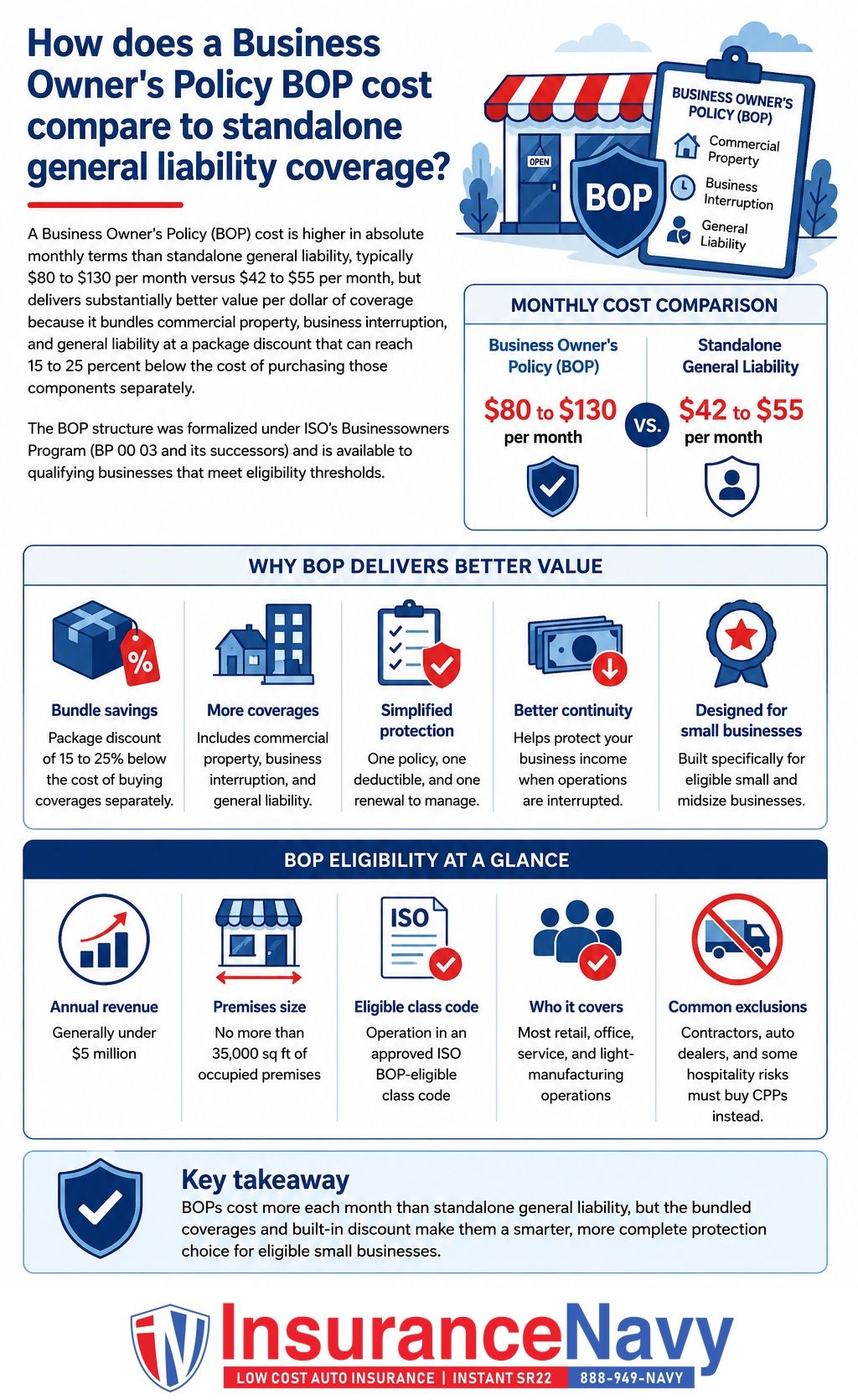
A Business Owner's Policy BOP cost is higher in absolute monthly terms than standalone general liability , typically $80 to $130 per month versus $42 to $55 per month , but delivers substantially better value per dollar of coverage because it bundles commercial property, business interruption, and general liability at a package discount that can reach 15 to 25 percent below the cost of purchasing those components separately.
The BOP structure was formalized under ISO's Businessowners Program (BP 00 03 and its successors) and is available to qualifying businesses that meet eligibility thresholds: generally under $5 million in annual revenue, no more than 35,000 sq ft of occupied premises, and operation in an approved ISO BOP-eligible class code , which covers the majority of retail, office, service, and light-manufacturing operations but excludes contractors, auto dealers, and some hospitality risks that must buy commercial package policies (CPPs) instead.
How does your industry risk level affect what you pay for business insurance?
Your industry risk level affects what you pay for business insurance more than almost any other single variable, with ISO class codes producing base GL rates that range from under $0.10 per $1,000 of revenue for low-hazard consulting firms to over $2.00 per $1,000 of revenue for high-hazard contractors , a 20-to-1 premium spread for identical coverage limits.
ISO's Commercial Lines Manual assigns each business a classification based on its primary operations, and each classification carries a Base Premium Rate (BPR) expressed per unit of exposure (typically per $1,000 of annual sales, per $1,000 of payroll, or per unit of area). The BPR reflects decades of actuarial loss data for that class, and while individual insurers file independent rates, most stay within 20–40% of the ISO advisory rate, meaning ISO class assignment is the single most determinative factor in premium for otherwise identical businesses.
What is the average cost of workers compensation insurance for small businesses in 2026?
The average cost of workers compensation insurance for small businesses in 2026 is approximately $1.00 to $2.50 per $100 of payroll across all industries combined, translating to a median monthly premium of $70 to $130 for businesses with total annual payrolls between $150,000 and $400,000 , though individual rates range from under $0.30 per $100 in low-hazard clerical classes to over $25.00 per $100 in high-hazard trades.
Workers' compensation pricing operates under a fundamentally different rating structure than GL: NCCI's loss cost filing system publishes advisory "loss costs" by class code in the 38 NCCI-administered states, and insurers file their own "loss cost multiplier" (LCM) , typically 1.1 to 1.6 , on top to recover expenses and profit margin. The resulting approved rate is then applied to each $100 of payroll, multiplied by the experience mod, and adjusted for any schedule credits or debits within the range permitted by state regulation (typically ±25%).
Clerical office workers (NCCI class 8810) carry advisory loss costs as low as $0.08–$0.15 per $100 of payroll in most states; with a typical LCM of 1.3–1.5, the all-in rate is $0.10–$0.23 per $100, meaning an administrative assistant earning $45,000 per year generates only $45–$103 in annual workers' comp premium , making workers' comp nearly negligible for pure office businesses.
Roofing contractors (NCCI class 5551) face advisory loss costs of $8.00–$18.00 per $100 of payroll in states like Florida, California, and Texas; at a 1.4 LCM, all-in rates reach $11.20–$25.20 per $100, meaning a roofer earning $60,000 annually generates $6,720–$15,120 in annual workers' comp premium , the single largest insurance line item for most roofing businesses.
Restaurants (NCCI class 9082 , full-service) average $1.80–$3.50 per $100 of payroll depending on state; a restaurant with $350,000 in total annual payroll expects $6,300–$12,250 per year in workers' comp premium before experience mod adjustments, with kitchen staff and delivery personnel typically allocated to the highest-rated class code applicable to their duties.
How do coverage limits and deductibles change your total business insurance cost?
Coverage limits and deductibles change your total business insurance cost through inverse and non-linear relationships: doubling your GL aggregate limit from $1 million to $2 million typically adds only 10–20% to premium because the actuarial probability of exhausting the first limit is much higher than exhausting the second, while raising your deductible from $500 to $2,500 can reduce premium by 8–18% depending on the line of coverage and the carrier's deductible credit schedule. For more information on coverage limits speak with an Insurance Navy agent today.
Some popular business insurance products Insurance Navy provides are: