Auto body shop insurance: Definition, Coverage, Cost, Premiums, Policy Structure, Claims
Auto body shop insurance protects shop owners from financial losses caused by accidents, injuries, and property damage. It covers customer vehicles, shop equipment, employees, and legal costs. Premiums depend on shop size, location, claims history, and the types of coverage chosen. Shop owners who understand policy structure and claims options can better protect their business and recover faster from setbacks.


What is Auto body shop insurance?
Auto body shop insurance is a group of policies that protects repair businesses from financial harm. It covers risks that are unique to shops that fix, paint, and restore vehicles. Shop owners need this coverage to stay legally compliant and financially secure.
A single policy rarely covers all risks. Most shop owners buy several policies together to fill every gap. This bundle protects the business, employees, customers, and equipment.
According to the Bureau of Labor Statistics, about 44,000 auto body shops in the U.S. employ around 150,000 workers. All those workers need coverage under state workers' compensation rules. That fact alone shows how important this insurance is.
These policies typically include the following core types of coverage.
General liability covers third-party injuries and property damage.
Garage keepers liability protects customer vehicles in the shop's care.
Workers' compensation pays for employee injuries on the job.
Commercial property covers tools, equipment, and the building.
Commercial auto covers vehicles the shop owns or uses.
What does Auto body shop insurance typically cover?
Auto body shop insurance covers a wide range of risks that shop owners face daily. It protects against physical damage, legal claims, and employee injuries. Understanding what is covered helps owners avoid costly coverage gaps.
Garage keepers liability is one of the most important policies for any shop. As stated by Investopedia, this coverage protects customer vehicles that are in the shop's care, custody, or control. Without it, the shop pays out of pocket for any damage to a customer's car.
Workers' compensation covers medical bills and lost wages for injured staff. As indicated by the U.S. Department of Labor, workers' compensation is required in 49 states for any business with at least one employee. Most shop owners must carry this policy by law.
A standard auto body shop insurance policy covers the following situations.
Slip-and-fall injuries to customers visiting the shop.
Fire or water damage to tools and equipment.
Theft of shop machinery or customer vehicles.
Employee injuries from chemicals, tools, or machines.
Legal defense costs from customer lawsuits.
Damage to customer vehicles while in the shop's care.
How does auto body shop insurance differ from standard commercial business insurance?
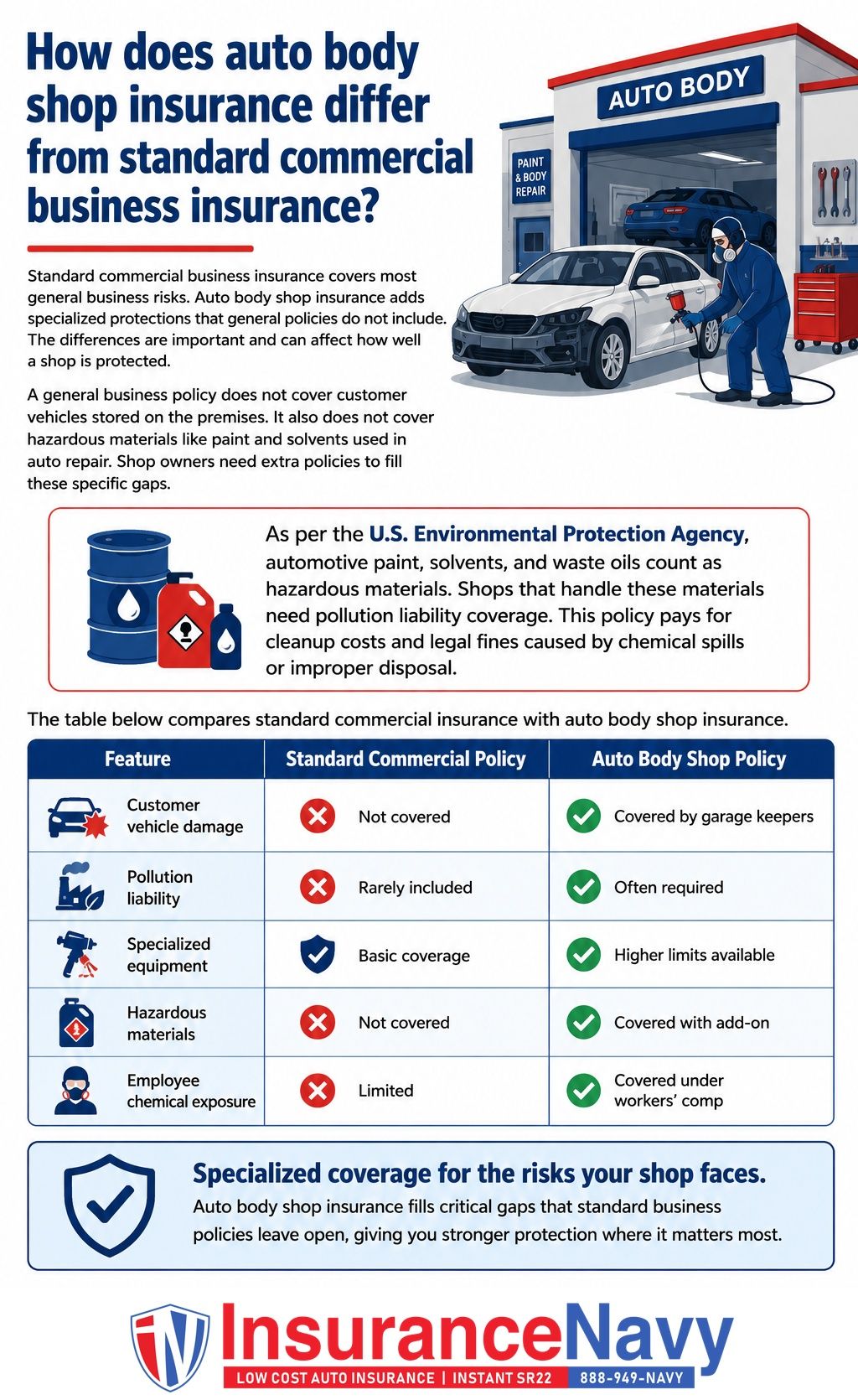
Standard commercial business insurance covers most general business risks. Auto body shop insurance adds specialized protections that general policies do not include. The differences are important and can affect how well a shop is protected.
A general business policy does not cover customer vehicles stored on the premises. It also does not cover hazardous materials like paint and solvents used in auto repair. Shop owners need extra policies to fill these specific gaps.
As per the U.S. Environmental Protection Agency, automotive paint, solvents, and waste oils count as hazardous materials. Shops that handle these materials need pollution liability coverage. This policy pays for cleanup costs and legal fines caused by chemical spills or improper disposal.
The table below compares standard commercial insurance with auto body shop insurance.
| Feature | Standard Commercial Policy | Auto Body Shop Policy |
|---|---|---|
| Customer vehicle damage | Not covered | Covered by garage keepers |
| Pollution liability | Rarely included | Often required |
| Specialized equipment | Basic coverage | Higher limits available |
| Hazardous materials | Not covered | Covered with add-on |
| Employee chemical exposure | Limited | Covered under workers' comp |
What is the typical cost of Auto body shop insurance?
The cost of auto body shop insurance varies based on many factors. Shop size, location, revenue, and claims history all affect the final price. Most small shops pay between a few hundred and several thousand dollars per year.
As noted by Investopedia, a commercial general liability (CGL) policy for a small auto body shop costs between $1,000 and $3,000 per year. That range depends on the shop's revenue, location, and past claims. Larger shops with more employees pay higher premiums.
Property insurance costs more when a shop holds expensive equipment. Specialized tools like frame straightening machines and paint booths raise insured values significantly. This directly increases the property insurance premium.
The following list shows common cost ranges for individual policy types.
General liability: $500 to $3,000 per year.
Garage keepers liability: $1,000 to $4,000 per year.
Workers' compensation: $2,000 to $10,000 per year depending on payroll.
Commercial property: $1,500 to $5,000 per year for mid-size shops.
Commercial auto: $1,200 to $3,500 per year per vehicle.
Pollution liability: $500 to $2,000 per year as an add-on.
How is an auto body shop insurance policy structured by underwriters?
Underwriters are insurance professionals who review a shop's risks and set premium prices. They look at many data points before offering a policy. Their goal is to match the price of coverage to the actual level of risk.
Underwriters review the shop's revenue, number of employees, and location. They also check the shop's claims history and the types of chemicals it uses. Shops with frequent past claims pay higher premiums than shops with clean records.
As outlined by Investopedia, property insurance for auto body shops must account for specialized equipment. Frame straightening machines and paint booths can push total insured equipment values above $1 million for mid-size shops. Underwriters factor those values directly into the property premium calculation.
The numbered steps below show how underwriters structure an auto body shop policy.
The underwriter reviews the shop's application and risk profile.
They assess property values, payroll, and revenue figures.
They check claims history from the past three to five years.
They assign risk ratings to each coverage type separately.
They calculate a base premium for each individual policy.
They apply discounts for safety programs or bundled policies.
They issue a final policy with stated limits and deductibles.
What are the effects of operating an auto body shop without adequate insurance coverage?
Operating without proper insurance exposes a shop owner to serious financial and legal risk. One large claim can cost more than the shop earns in an entire year. Many shops that lack coverage are forced to close after a single major incident.
As per the OECD, about 40 percent of small U.S. businesses are either uninsured or underinsured against key risks. This includes many auto repair shops across the country. Underinsured shops face major financial losses when claims exceed their policy limits.
Without workers' compensation coverage, a shop owner pays all medical and legal costs for injured workers directly. State regulators can also issue heavy fines for operating without required coverage. In some states, the shop must close until compliant coverage is in place.
The risks of operating without adequate insurance include the following.
Paying full legal defense costs out of pocket.
Covering customer vehicle damage from personal funds.
Facing state fines for missing required policy types.
Losing the business license for non-compliance.
Paying employee injury costs with no reimbursement.
Facing bankruptcy after a single large liability claim.
What are the coverage options with a comprehensive auto body shop insurance policy?
A comprehensive auto body shop policy bundles several coverages into one package. This approach reduces total cost and ensures no major gap is left unprotected. Shop owners can also add optional coverages to meet specific needs.
As referenced by Investopedia, bundling garage keepers liability into a Business Owners Policy (BOP) can reduce total premiums by 10 to 15 percent. A BOP combines general liability and commercial property into one policy. Adding garage keepers coverage to that bundle creates strong base protection.
Cyber liability is a newer but growing coverage need for auto body shops. As in accordance with the Federal Trade Commission, shops that store customer payment data must follow the FTC's Safeguards Rule. A cyber liability policy covers costs from data breaches, ransomware, and customer notification.
A comprehensive policy can include the following optional coverage types.
Business interruption insurance replaces lost income during forced closures.
Umbrella liability adds extra limits above standard policy caps.
Cyber liability covers data breaches and digital security incidents.
Pollution liability pays for chemical spill cleanup and related fines.
Employment practices liability covers wrongful termination or harassment claims.
Tools and equipment floater covers portable tools used off-site.
How to recover financially after an auto body shop insurance claim is denied or underpaid?
A denied or underpaid claim can create serious cash flow problems for a shop. Shop owners have the right to challenge any decision made by their insurer. Knowing the correct steps speeds up recovery and protects the shop's finances.
As stated by the IRS, shop owners can deduct 100 percent of qualifying insurance premiums under IRS Section 162. This deduction reduces taxable income and lowers the net cost of buying better coverage. Strong coverage reduces the chance of a claim being underpaid in the first place.
A public adjuster is an independent professional who reviews claims on the shop owner's behalf. They check the insurer's valuation and negotiate for a higher payout if the initial offer is too low. Hiring one often results in a larger settlement for the shop owner.
The steps below show how to recover after a denied or underpaid claim.
Request a full written explanation of the denial or underpayment.
Review the original policy to check what coverage applies.
Gather all repair estimates, photos, and incident reports.
File a formal appeal with the insurance company in writing.
Hire a public adjuster to review the claim independently.
Contact the state insurance commissioner if the dispute continues.
Consult a commercial insurance attorney for unresolved disputes.
Insurance Navy is a U.S.-based insurance resource that helps auto body shop owners find the right commercial coverage. Visit Insurance Navy to compare policy options and get quotes for your shop today.