Car dealer insurance: Types, Importance, Coverage, Costs, Premiums
Car dealer insurance protects auto dealerships from financial loss, legal claims, and inventory damage. It covers everything from test drive accidents to cyberattacks and employee injuries. Dealers must carry multiple coverage types to meet state and lender requirements. This article explains what car dealer insurance covers, what it costs, and why every dealership needs it


What is car dealer insurance?
Car dealer insurance is a group of policies designed for auto dealerships. It protects the business, its employees, and its vehicle inventory. No single policy covers every risk a dealership faces.
Dealers need several types of coverage working together. Each policy covers a different part of the business. Together, they form a complete protection plan.
According to the Insurance Information Institute, the U.S. commercial auto insurance market exceeded $50 billion in direct written premiums in 2023. This growth reflects rising vehicle values and larger dealer fleets. It shows how important this market has become.
The main types of car dealer insurance include the following.
Garage liability insurance covers injuries and damage from dealership operations.
Dealer open lot (DOL) coverage protects vehicle inventory on the lot.
Commercial auto insurance covers vehicles used for business purposes.
Workers' compensation insurance pays for employee injuries on the job.
Cyber liability insurance protects against data breaches and ransomware attacks.
Errors and omissions (E&O) insurance covers mistakes made during sales and finance.
Why is car dealer insurance so important for auto dealerships?
Auto dealerships face many risks every single day. A customer can get hurt during a test drive. A hailstorm can damage an entire vehicle inventory overnight.
Most U.S. states require dealers to carry specific insurance as part of licensing. Without the right coverage, a dealer can lose their license. That means the business must close.
As stated by the National Automobile Dealers Association, approximately 16,839 franchised new-car dealerships operated in the U.S. in 2023. Every one of those dealerships must carry multiple lines of specialized insurance. The requirement protects dealers, customers, and lenders alike.
The key reasons car dealer insurance is important include the following.
Protects inventory worth millions of dollars from theft and weather damage.
Covers legal costs when customers file injury or property damage claims.
Satisfies lender requirements tied to floorplan financing agreements.
Meets state licensing rules that require proof of coverage before opening.
Guards employee wages through workers' compensation during injury recovery.
Lenders who finance dealer inventory require proof of insurance. They do this to protect the vehicles they have a financial interest in. A dealer without coverage can lose their financing line quickly.
What does car dealer insurance cover?
Car dealer insurance covers a wide range of risks. The exact coverage depends on the policies a dealer chooses. Most dealers need several types of coverage to stay fully protected.
Garage liability insurance covers bodily injury and property damage. As reported by Investopedia, this coverage applies to test drives and service work. It is mandatory for most licensed U.S. auto dealers.
The core coverages included in car dealer insurance are the following.
| Coverage Type | What It Protects |
|---|---|
| Garage Liability | Third-party injuries and property damage |
| Dealer Open Lot | Vehicle inventory on the dealership lot |
| Commercial Auto | Business-use vehicles owned by the dealer |
| Workers' Compensation | Employee injuries and lost wages |
| Cyber Liability | Data breaches and ransomware attacks |
| E&O Insurance | Mistakes in sales, finance, and F&I products |
| Employment Practices Liability | Wrongful termination and discrimination claims |
Dealer open lot (DOL) coverage protects the vehicle inventory. It covers events like hail, fire, flooding, theft, and vandalism. Without it, a single storm could cause catastrophic financial loss.
Cyber liability insurance has become a critical coverage for dealers. The CDK Global ransomware attack in 2024 disrupted thousands of dealerships. Dealers without cyber coverage faced enormous out-of-pocket recovery costs.
What is the cost of car dealer insurance?
Car dealer insurance costs vary widely across the USA. The size of the dealership affects the price the most. Location, inventory value, and claims history also play a major role.
Small independent dealers may pay a few thousand dollars per year. Large franchised dealerships can pay tens of thousands annually. Multi-location dealer groups pay significantly more than single-lot operators.
As noted by the National Automobile Dealers Association, the average U.S. franchised dealership carried new-vehicle inventory valued at approximately $7.5 million in 2022. Insuring that much inventory raises the cost of dealer open lot coverage considerably. Lenders also set minimum insurance requirements tied to that inventory value.
The main factors that affect car dealer insurance cost include the following.
Inventory value determines the premium for dealer open lot coverage.
Location affects weather risk, crime rates, and state regulatory costs.
Number of employees raises workers' compensation and EPLI premiums.
Claims history pushes premiums higher after past losses.
Coverage limits chosen by the dealer increase or decrease the total cost.
Type of vehicles sold impacts risk ratings for garage liability policies.
In accordance with Investopedia, commercial general liability coverage for auto dealers typically requires minimum limits of $1 million per occurrence. Many larger dealer groups carry umbrella policies of $10 million or more. Higher limits protect against large lawsuits but raise annual premium costs.
What are the effects of operating a car dealership without adequate insurance in the USA?
Running a dealership without proper insurance creates serious risks. A single lawsuit or weather event can cause devastating financial harm. Many dealers who go uninsured are forced to close permanently.
State regulators take insurance requirements seriously. A dealer caught without required coverage can lose their operating license. In some states, criminal charges can follow a serious lapse in coverage.
As cited by Investopedia, most state DMV regulations require auto dealers to maintain a surety bond ranging from $25,000 to $100,000. This bond is separate from standard insurance coverage. Failing to maintain it can trigger immediate license suspension.
The serious effects of operating without adequate insurance include the following.
Loss of dealer license from failing to meet state insurance requirements.
Personal financial liability for lawsuits that insurance would have covered.
Lender repossession of inventory when insurance lapses under floorplan agreements.
Business closure after a catastrophic uninsured loss like fire or flood.
Regulatory fines from the FTC or CFPB for data and compliance failures.
Criminal exposure in states where uninsured operation is a criminal offense.
The Consumer Financial Protection Bureau can impose penalties up to $1 million per day for knowing violations. As referenced by the Consumer Financial Protection Bureau, dealers offering financing products face significant compliance risks. Dealers without errors and omissions coverage face these penalties with no financial buffer.
How does car dealer insurance affect risk management of a dealership?
Good risk management helps a dealership survive long-term. Car dealer insurance is the foundation of that strategy. Without it, even a small incident can threaten the whole business.
Insurance lets dealers transfer financial risk to an insurer. The dealer pays a premium and the insurer covers major losses. This keeps the dealership's cash flow stable after an unexpected event.
As outlined by the Bureau of Labor Statistics, the automotive retail sector experiences approximately 3.5 injury incidents per 100 full-time workers annually. This rate sits above the private-industry average. Workers' compensation insurance helps dealers manage the financial impact of these claims.
The ways car dealer insurance improves dealership risk management include the following.
Identify all business risks including inventory, employees, and customer interactions.
Match each risk to the correct insurance coverage type.
Set coverage limits high enough to cover the worst-case loss scenario.
Review policies annually and update them as inventory values change.
Train staff on safety practices to reduce claims and keep premiums lower.
The FTC's Safeguards Rule requires auto dealers to maintain data security programs. As per the Federal Trade Commission, dealers must treat data security as a formal risk management obligation. Cyber liability insurance supports compliance with this federal requirement.
Employment practices liability is also a growing concern for dealerships. EEOC charge rates in retail trade average roughly 3.3 charges per 1,000 employees. EPLI coverage protects dealers from costly wrongful termination and discrimination claims.
How effective is car dealer insurance at protecting dealerships from liability and inventory loss?
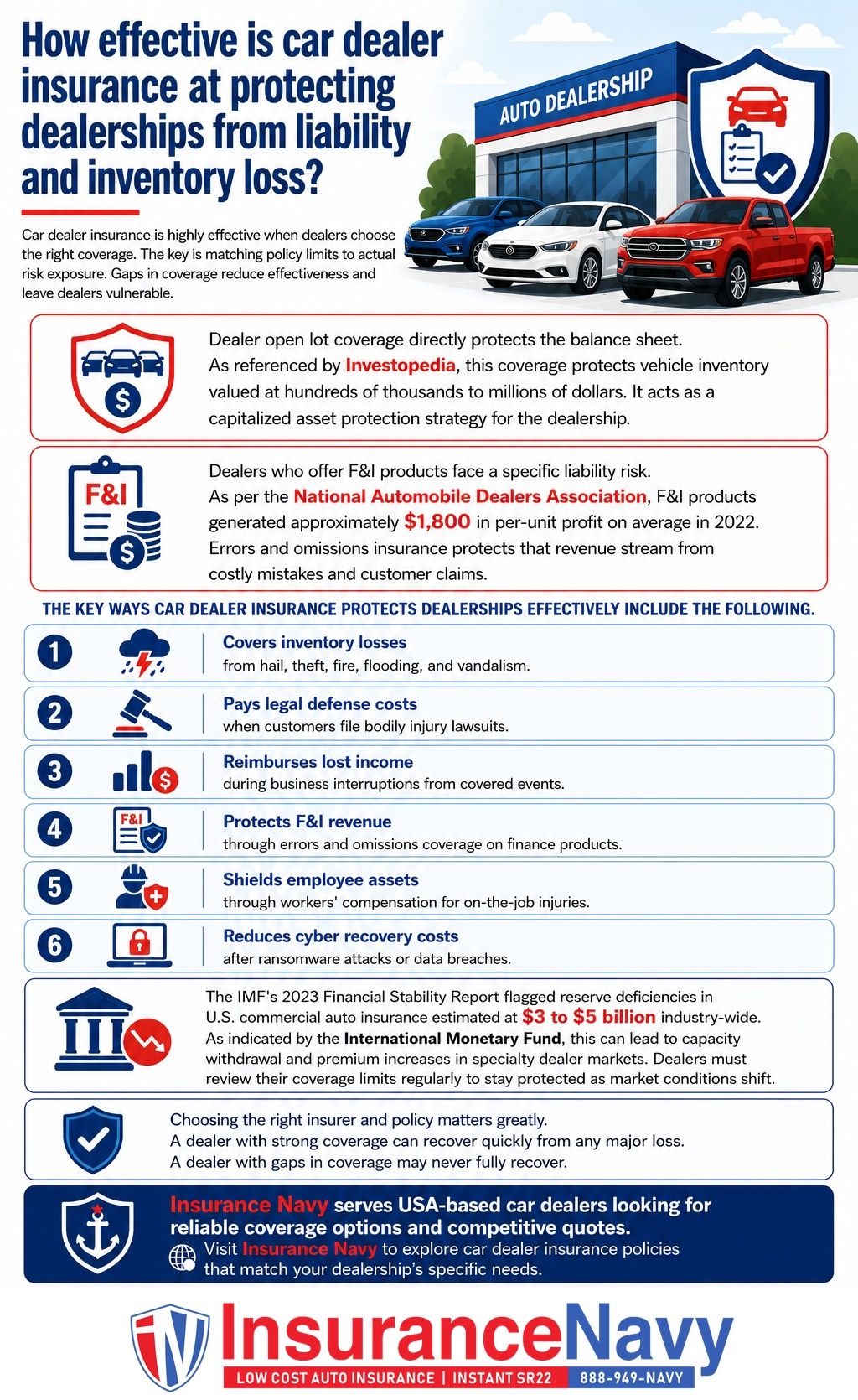
Car dealer insurance is highly effective when dealers choose the right coverage. The key is matching policy limits to actual risk exposure. Gaps in coverage reduce effectiveness and leave dealers vulnerable.
Dealer open lot coverage directly protects the balance sheet. As referenced by Investopedia, this coverage protects vehicle inventory valued at hundreds of thousands to millions of dollars. It acts as a capitalized asset protection strategy for the dealership.
Dealers who offer F&I products face a specific liability risk. As per the National Automobile Dealers Association, F&I products generated approximately $1,800 in per-unit profit on average in 2022. Errors and omissions insurance protects that revenue stream from costly mistakes and customer claims.
The key ways car dealer insurance protects dealerships effectively include the following.
Covers inventory losses from hail, theft, fire, flooding, and vandalism.
Pays legal defense costs when customers file bodily injury lawsuits.
Reimburses lost income during business interruptions from covered events.
Protects F&I revenue through errors and omissions coverage on finance products.
Shields employee assets through workers' compensation for on-the-job injuries.
Reduces cyber recovery costs after ransomware attacks or data breaches.
The IMF's 2023 Financial Stability Report flagged reserve deficiencies in U.S. commercial auto insurance estimated at $3 to $5 billion industry-wide. As indicated by the International Monetary Fund, this can lead to capacity withdrawal and premium increases in specialty dealer markets. Dealers must review their coverage limits regularly to stay protected as market conditions shift.
Choosing the right insurer and policy matters greatly. A dealer with strong coverage can recover quickly from any major loss. A dealer with gaps in coverage may never fully recover.
Insurance Navy serves USA-based car dealers looking for reliable coverage options and competitive quotes. Visit Insurance Navy to explore car dealer insurance policies that match your dealership's specific needs.