
Dump Truck Insurance: Policy, Types, Costs, Coverage, Factors
Dump truck insurance protects your business from financial ruin. Every operator hauling dirt, sand, gravel, or construction debris faces serious risks on the road. A single accident can generate millions in liability claims. Commercial dump truck insurance provides the truck insurance coverage your operations need. The right policy covers bodily injury, property damage, and physical damage to your truck. According to Insuranks CEO Ofir, the average dump truck insurance cost reaches $438 per month in 2025. Finding the right insurance at the right price requires understanding your options. This guide helps owner-operators, small fleets, and businesses get a commercial dump truck insurance quote with confidence.



What Is Dump Truck Insurance?
Dump truck insurance is a type of commercial auto insurance designed for trucks hauling materials. Insurance for dump trucks covers operators, businesses, and drivers from financial losses. Damage like accident claims, cargo losses, and liability exposure can end your business overnight. As reported by Allied Market Research, the global commercial auto insurance market will reach $390.5 billion by 2033, reflecting explosive demand for commercial trucking protection.
| Coverage Type | What It Protects | Who Needs It |
|---|---|---|
| Liability Insurance | Bodily injury and property damage to others | All operators |
| Physical Damage | Your truck from collision or comprehensive loss | Owner-operators |
| Motor Truck Cargo | Materials hauled like dirt, sand, gravel, debris | Hauling businesses |
| General Liability | Third-party injuries beyond auto incidents | Construction companies |
Dump truck insurance is not optional, it is a legal and financial requirement for commercial operations across the USA.
How to Choose a Policy for Dump Truck Insurance?
Choose a dump truck insurance policy by assessing your hauling range, cargo type, truck value, and driver history. Every company hauling construction, landscaping, or demolition materials needs commercial coverage tailored to its risk. Your commercial insurance needs differ based on whether you haul dirt, sand, gravel, or construction debris locally or across state lines. Per InsuranceHub Leavitt Agency, annual costs range from $2,500 to $25,000 depending on these unique factors.
Follow this process to choose the right coverages:
Identify your cargo - dirt, sand, gravel, construction debris, or landscaping materials each carry different risk profiles
Assess your driving range - local hauls carry lower risk than interstate operations
Review your driver records - a clean driving record reduces your premium significantly
Determine required limits - federal and state authority requirements shape your minimum coverage
Request an insurance quote for dump truck operations - compare multiple options from licensed agents
A knowledgeable insurance agent will help you build a policy that meets your business needs and budget.
What Are the Types of Dump Truck Insurance?
The types of dump truck insurance include commercial auto liability, physical damage, motor truck cargo, and general liability coverage. Coverage can be bundled or purchased separately depending on your operations and budget. Per AM Best, commercial auto liability posted its largest single-year underwriting loss of $6.4 billion in 2024, underscoring the high-risk nature of the industry.
| Insurance Type | Coverage Provided | Required or Optional |
|---|---|---|
| Commercial Auto Liability | Bodily injury and property damage liability | Required |
| Physical Damage | Collision and comprehensive vehicle coverage | Optional but recommended |
| Motor Truck Cargo | Damage to cargo like dirt, sand, and gravel | Required by many contracts |
| General Liability | Third-party injury at job sites | Required for construction |
| Workers' Compensation | Injuries to employees on the job | Required in most states |
Truckers need a deep understanding of each coverage type before selecting a policy. A comprehensive package protects your business from claims that could otherwise end your operations permanently.
How Much Does Dump Truck Insurance Typically Cost?
Dump truck insurance typically costs between $2,500 and $25,000 annually per vehicle, or $438 to $2,000 per month. Most dump truck operators pay between $450 and $2,000 per vehicle per month in 2026. New ventures and operators without established authority pay considerably more.
| Operator Type | Monthly Cost | Annual Cost |
|---|---|---|
| Owner-operator, clean record | $438 | $5,250 |
| Small fleet, established carrier | $400–$1,200 | $4,800–$14,400 |
| New authority, first year | $800–$2,000+ | $9,600–$25,000+ |
| California-based operator | $986 | $11,834 |
Want a quick estimate? A quick look at your fleet size, driver history, and cargo type gives insurers a starting point. Truck insurance can vary widely, so comparing multiple quotes is always recommended.
What Are the Cost Factors for Dump Truck Insurance?
The cost factors for dump truck insurance include truck age, cargo type, geographic location, driving record, and coverage limits. Urban area rates run 15–25% higher than rural areas due to accident frequency and litigation risk. Understanding these factors helps operators manage their insurance cost strategically.
Key cost factors include:
Truck age and value - newer trucks require higher physical damage premiums
Materials hauled - hauling sand, gravel, dirt, sand, or construction debris affects risk rating
Operating radius - local vs. long-haul operations impact the premium
Fleet size - per Foley.io, small fleets pay over three times more per mile than large fleets
Claims history - prior accidents and insurance claims raise your rate significantly
Illinois dump truck operators must carry a minimum of $750,000 in liability insurance (or $1,000,000 for hazardous materials), file Form E with the Illinois Commerce Commission
Operators who implement strong risk management practices consistently pay lower premiums over time.
Do I Need Dump Truck Insurance for My Business?
Do I need dump truck insurance? Yes, any business operating commercial vehicles on public roads needs commercial insurance protection by law. Truck insurance may be required by federal authority, state motor carrier filings, or client contracts, depending on your operations. Insurance may also be required before a lender finances your truck.
Ask yourself these questions to assess your needs:
Do I haul materials like dirt, sand, or construction debris for customers?
Can I afford a collision claim, property damage liability claim, or cargo loss out of pocket?
Do I need to file proof of insurance before receiving my operating authority?
Does my contract require a specific amount of coverage per vehicle?
Am I at fault in an accident - can I cover bodily injury and property damage liability coverage?
If you answered yes to any question, you need commercial dump truck insurance immediately. A company without proper coverage risks license suspension, lawsuits, and financial collapse.
How Does Driver Experience Influence Dump Truck Insurance Costs?
Driver experience directly influences dump truck insurance costs - more experience means lower premiums. As reported by AtoB using ATRI data, new authority operators pay 40–100% more than established carriers. Rates drop significantly after three years of clean operation, rewarding truckers who build strong safety records.
Insurers evaluate driver experience using these criteria:
Years of commercial driving - more years equal lower risk classifications
MVR (Motor Vehicle Record) - violations and accidents raise the premium sharply
CDL history - a valid commercial license with no suspensions lowers the rate
Prior claims - operators with claims pay more per vehicle per year
Training certifications - safety course completions can reduce premium costs
Businesses that invest in driver safety and ongoing training earn better insurance rates. Hire experienced drivers and require regular safety reviews to protect your operations and reduce your insurance cost.
What Liability Limits Does Dump Truck Insurance Require?
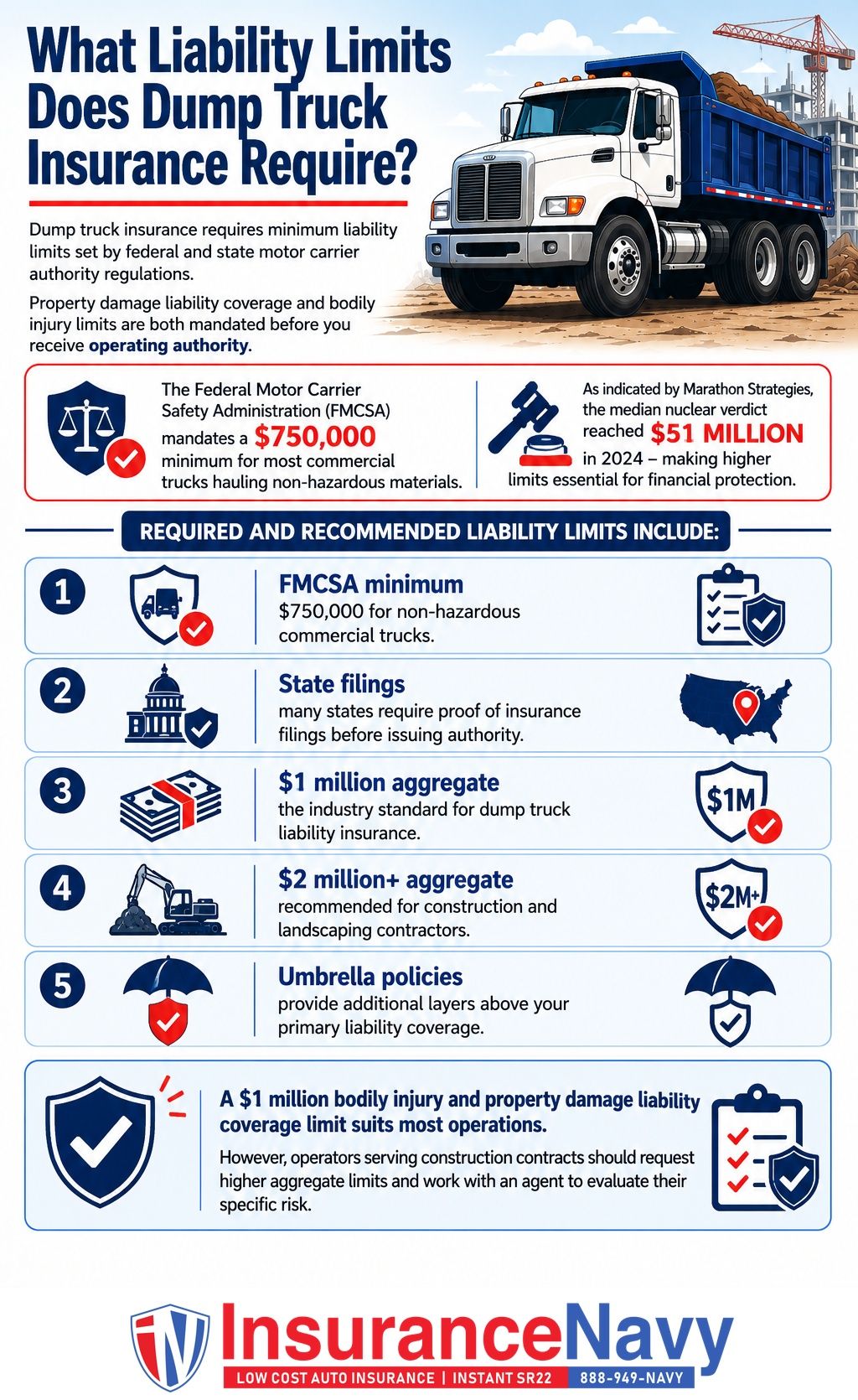
Dump truck insurance requires minimum liability limits set by federal and state motor carrier authority regulations. Property damage liability coverage and bodily injury limits are both mandated before you receive operating authority. The Federal Motor Carrier Safety Administration (FMCSA) mandates a $750,000 minimum for most commercial trucks hauling non-hazardous materials. As indicated by Marathon Strategies, the median nuclear verdict reached $51 million in 2024 - making higher limits essential for financial protection.
Required and recommended liability limits include:
FMCSA minimum - $750,000 for non-hazardous commercial trucks
State filings - many states require proof of insurance filings before issuing authority
$1 million aggregate - the industry standard for dump truck liability insurance
$2 million+ aggregate - recommended for construction and landscaping contractors
Umbrella policies - provide additional layers above your primary liability coverage
A $1 million bodily injury and property damage liability coverage limit suits most operations. However, operators serving construction contracts should request higher aggregate limits and work with an agent to evaluate their specific risk.
What Deductible Should I Choose for Dump Truck Insurance?
Choose a dump truck insurance deductible that balances your monthly premium against your ability to pay out-of-pocket after a claim. Higher deductibles lower your commercial truck insurance cost. According to ATRI's 2025 Operational Costs of Trucking Report, insurance premiums hit a record $0.102 per mile in 2024, making premium management critical for operating budgets.
Consider these deductible strategies:
$1,000 deductible - common for owner-operators with limited cash reserves
$2,500 deductible - reduces premium while remaining manageable after a collision
$5,000 deductible - ideal for established businesses with strong cash flow
Per-occurrence vs. aggregate - understand whether your deductible applies per claim or annually
Cargo deductibles - motor truck cargo policies often carry separate deductibles for hauled materials
A small business with tight margins should choose a lower deductible. Operators with financial reserves can get a lower insurance quote by accepting a higher deductible on physical damage coverage.
What Are the State Requirements for Dump Truck Insurance?
State requirements for dump truck insurance vary by jurisdiction but always include minimum liability coverage and motor carrier filings. Most states require commercial operators to file proof of insurance with the state transportation authority before receiving operating authority. As reported by ATRI, commercial auto premiums increased 12.5% in 2023 and an additional 3.0% in 2024, partly driven by rising state-mandated minimums.
| State Requirement | Description | Who Must Comply |
|---|---|---|
| Liability Minimum | Bodily injury and property damage limits | All commercial operators |
| State Insurance Filings | Proof of insurance filed with motor carrier authority | Carriers crossing state lines |
| Workers' Compensation | Coverage for employees injured on the job | Businesses with employees |
| Cargo Insurance | Required by many state contracts for construction debris | Haulers under state contracts |
Federal authority filings apply when dump trucks operate across state lines. Local operators may qualify for lower minimums, but most commercial insurance agents recommend exceeding state minimums to protect your business from catastrophic claims. Always verify your state requirements before starting operations.
Why Choose Insurance Navy for Dump Truck Insurance?
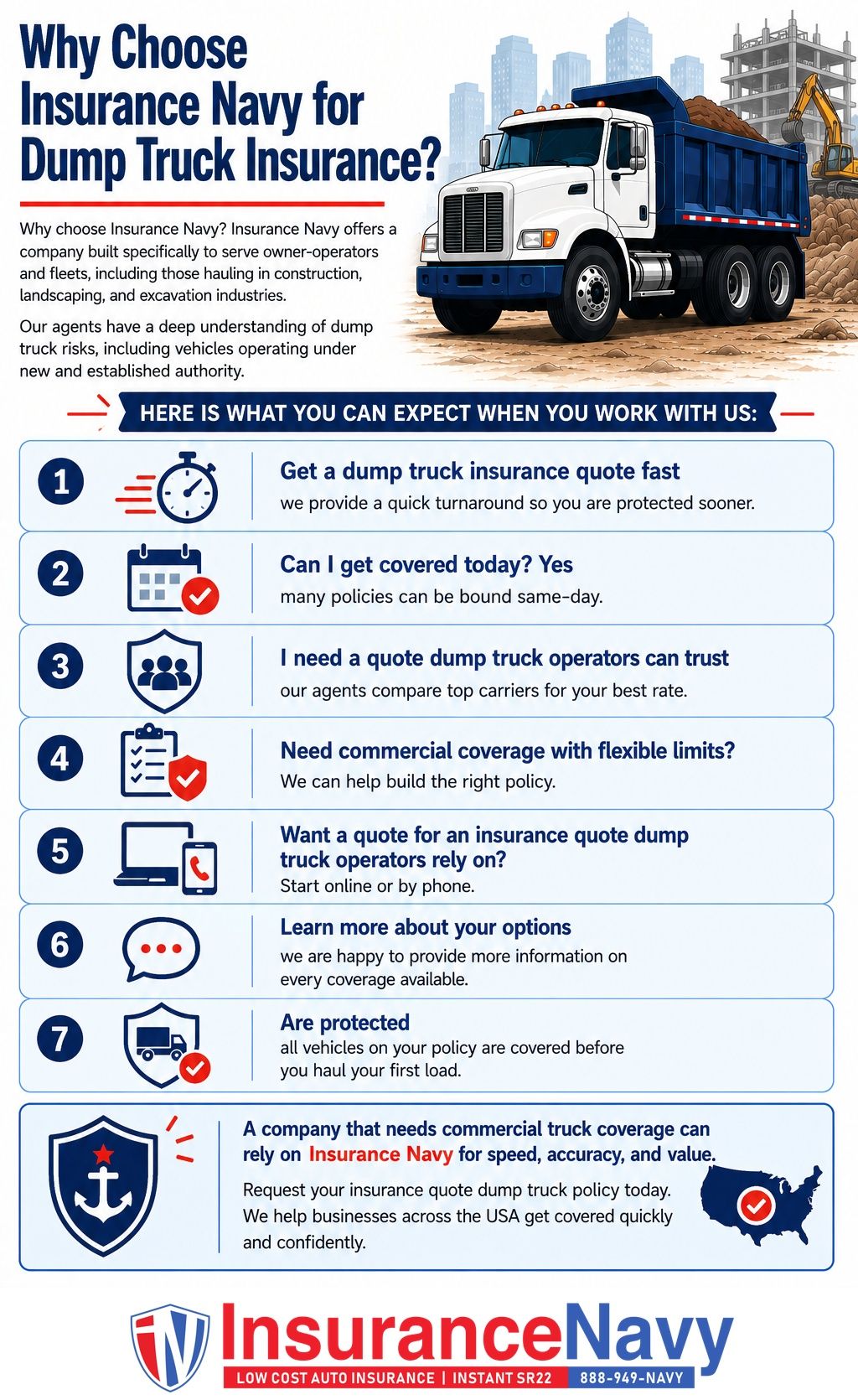
Why choose Insurance Navy? Insurance Navy offers a company built specifically to serve owner-operators and fleets, including those hauling in construction, landscaping, and excavation industries. Our agents have a deep understanding of dump truck risks, including vehicles operating under new and established authority.
Here is what you can expect when you work with us:
Get a dump truck insurance quote fast - we provide a quick turnaround so you are protected sooner
Can I get covered today? Yes - many policies can be bound same-day
I need a quote dump truck operators can trust - our agents compare top carriers for your best rate
Need commercial coverage with flexible limits? We can help build the right policy
Want a quote for an insurance quote dump truck operators rely on? Start online or by phone
Learn more about your options - we are happy to provide more information on every coverage available
Are protected - all vehicles on your policy are covered before you haul your first load
A company that needs commercial truck coverage can rely on Insurance Navy for speed, accuracy, and value. Request your insurance quote dump truck policy today. We help businesses across the USA get covered quickly and confidently.