
Fleet Insurance Costs: Factors, Premiums, Size
Across U.S. industries, fleet insurance costs change a lot based on vehicle types and how risky a business is. When a company runs many vehicles, it needs solid coverage but does not want to spend too much. In 2024, the global fleet insurance market hit USD $86.88 billion, according to Consegic Business Intelligence. This guide goes through every factor that changes what a business pays for fleet insurance. When you understand these factors, you can make better choices about your coverage. Insurance Navy works to match people with the right insurance at a fair price. Running five vans or a hundred trucks does not matter. This guide has the numbers and information you need to keep your commercial auto insurance costs under control.
How much does Fleet insurance cost?
What you pay for fleet insurance depends on how many vehicles you have, what kind they are, your drivers' records, and how much coverage you pick. In 2022, the average cost per vehicle was USD $1,258, according to the NAIC. For commercial trucks, that number can go much higher.
| Fleet Type | Estimated Annual Cost Per Vehicle | Key Cost Driver |
|---|---|---|
| Small business vans | $1,200,$2,500 | Urban delivery routes |
| Light commercial trucks | $2,500,$5,000 | Cargo weight and use |
| Heavy-duty trucks | $8,000,$16,000 | Nuclear verdict exposure |
| Mixed fleets | $3,000,$7,000 | Vehicle diversity |
Small fleets usually pay more per vehicle than large ones do.
One heavy truck can cost more than $10,000 a year to insure.
Delivery vehicles driving in busy cities pay higher premiums.
Total yearly costs for a full fleet add up fast and can reach six figures.
How does fleet size affect insurance pricing?
When your fleet grows, your insurance pricing gets better. More vehicles spread risk around and give you room to ask for volume discounts. According to ATRI, fleets with 5 to 25 trucks paid almost twice the per-mile insurance cost compared to fleets with 101 to 250 trucks. Small fleets do not have much room to push back on insurer pricing.
| Fleet Size | Per-Mile Insurance Cost | Insurance as % of Revenue |
|---|---|---|
| 5,25 trucks | ~$0.20/mile | ~5% |
| 26,100 trucks | ~$0.14/mile | ~3.5% |
| 101,250 trucks | ~$0.10/mile | ~2.5% |
| 250+ trucks | ~$0.08/mile | ~2% |
What coverage types are included in fleet insurance?
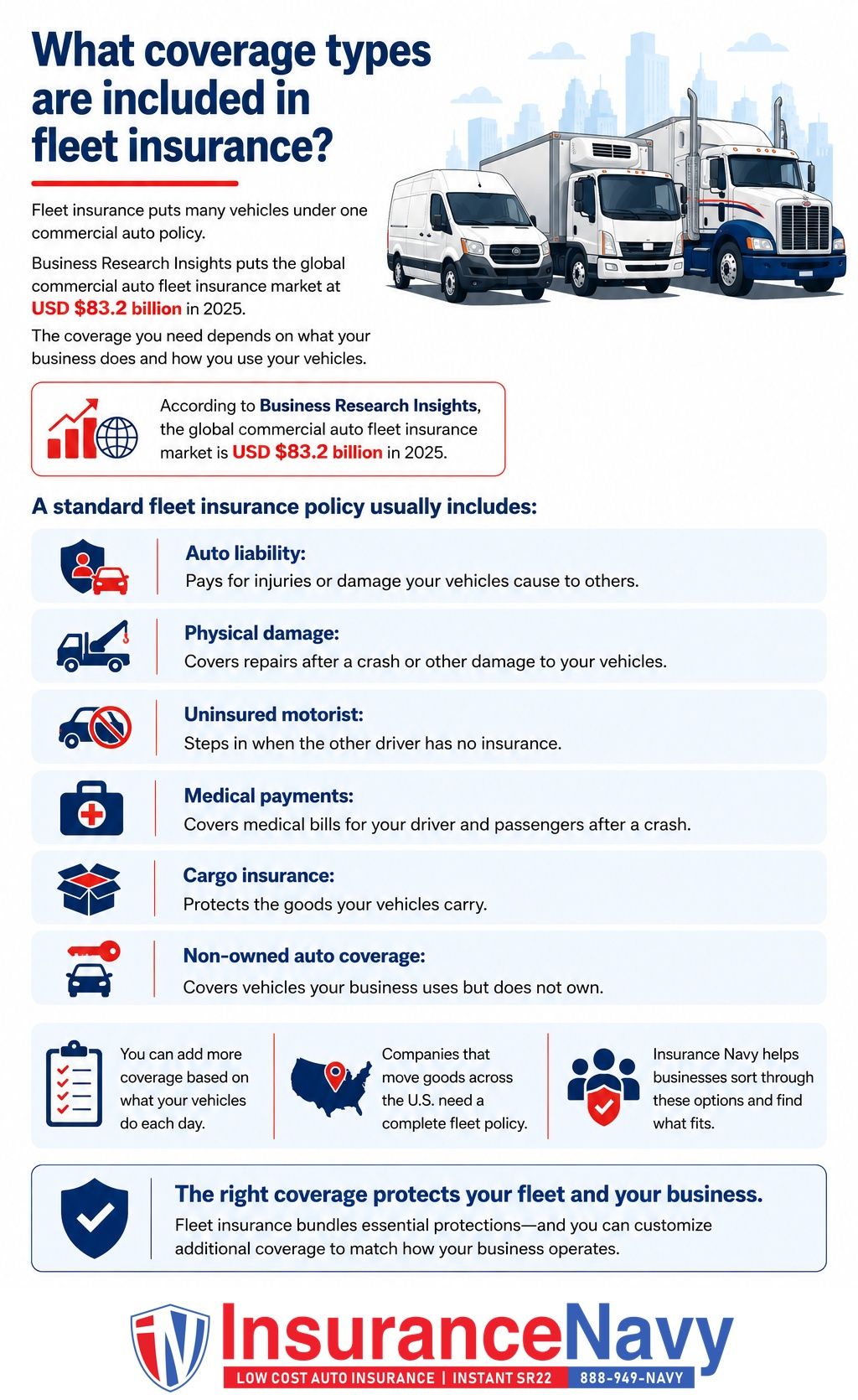
Fleet insurance puts many vehicles under one commercial auto policy. Business Research Insights puts the global commercial auto fleet insurance market at USD $83.2 billion in 2025. The coverage you need depends on what your business does and how you use your vehicles.
A standard fleet insurance policy usually includes:
Auto liability: Pays for injuries or damage your vehicles cause to others.
Physical damage: Covers repairs after a crash or other damage to your vehicles.
Uninsured motorist: Steps in when the other driver has no insurance.
Medical payments: Covers medical bills for your driver and passengers after a crash.
Cargo insurance: Protects the goods your vehicles carry.
Non-owned auto coverage: Covers vehicles your business uses but does not own.
You can add more coverage based on what your vehicles do each day. Companies that move goods across the U.S. need a complete fleet policy. Insurance Navy helps businesses sort through these options and find what fits.
Do vehicle type and use raise fleet insurance costs?
Yes. What your vehicles weigh, what they carry, and how you use them all push costs up. In 2024, trucking insurance premiums hit a record $0.102 per mile, according to ATRI. A heavy truck running long routes costs much more to insure than a light van doing short city runs.
| Vehicle Type | Primary Use | Risk Level | Relative Cost |
|---|---|---|---|
| Passenger cars | Sales or service | Low | $ |
| Delivery vans | Urban delivery | Medium | $$ |
| Light trucks | Construction or trades | Medium-High | $$$ |
| Heavy-duty trucks | Long-haul trucking | High | $$$$ |
Truck delivery operations pay higher premiums than standard commercial vehicles.
Insurers rate vehicles based on what they are used for every day.
Vehicles carrying dangerous cargo need special coverage.
Vehicles that rack up high mileage face more road risk over time.
Whether a vehicle is used for personal or business purposes changes its insurance requirements. Businesses running vehicles on many high-risk routes should expect to pay more.
Which coverage levels lower fleet insurance costs most?
Liability-only coverage gives you the lowest premium, but it leaves your business exposed to big costs. Commercial auto liability premiums went up 12.2% in the first half of 2024, according to NAIC data cited by DriveGuardians. Picking the right coverage level means balancing what you save against what you could owe.
| Coverage Level | Cost Impact | Financial Risk |
|---|---|---|
| Liability only | Lowest premium | High out-of-pocket exposure |
| Liability \+ collision | Moderate premium | Medium risk |
| Liability \+ comprehensive | Higher premium | Lower risk |
| Full commercial coverage | Highest premium | Minimal exposure |
Dropping to a lower tier can make sense when your vehicles are older and fully paid off. Just know that you will pay more out of pocket when something goes wrong.
Do higher deductibles reduce fleet insurance costs?
Yes. When you take on a higher deductible, you take on more of the cost yourself, and your premium drops. Auto insurance rate increases slowed to about 10% year-over-year in 2024, according to LexisNexis Risk Solutions. Raising your deductible is one way to fight back against rising premiums.
Here is what to weigh when thinking about higher deductibles:
Immediate savings: A higher deductible means a lower monthly or yearly premium.
Cash reserve requirement: Your business needs money set aside to cover that deductible when claims happen.
Per-vehicle deductibles: Every vehicle in the fleet has its own deductible, so costs can add up.
Best for large fleets: Bigger operations can handle deductible costs more easily since they spread the risk.
Risk of frequent claims: High deductibles hurt businesses that have crashes regularly.
A small business that is tight on cash should think carefully before raising deductibles. Insurance Navy helps companies compare deductible options to find a plan that fits their budget.
Does geographic operating area affect fleet insurance prices?
Yes. Where your fleet runs changes what you pay, based on local accident rates, lawsuit trends, and theft numbers. In 2024, there were 135 nuclear verdicts, a 52% jump over 2023, according to Marathon Strategies. Fleets in states where large lawsuits are common will pay much more for liability coverage.
Location-based factors that change fleet insurance costs:
Urban vs. rural: Busy city routes bring more accidents and theft.
State tort laws: States where lawsuits are more aggressive push liability costs up.
Weather patterns: Heavy snow or flooding regions see more physical damage claims.
Crime rates: Areas with high theft rates raise the cost of comprehensive coverage.
Nuclear verdict exposure: Auto accident cases make up 23.2% of all nuclear verdicts.
Running a fleet across many U.S. states brings complex rules and pricing to manage. Tracking where your risk is highest can help you plan smarter routes and bring costs down.
Fleet insurance costs come from a mix of risk, coverage choices, and how your operation runs. From 2021 to 2024, liability insurance costs for trucking rose 18.6%, according to ATRI. Better hiring, regular driver training, telematics tools, and solid risk management all bring those costs down. Every choice you make, from deductible levels to safety programs, changes your premium.
Insurance Navy works with businesses to find the right commercial auto insurance at a fair price. Reach out to Insurance Navy today to compare fleet policies, look at your coverage options, and make sure your whole fleet is protected.