
Motor Truck Cargo Insurance: Types, Coverage, Costs, Premiums
Motor truck cargo insurance protects freight carriers against financial losses from damaged, destroyed, or stolen goods. Every trucking business faces real risks during transit operations. According to Verisk CargoNet, U.S. cargo theft reached a record 3,625 incidents in 2024. This guide helps carriers find the right insurance at the right price. Insurance Navy specializes in commercial coverage for trucking operations across the USA. This article explains every essential attribute of motor truck cargo insurance. Carriers will learn about types, costs, exclusions, deductibles, and theft claims. Read this guide to protect your business and your customers' freight.



What Is Motor Truck Cargo Insurance?
Motor truck cargo insurance is a commercial policy that covers a carrier's liability for freight damage or loss during transportation. This transportation insurance protects trucking businesses when goods are damaged, stolen, or destroyed in transit. A motor carrier needs motor cargo insurance to meet shipper contract requirements and federal regulations.
| Coverage Aspect | What It Means | Why It Matters |
|---|---|---|
| Covered Property | Freight a carrier hauls | Protects client goods |
| Liable Party | The motor carrier | Carrier pays for losses |
| Trigger Event | Damage or loss in transit | Claims arise during transport |
| Policy Basis | Legal liability | Contract-based protection |
Motor cargo insurance is not the same as freight insurance. Cargo insurance protects the carrier, while freight insurance protects the shipper. Companies that need cargo insurance should contact a licensed commercial agent immediately.
What Are the Types of Motor Truck Cargo Insurance?
The types of motor truck cargo insurance include broad form coverage, specified perils coverage, and specialized endorsements for unique cargo. Carriers choose a type based on the goods they haul and the risks they face. Each type of coverage may be designed for different trucking operations and business needs.
Broad Form Coverage: This type covers all risks unless specifically excluded. It provides the widest protection for transported goods and can help carriers facing unexpected damage loss.
Specified Perils Coverage: This type covers only listed risks like fire, theft, or collision. Carriers hauling lower-risk freight commonly select this option.
Refrigeration Breakdown Coverage: This optional insurance with refrigeration breakdown of refrigeration equipment helps cover spoilage from a change in temperature.
Specialized Endorsements: These include car haulers, ice cream trucks, and pharmaceuticals coverage. Insurers design these endorsements for specialized cargo types including owned vehicles and leased equipment.
Per Select Insurance Group, motor truck cargo insurance for $100,000 in coverage typically costs $400 to $1,200 annually.
What Does Motor Truck Cargo Insurance Cover?
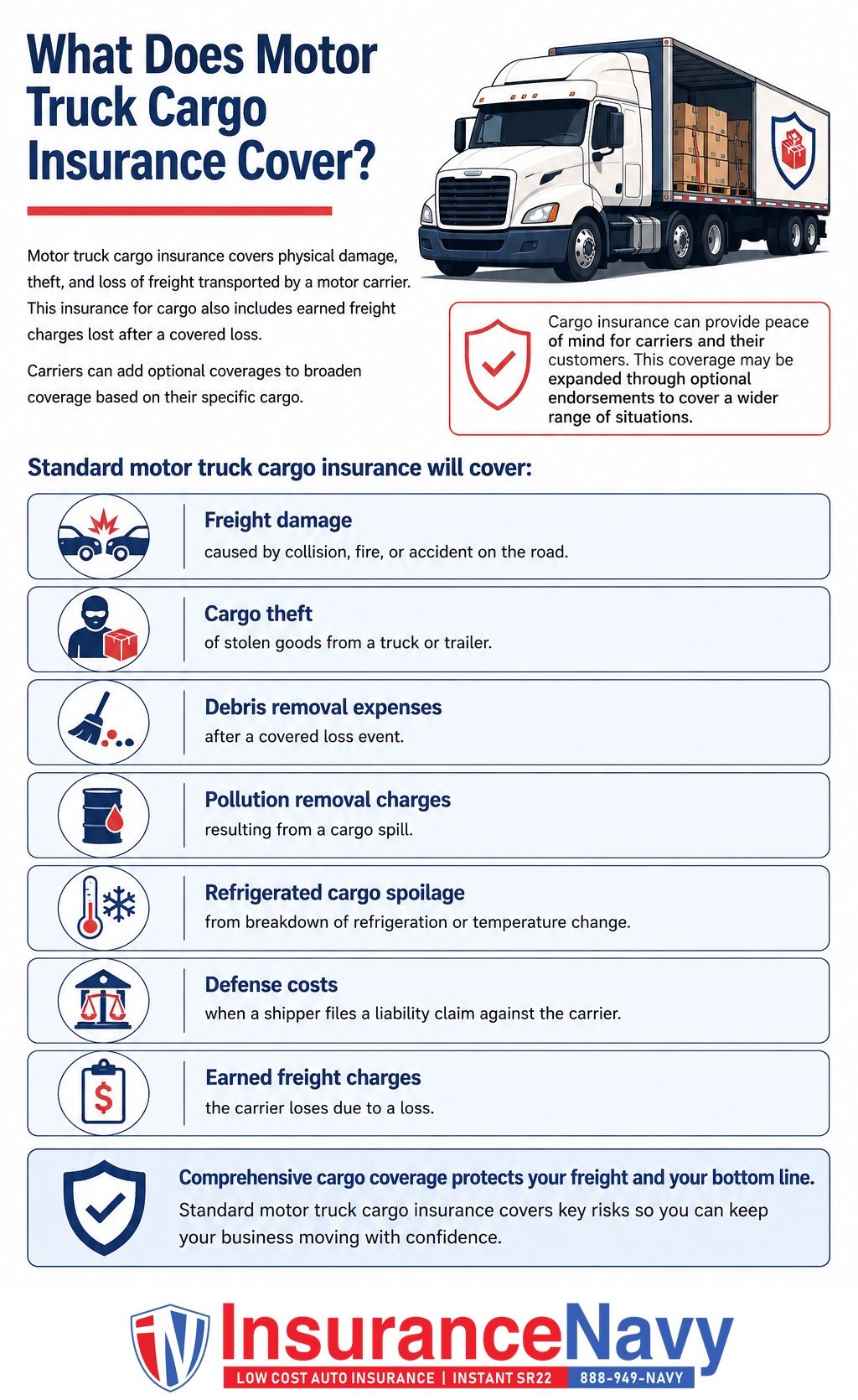
Motor truck cargo insurance covers physical damage, theft, and loss of freight transported by a motor carrier. This insurance for cargo also includes earned freight charges lost after a covered loss. Carriers can add optional coverages to broaden coverage based on their specific cargo.
Standard motor truck cargo insurance will cover:
Freight damage caused by collision, fire, or accident on the road
Cargo theft of stolen goods from a truck or trailer
Debris removal expenses after a covered loss event
Pollution removal charges resulting from a cargo spill
Refrigerated cargo spoilage from breakdown of refrigeration or temperature change
Defense costs when a shipper files a liability claim against the carrier
Earned freight charges the carrier loses due to a loss
Cargo insurance can provide peace of mind for carriers and their customers. This coverage may be expanded through optional endorsements to cover a wider range of situations.
What Is the Cost of Motor Truck Cargo Insurance?
The cost of motor truck cargo insurance ranges from $400 to $1,800 annually for standard $100,000 coverage limits. As noted by DriverAdvantage, the industry standard cargo insurance cost runs approximately $129 per month. However, actual insurance cost can be highly variable based on cargo type, fleet size, and operating region.
| Coverage Level | Annual Cost Range | Monthly Estimate |
|---|---|---|
| $50,000 Limit | $300 – $800 | $25 – $67 |
| $100,000 Limit | $400 – $1,200 | $33 – $100 |
| $250,000 Limit | $900 – $2,500 | $75 – $208 |
| $500,000 Limit | $1,800 – $5,000 | $150 – $417 |
According to ATRI, insurance premiums hit a record $0.102 per mile in 2024. Carriers should get an insurance quote today from a commercial insurance agent to find accurate rates. An insurance quote helps carriers compare options and select coverage based on their actual operational needs.
What Cargo Types Affect Motor Truck Insurance Coverage?
Cargo types significantly affect motor truck insurance coverage limits, exclusions, and premium costs. Insurers treat high-risk or high-value cargo as a specialized category requiring damage coverage beyond standard policy terms. Carriers hauling certain goods may need additional endorsements or separate policies to insure properly.
| Cargo Category | Risk Level | Coverage Consideration |
|---|---|---|
| General freight | Standard | Broad form policy applies |
| Refrigerated goods | Moderate-high | Requires refrigeration breakdown rider |
| Pharmaceuticals, tobacco | High value | Specialized endorsement needed |
| Art, jewelry, money | Very high | Separate inland marine policy advised |
| Hazardous materials | High risk | Exclusions commonly apply |
Motor cargo insurance coverage for refrigerated cargo must address spoilage caused by a change in temperature or equipment failure. Cargo can present unique risks when it includes pharmaceuticals, tobacco, or art, jewelry money combinations that require specialized service. Carriers transporting art jewelry money or pharmaceuticals tobacco should contact an agent to learn more about specialized coverages.
How Do Coverage Limits Work in Cargo Insurance?
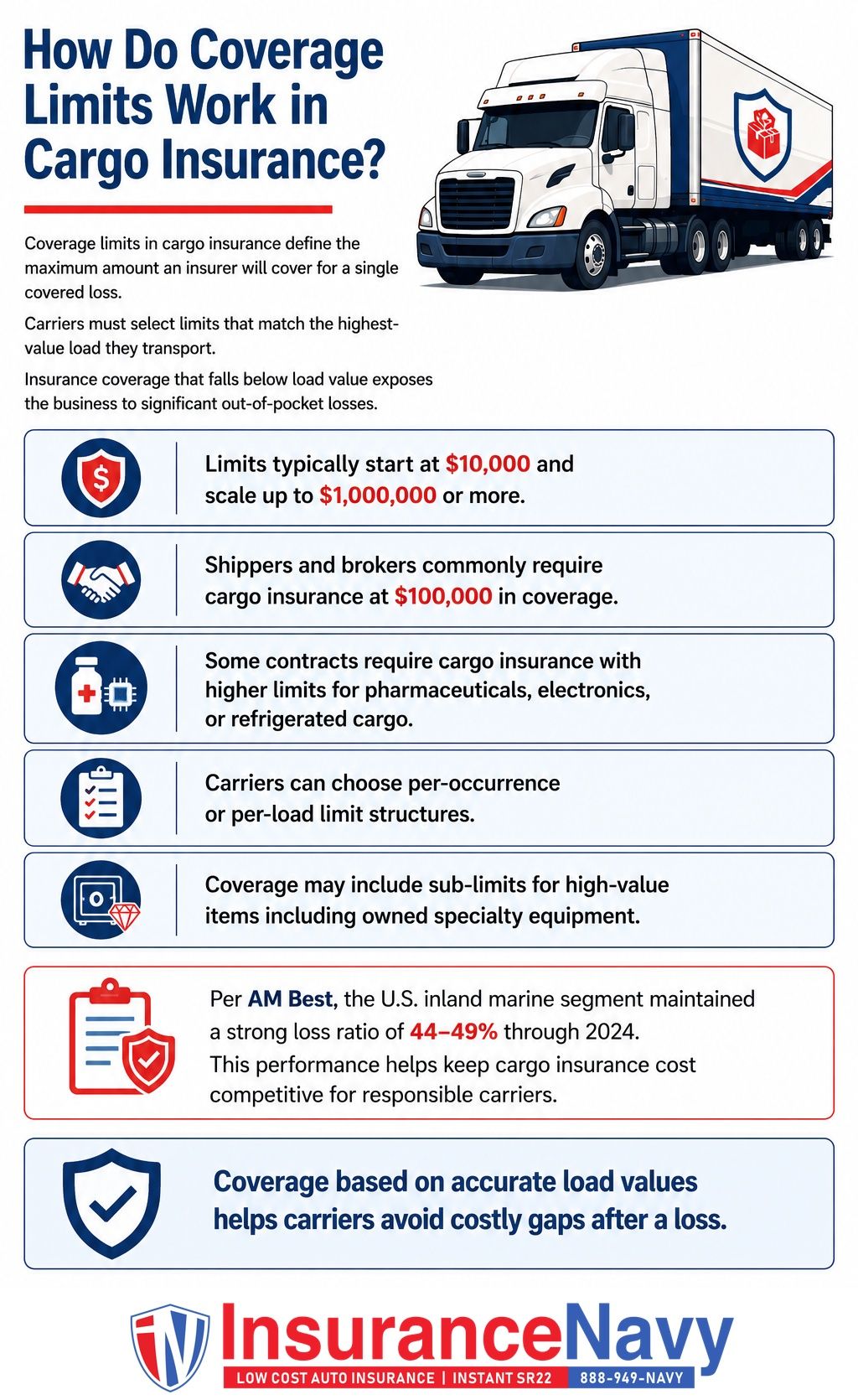
Coverage limits in cargo insurance define the maximum amount an insurer will cover for a single covered loss. Carriers must select limits that match the highest-value load they transport. Insurance coverage that falls below load value exposes the business to significant out-of-pocket losses.
Limits typically start at $10,000 and scale up to $1,000,000 or more.
Shippers and brokers commonly require cargo insurance at $100,000 in coverage.
Some contracts require cargo insurance with higher limits for pharmaceuticals, electronics, or refrigerated cargo.
Carriers can choose per-occurrence or per-load limit structures.
Coverage may include sub-limits for high-value items including owned specialty equipment.
Per AM Best, the U.S. inland marine segment maintained a strong loss ratio of 44–49% through 2024. This performance helps keep cargo insurance cost competitive for responsible carriers. Coverage based on accurate load values helps carriers avoid costly gaps after a loss.
What Exclusions Exist in Motor Truck Cargo Policies?
Motor truck cargo policies contain exclusions that remove coverage for specific causes of loss or cargo types. Carriers must review all exclusions carefully before signing a policy contract. Understanding exclusions can help businesses avoid gaps in coverage during trucking operations.
| Common Exclusion | What It Eliminates | Carrier Impact |
|---|---|---|
| Rust, corrosion | Rust corrosion damage | No payout for gradual decay |
| Employee dishonesty | Internal theft by staff | Separate crime policy needed |
| Contraband | Illegal transported goods | No coverage applies |
| Improper packaging | Shipper-caused damage | Carrier avoids liability |
| War, terrorism | Political loss events | Excluded from standard policy |
Policies also exclude losses caused by the cargo's inherent nature or vice. Insurance may be extended through optional endorsements to fill these exclusion gaps in specific situations. Carriers should ask their agent about resources designed to address exclusion gaps including department service contacts at their insurer.
How Does Cargo Theft Impact Motor Truck Insurance Claims?
Cargo theft directly increases motor truck insurance claims, raising premiums for all carriers across trucking operations. As reported by Verisk CargoNet via Burns & Wilcox, the average value of stolen cargo rose to $202,364 per incident in 2024. Total aggregate cargo theft losses reached $454.9 million that same year.
Cargo theft impacts claims in these key ways:
Stolen loads trigger covered loss claims that carriers must document thoroughly.
Theft frequency raises premiums for all carriers in high-risk lanes and regions.
Strategic theft involves fraud, making claims more complex to process.
Unattended vehicle theft may be excluded under some policy terms.
GPS and security tools can help reduce risk and may help lower insurance cost.
Cargo insurance can provide critical financial protection when theft occurs during transit. Carriers must report theft promptly, as a delayed claim may be denied under policy terms.
What Deductible Options Exist for Cargo Insurance Policies?
Cargo insurance policies offer deductible options ranging from $250 to $5,000 or more per covered loss. A higher deductible reduces the insurance premium but increases out-of-pocket costs after a loss. Carriers should choose a deductible that matches their financial capacity and risk tolerance.
Common deductible structures include:
$250 – $500: Best for small carriers with limited cash reserves.
$1,000 – $2,500: A balanced option for mid-size trucking operations.
$5,000+: Ideal for large fleets with strong risk management programs.
Per-load deductibles: The carrier pays a deductible on each individual load claim.
Annual aggregate deductibles: The carrier pays up to a fixed total per policy year.
Carriers should contact an insurance agent to select the right deductible for their business. Choosing wisely helps cover a range of claim situations and keeps operations financially stable.
How Does Fleet Size Affect Cargo Insurance Pricing?
Fleet size directly affects cargo insurance pricing, with larger fleets earning substantially lower per-unit rates. As noted by Foley.io, small trucking fleets pay over three times more per mile for insurance coverage than large fleets. Insurers reward scale because larger operations spread risk across more vehicles and loads.
Fleet size influences pricing in these ways:
Single owner-operators pay the highest per-truck insurance premium rates.
Small fleets (2–10 trucks) gain modest discounts including service credits for safety programs.
Mid-size fleets benefit from volume pricing designed to reward consistent loss records.
Large fleets with owned equipment may qualify for specialized risk insurance programs.
All fleet sizes should request an insurance quote today to compare market options.
Cargo insurance can be tailored to match any fleet size or operational model. Companies that needs motor truck cargo insurance should contact Insurance Navy for a motor cargo insurance quote today. Why choose a specialist? Because coverage based on accurate fleet data can help reduce premiums significantly across all operations.