
Car Hauler Insurance: Costs, Coverage, Cargo Capacity and Requirements
Car hauler insurance protects trucking businesses that transport vehicles for profit. American haulers face serious financial risks every time they load cars onto a trailer. A single accident can destroy equipment, damage customer vehicles, and trigger massive liability claims. Finding the right insurance at the right price requires understanding specific coverage types, federal requirements, and cost drivers. This guide answers the most important questions about car hauler insurance. Insurance Navy helps haulers across the USA secure competitive rates and compliant policies. Read on to learn how coverage works, what it costs, and what every hauler needs to stay protected and legally operating.


What Is Car Hauler Insurance?
Car hauler insurance is a specialized commercial truck insurance policy covering businesses that transport vehicles. It protects haulers from financial loss caused by accidents, cargo damage, and liability claims. According to STAR Mutual RRG, auto transport operations face unique risks that standard commercial auto insurance policies do not fully address.
A trucking company engaged in car hauling must understand what a hauler insurance policy actually covers. Auto haulers operate in a transportation business where damages can run into hundreds of thousands of dollars. There are a few core protections that car haulers need regardless of fleet size.
Car hauler insurance typically protects against:
Damage to vehicles being transported
Bodily injury and injuries to third parties in accidents
Property damage caused during hauling operations
Theft and vandalism of hauled vehicles
Physical damage to the truck and trailer
Auto haulers need commercial coverage built for their specific operations. A tow truck operator and an enclosed transport carrier do not share the same risks. Every hauling company needs a policy built for its exact work.
How Much Does Car Hauler Insurance Cost Annually?
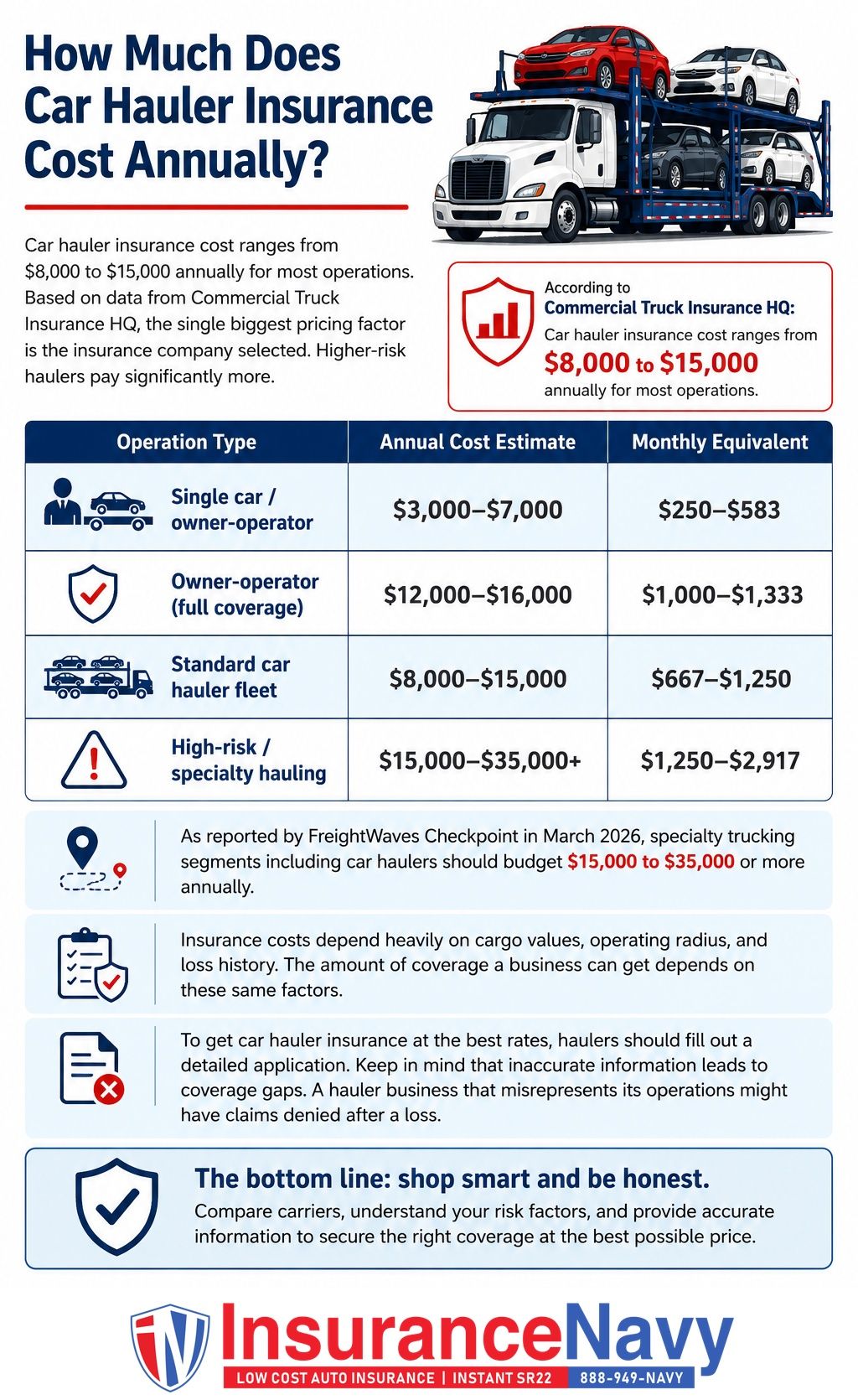
Car hauler insurance cost ranges from $8,000 to $15,000 annually for most operations. Based on data from Commercial Truck Insurance HQ, the single biggest pricing factor is the insurance company selected. Higher-risk haulers pay significantly more.
| Operation Type | Annual Cost Estimate | Monthly Equivalent |
|---|---|---|
| Single car / owner-operator | $3,000–$7,000 | $250–$583 |
| Owner-operator (full coverage) | $12,000–$16,000 | $1,000–$1,333 |
| Standard car hauler fleet | $8,000–$15,000 | $667–$1,250 |
| High-risk / specialty hauling | $15,000–$35,000+ | $1,250–$2,917 |
As reported by FreightWaves Checkpoint in March 2026, specialty trucking segments including car haulers should budget $15,000 to $35,000 or more annually. Insurance costs depend heavily on cargo values, operating radius, and loss history. The amount of coverage a business can get depends on these same factors.
To get car hauler insurance at the best rates, haulers should fill out a detailed application. Keep in mind that inaccurate information leads to coverage gaps. A hauler business that misrepresents its operations might have claims denied after a loss.
What Cargo Capacity Affects Car Hauler Insurance Rates?
Cargo capacity directly affects car hauler insurance rates by increasing exposure and potential claims. Haulers who carry more vehicles face higher liability per trip. As noted by Logrock in May 2026, higher-risk operations price closer to $1,500–$2,500 per month per truck.
The number of vehicles at any given time on a trailer determines base risk. A heavy multi-car configuration raises premiums significantly compared to a single-car setup. Depending on trailer type, additional endorsements may still be required.
Key capacity factors that raise insurance rates include:
Number of vehicles loaded per transport
Maximum weight capacity of the trailer
Use of single-car versus multi-car open trailers
Enclosed versus open transport configuration
Operating radius and haul distance
A single car hauler pays far less than a ten-car open carrier. Enclosed transport adds premium costs because damage exposure increases significantly. Carriers should get car hauler quotes based on their exact trailer capacity and cargo type.
Does Car Hauler Insurance Cover Luxury Vehicle Types Hauled?
Yes, car hauler insurance can cover luxury vehicle types hauled, but standard policies often require endorsements. Hauling high-value vehicles raises the cargo insurance limit needed. As stated by STAR Mutual RRG, brokers and shippers often demand $1.5 million or even $2 million in coverage for fleets moving luxury vehicles.
Do car haulers need different insurance depending on what they transport? The answer is yes. A vehicle like an exotic sports car requires far more protection than a standard sedan.
| Vehicle Type Hauled | Standard Coverage | Endorsement Needed | Suggested Cargo Limit |
|---|---|---|---|
| Standard passenger cars | Yes | No | $100,000 |
| Classic or collector vehicles | Partial | Yes | $250,000–$500,000 |
| Luxury vehicles (BMW, Mercedes) | Partial | Yes | $500,000+ |
| Exotic or ultra-luxury vehicles | No | Yes | $1,000,000+ |
Haulers must disclose the types of vehicles they transport when purchasing a policy. A client hauling exotic cars will need far higher cargo limits. Failing to disclose vehicle types can result in denied claims after an accident.
What Liability Limits Are Required for Car Hauler Insurance?
Federal law requires a minimum of $750,000 in public liability coverage for most for-hire interstate carriers. Per FMCSA regulations under 49 CFR § 387.9, this applies to vehicles exceeding 10,001 pounds GVWR. Most auto transport operations require $1 million in auto liability coverage.
A liability policy protects a business with a wide range of third-party claims. Trucks are classified under federal rules that set minimum personal and commercial liability thresholds. A commercial auto policy must meet U.S. federal standards before a carrier can operate legally.
Required and recommended liability limits include:
FMCSA federal minimum: $750,000 combined single limit
Auto transport industry standard: $1,000,000 combined single limit
New Jersey state requirement: $1,500,000 for trucks entering the state
Broker and shipper demand: $1,000,000–$2,000,000
As noted by COGO Insurance in December 2025, New Jersey mandates $1.5 million for any truck operating in the state. Haulers serving dealer auctions must carry higher auto liability insurance limits to win contracts. Primary liability coverage protects against bodily injury and property damage claims.
Is Cargo Insurance Included in Car Hauler Insurance Policies?
No, cargo insurance is not automatically included in all car hauler insurance policies. Haulers must add motor truck cargo coverage as a separate component. According to Insuranks in March 2025, auto transport insurance requires $100,000 to $500,000 in cargo insurance to cover loss or damage from theft and vandalism.
Coverage options are available to address specific cargo risks like fire, collision, and theft. Options like fire collision protection and vandalism riders can help a business stay financially whole after a loss. A commercial policy without these additions can still be legally compliant but leaves cargo unprotected.
| Cargo Coverage Type | What It Covers | Typical Limit |
|---|---|---|
| Motor truck cargo insurance | Vehicles damaged in transit | $100,000–$500,000 |
| Theft protection | Stolen vehicles on trailer | Varies by policy |
| Vandalism coverage | Intentional damage to hauled cars | Included in cargo |
| Loading/unloading coverage | Damage during loading and unloading | Endorsement required |
Per FMCSA regulations, motor common carriers must maintain cargo insurance of $5,000 per vehicle and $10,000 per occurrence at minimum. Most haulers need far more protection than federal minimums provide. Truck cargo insurance protects the client's vehicles and keeps the business financially sound.
What Driver Requirements Lower Car Hauler Insurance Costs?
Experienced drivers with clean records lower car hauler insurance costs significantly. Insurance companies reward haulers who employ safe, qualified drivers. As reported by AtoB in March 2026, insurance rates can swing more than 240% between states based on driver profiles and operating territory.
A trucking operation that invests in driver safety will have lower long-term insurance expenses. Insurers want to know that transporting vehicles is handled by qualified professionals. A business can get better rates when drivers maintain clean records and complete certified safety training.
Driver qualifications that reduce premiums include:
Commercial Driver's License (CDL) with clean violations record
Minimum three years of hauling or trucking experience
No at-fault accidents in the past three to five years
Completion of safety training programs
Participation in drug and alcohol testing programs
Low CSA scores maintained through FMCSA compliance
Younger drivers or those with recent claims will raise premium costs substantially. Hauling companies benefit financially from investing in driver training and safety programs. Insurance will reflect driver quality directly in the final quote.
Does FMCSA Compliance Affect Car Hauler Insurance Pricing?
Yes, FMCSA compliance directly affects car hauler insurance pricing by signaling lower risk to underwriters. Carriers with strong DOT safety ratings qualify for better rates. As noted by ATRI in its 2025 Operational Costs of Trucking report, insurance premiums hit a record $0.102 per mile in 2024.
A commercial carrier operating in the U.S. must need commercial registration and valid operating authority. Non-compliant carriers are a, at least in the eyes of underwriters, higher-risk account. Insurance get reviewed at renewal, and poor compliance history raises costs sharply.
| FMCSA Compliance Factor | Impact on Premium |
|---|---|
| Satisfactory DOT safety rating | Lower rates |
| Conditional or unsatisfactory rating | Higher rates or non-renewal |
| Clean CSA scores across all categories | Favorable underwriting |
| History of DOT violations | Significant surcharges |
| Valid operating authority | Required for coverage |
Federal law requires carriers to maintain proof of insurance on file with FMCSA. Non-compliant motor carriers face policy cancellation and loss of operating authority. Maintaining DOT compliance is one of the most effective ways to control trucking insurance costs.
How Do Deductibles Work in Car Hauler Insurance?
Deductibles in car hauler insurance represent the amount a hauler pays out of pocket before coverage applies. Higher deductibles lower monthly premiums but increase financial exposure after a collision. As reported by CoverWallet, insuring one car hauler with $1 million general liability coverage costs approximately $810 per month or $9,720 per year.
In the event of a claim, a hauler must pay the deductible before insurance will cover the remaining damages. A tow truck or transport vehicle involved in a collision can generate significant out-of-pocket costs. An auto policy with a high deductible can be, depending on cash reserves, either a smart or risky choice.
Common deductible structures for car hauler policies include:
Physical damage deductible: $1,000–$5,000 per occurrence
Cargo insurance deductible: $500–$2,500 per claim
Collision coverage deductible: $1,000–$3,000 standard
Comprehensive coverage deductible: $500–$2,000 for like fire and theft
Haulers with strong cash reserves can choose higher deductibles to reduce premiums. Smaller owner-operators often benefit from lower deductibles to avoid financial hardship after a damaged vehicle claim. Choosing a deductible level depends on the hauler's financial situation and risk tolerance.
What Coverage Types Does Car Hauler Insurance Typically Include?
Car hauler insurance typically includes several coverage types that protect the truck, trailer, cargo, and third parties. A complete commercial car hauler policy addresses physical damage, liability, and cargo risks. As stated by Super Dispatch in April 2026, owner-operators typically pay $12,000 to $16,000 per year for full coverage combining liability and cargo protection.
Auto haulers operating across the U.S. need commercial coverage that keeps transportation running after a loss. A hauler can help a client get back their vehicle value through proper cargo protection. Learn more about each coverage type to understand how a trucking company stays protected. Standard coverage types in car hauler insurance policies include:
Auto liability coverage: Covers bodily injury and property damage to others
Motor truck cargo insurance: Covers vehicles damaged or lost in transit
Physical damage coverage: Covers the truck and trailer from collision and comprehensive risks
Trailer interchange coverage: Covers non-owned trailers used under interchange agreements
General liability insurance: Covers business premises and non-driving incidents
Uninsured/underinsured motorist coverage: Protects against drivers without adequate insurance
Commercial auto insurance: Covers the fleet vehicle itself for on-the-job accidents and daily operation
Get Car Hauler Insurance quotes from Insurance Navy
To get more information on what insurance suits your needs, reach out to Insurance Navy today to get an up to date quote.