
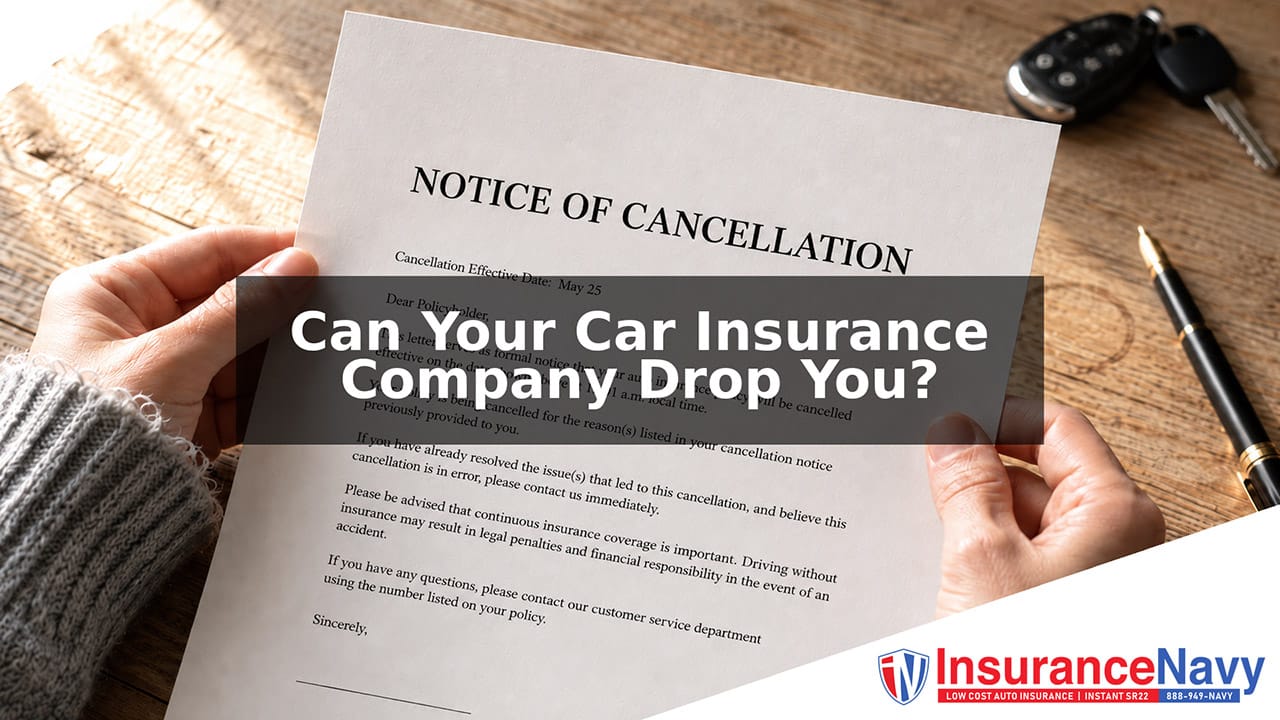
A car insurance company can drop you. The company ends coverage in two ways: cancellation and non-renewal. Cancellation ends a policy before the term ends. Non-renewal lets the policy term expire without a new offer. The company cancels a policy for multiple at-fault accidents, reckless driving, excessive moving violations, a DUI conviction, non-payment of premiums, a suspended or revoked license, insurance fraud, a failed vehicle inspection, or unauthorized commercial use. The company declines to renew a policy for frequent claims, an increased risk profile, or consistent late premium payments. State laws require the company to send written notice 10 to 75 days before cancellation. A cancellation makes new coverage harder to find. A cancellation also raises your premiums. You can appeal a cancellation through your state department of insurance. You can buy a new policy from a standard insurer, a high-risk insurer, or a state assigned risk pool.
Table of contents
- Why Can Your Car Insurance Company Drop You?
- Cancellation vs. Non-Renewal
- Cancellation Notice Requirements & State Regulations
- Reasons for Non-Renewal
- How Many Accidents Can You Have Before a Car Insurance Company Drops You?
- How Long Does an Accident Affect Your Insurance?
- Can My Insurance Policy Be Canceled After a Claim?
- Can Insurance Companies Drop You Without Notice?
- What Happens After Your Car Insurance Drops You
- What Happens If Your Coverage Lapses
- Will You Need an SR-22 After Being Dropped?
- Can You Appeal a Car Insurance Cancellation?
- Getting Car Insurance After Cancellation or Non-Renewal
- Steps to Get a New Policy After Cancellation:
- Non-Standard Insurers vs. State Assigned-Risk Plans
Yes. A car insurance company can drop you in 2 ways. Cancellation ends the policy before the term ends. Non-renewal lets the term run out without a new offer. Insurers cancel for multiple at-fault accidents, a driving under the influence (DUI) conviction, a suspended license, non-payment, or fraud. Insurers decline to renew for frequent claims or a rising risk profile. State law requires written notice first. The notice period runs from 10 days for non-payment to 60 days or more for a non-renewal, depending on the state.
A cancellation makes new coverage harder to find and raises your premiums. You can appeal through your state department of insurance. You can buy a new policy from a standard insurer, a high-risk insurer, or a state assigned-risk plan.
Why Can Your Car Insurance Company Drop You?
Car insurance companies can drop you if your risk profile changes significantly, making it more expensive to insure.
An insurance company can end coverage in two ways: non-renewal and cancellation. Non-renewal means the company allows the current policy term to expire but doesn't offer a new one.
Cancellation requires written notice. The Can Insurance Companies Drop You Without Notice? section below lists the state deadlines.
Common reasons for policy cancellation are listed below.
High-risk driving - Multiple at-fault accidents, reckless driving, excessive moving violations, or a DUI conviction can make you too risky to insure.
Non-payment of premiums - While most insurance companies give you a grace period, continuing late or a missed payment of premiums can lead to cancellation.
Suspended or revoked driver's license - Losing your drivers license due to DUIs, driving without insurance, or repeat traffic violations can discontinue your insurance coverage.
Insurance fraud - Providing false information on your insurance application or making fraudulent claims will cause immediate policy cancellation.
Failed vehicle inspection - A car that doesn't meet safety or emissions standards can cause your coverage to be dropped.
Unauthorized commercial use - Using a personal vehicle for ride sharing or other commercial purposes without the correct endorsements may violate your auto policy terms.
California allows cancellation for material misrepresentation about household drivers. Under the California Insurance Code, an insurer can cancel a policy if the applicant gives false information about a household resident who regularly drives the insured vehicle. This information includes the driver's safety record, prior claims, and years of driving experience.
Cancellation vs. Non-Renewal
Cancellation and non-renewal follow different notice rules and different triggers.
Cancellation Notice Requirements & State Regulations
Most states require an insurer to give advance written notice before canceling a policy. Florida requires at least 45 days' written notice before canceling an auto policy, according to Florida Statutes Section 627.728. Florida shortens this notice to at least 10 days when the cancellation is for nonpayment of premium.
Most states give insurers a 60-day underwriting window at the start of a new policy. During this initial 60-day period, an insurer can cancel for most non-discriminatory reasons. New York follows this pattern and then limits mid-term cancellation after 60 days to specific grounds, such as nonpayment, license suspension, or fraud, according to the New York Department of Financial Services. New York requires at least 20 days' notice for a mid-term cancellation, or 15 days when the reason is nonpayment of premium.
Reasons for Non-Renewal
Non-renewal follows the same triggers as cancellation, plus 2 triggers that concern the insurer and not the driver: the insurer withdraws from your state or ZIP code, or the insurer cuts exposure after a catastrophe year.
How Many Accidents Can You Have Before a Car Insurance Company Drops You?
There is no fixed number. 1 serious at-fault accident can be enough. 2 or more claims inside a short period is the most common trigger for non-renewal. Insurers weigh claim frequency, claim severity, and your driving history. Insurers read that history from a CLUE report, which holds up to 7 years of auto claims.
You can request a free copy of your CLUE report once a year and dispute any claim that is not yours.
How Long Does an Accident Affect Your Insurance?
Accident-related rate increases are not permanent.
At-fault accidents usually affect your insurance rates for three to five years, depending on your state and your insurer's look-back period, according to Insurify's 2025 analysis. Serious violations such as a DUI affect rates for longer, up to 10 years. Rates drop at renewal for a driver who avoids new accidents during the look-back period.
Can My Insurance Policy Be Canceled After a Claim?
Yes, an insurance company can cancel your policy after a claim, usually due to too many claims, high risk, insurance fraud, or poor payment history.
A cancellation after a claim follows the same notice rules, lapse penalties, and appeal steps as any other cancellation. The sections below cover each one.
Can Insurance Companies Drop You Without Notice?
No. State law requires written notice before an insurer ends your policy. The notice period depends on the state and the reason. Cancellation notice is short. Texas requires 10 days. Non-renewal notice is longer. Texas requires 60 days for policies bought or renewed in 2024 or later. The Cancellation Notice Requirements & State Regulations section above lists the Florida and New York deadlines and the 60-day underwriting window.
If your policy is dropped, you will get a cancellation letter or non-renewal notice from your insurer.
If you believe the insurer skipped the required notice, file a complaint with your state insurance department. The Can You Appeal a Car Insurance Cancellation? section below lists the steps.
What Happens After Your Car Insurance Drops You
4 things happen in order after an insurer drops you. You receive written notice. Your coverage ends on the date in that notice. The insurer refunds any premium you paid past that date. Your claims history follows you to the next insurer.
The notice arrives. The notice states the end date and the reason. If the insurer based the decision on a consumer report, such as a CLUE claims report or a credit-based insurance score, the Fair Credit Reporting Act requires the insurer to send an adverse action notice. The adverse action notice names the reporting agency. You can get a free copy of the report from that agency within 60 days and dispute any inaccurate item.
Coverage ends on the stated date. Driving after that date is driving uninsured. Every state penalizes a lapse. The next section lists the penalties.
You get a refund of unearned premium. Texas requires the insurer to refund the unearned premium within 15 days of the cancellation date. Other states set their own deadlines.
Your record follows you. The cancellation itself does not appear on your driving record. The claims and violations behind the cancellation do appear. Every insurer you apply to reads those claims on your CLUE report.
Start shopping the day the notice arrives. A policy that begins on the old policy's end date avoids a lapse, reinstatement fees, and a lapse surcharge on the new premium.
What Happens If Your Coverage Lapses
A lapse is any day you own a registered vehicle with no liability coverage. States detect a lapse through electronic insurance verification. The state then suspends the vehicle registration, the driver's license, or both, and charges a reinstatement fee to restore them.
State | Reinstatement fee | Other penalty for driving uninsured |
|---|---|---|
Illinois | $100 registration, plus $100 license reinstatement after a mandatory-insurance conviction | Minimum $500 fine; repeat offenders serve a 4-month plate suspension |
Nevada | $250 to $750, tiered by lapse length | Fines of $250 to $1,000 |
Georgia | $25, rising to $160 if unpaid after 30 days | Registration suspension until paid |
California | $14 | Registration suspension; 45-day window to prove coverage |
Texas | No state surcharge (the Driver Responsibility Program was repealed in 2019) | Fines for driving without insurance still apply |
A lapse also raises your next premium. Insurers treat a gap in coverage as a risk signal. A lapse can also trigger an SR-22 filing requirement. The next section explains the SR-22. Read more in what happens if your car insurance lapses.
Will You Need an SR-22 After Being Dropped?
No. The cancellation itself does not trigger an SR-22. An SR-22 is a certificate that your insurer files with the state to prove that you carry liability coverage. States require an SR-22 after specific events: a DUI conviction, a license suspension, driving without insurance, or an at-fault accident while uninsured. If the reason for your cancellation is on that list, expect the state to require an SR-22 before the state reinstates your license or registration.
An SR-22 does not change your coverage. An SR-22 adds a filing fee and moves you into the high-risk market, where the SR-22 is a routine filing. If you no longer own a car but need to keep your license, a non-owner SR-22 policy satisfies the requirement.
Each state sets the filing period and the fee. See the Insurance Navy SR-22 insurance guide for the rules in Illinois, Texas, California, Indiana, Nevada, and Georgia.
Can You Appeal a Car Insurance Cancellation?
Yes, you can appeal by contacting your state department of insurance.
The regulator checks whether the insurer followed the notice rules and the cancellation grounds in state law. The regulator can order the insurer to correct a violation. The regulator cannot force an insurer to keep a driver that state law allows the insurer to drop.
To appeal:
Keep the cancellation or non-renewal notice and every letter, email, and claim document from the insurer.
Ask the insurer in writing for the specific reason. Texas requires the insurer to give the reason for a non-renewal on request.
If the decision relied on a consumer report, request the free copy that the adverse action notice describes and dispute any error with the reporting agency. The agency must investigate at no charge. The furnisher must correct wrong information.
File the complaint with your state department of insurance. Attach the notice and your correspondence.
A complaint takes weeks to resolve. Buy replacement coverage while the complaint is pending so that you never drive uninsured.
Getting Car Insurance After Cancellation or Non-Renewal
A cancellation is harder to recover from than a non-renewal. Many insurers still offer coverage after a non-renewal, at higher rates. After a cancellation for high-risk driving, non-payment, or a suspended license, fewer insurers offer coverage, and those insurers charge higher premiums or higher deductibles.
Steps to Get a New Policy After Cancellation:
Start shopping now - Contact local insurance agents at Insurance Navy for help finding the best insurance rates.
Show good behavior - Keep a clean driving record and take a defensive driving course to qualify for better rates at a later renewal.
Non-Standard Insurers vs. State Assigned-Risk Plans
2 markets exist for drivers that the standard market turns down. Non-standard insurers are private companies, or divisions of well-known carriers, that specialize in drivers with poor records. Non-standard insurers write a policy after a cancellation at a higher rate. Insurance Navy places drivers in the non-standard market every day.
If no insurer will write your policy voluntarily, every state runs an assigned-risk plan. Insurers licensed in the state must accept the drivers that the plan assigns to them. Coverage is guaranteed, at the highest rates in the market. Texas runs its plan through the Texas Automobile Insurance Plan Association. Most other states use plans that AIPSO administers. Treat the assigned-risk plan as a 1- to 3-year bridge. Re-shop each renewal to move back to a non-standard or standard insurer.
Have you been denied or dropped by your current insurer? We can insure all cars and drivers regardless of risk level or credit score. Call us at 888-949-6289 or get a free quote online today!