
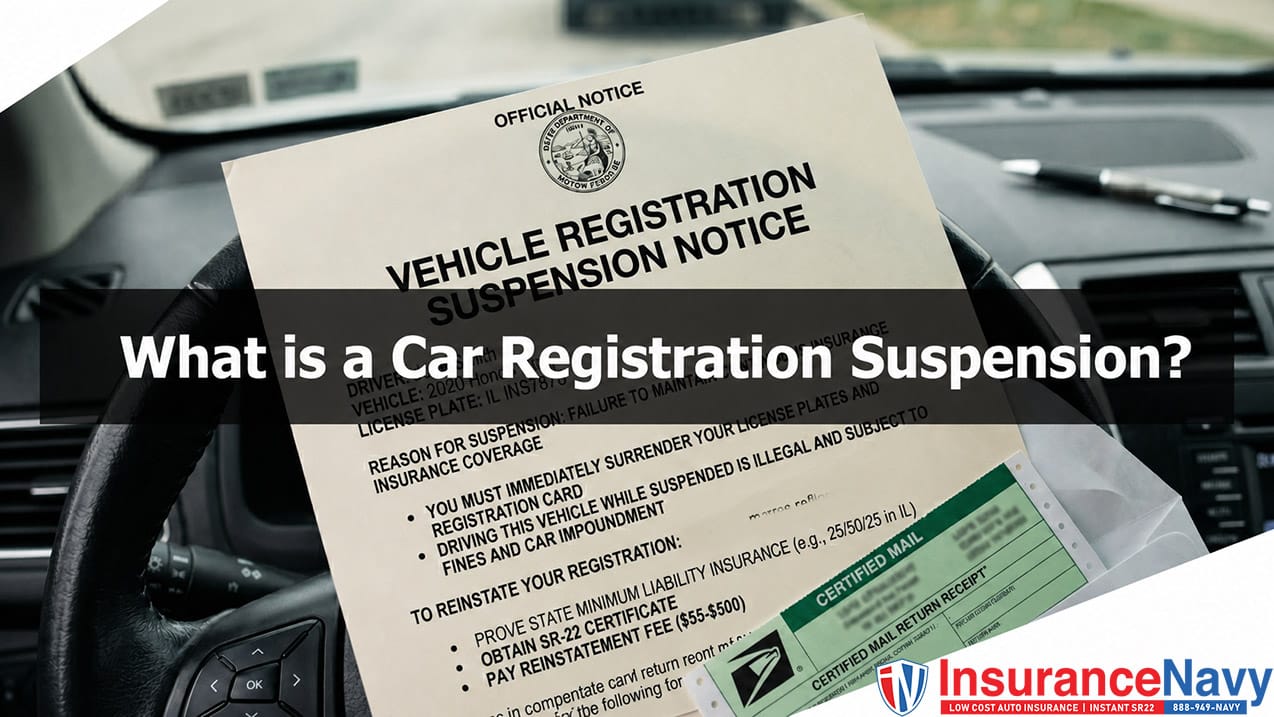
A car registration suspension is a state DMV action that revokes a vehicle's permission to operate on public roads. A DMV suspends a registration when the owner lets car insurance lapse, owes more than $500 in traffic fines, skips registration renewal fees, fails a state emissions test, or holds a suspended driver's license. A suspended registration requires the owner to surrender the license plates and registration card. Illinois sets the surrender deadline at 7 days. California sets the surrender deadline at 10 days. Driving on a suspended registration carries fines between $250 and $1,000 in most states. A suspended registration differs from a suspended license. A suspended registration blocks the vehicle from the road. A suspended license blocks the driver from operating any vehicle. Reinstating a suspended registration requires state minimum liability insurance, an SR-22 filing, and reinstatement fees starting at $55. A car insurance lapse raises auto insurance rates for 3 to 5 years.
Table of contents
A suspension of vehicle registration means your state's DMV will no longer let you drive your car on the public roads because they've revoked your permission.
In Illinois, under 625 ILCS 5/3-704, most suspensions happen when you've let your insurance lapse, owe fines for traffic violations over $500, or refuse to pay to renew your registration.
In California, the DMV will suspend your registration until proof of insurance is provided to get back in good standing. The reinstatement fees start at $55.
What Happens When Your Vehicle Registration is Suspended?
When your DMV suspends your registration, you have to surrender your license plates and registration card immediately.
Illinois requires you to return them within 7 days per the statue 625 ILCS 5/3-414.
California gives you 10 days to surrender your plates under statute CVC 4604. If you get caught driving with a suspended registration, you could be looking at fines between $250 and $1,000 in most states.
It's also possible you might get a misdemeanor charge, get your car towed or be required to have an SR-22 on file for 3 years.
In Texas, it's possible to get a Class C misdemeanor with fines up to $500 if you get caught driving on a suspended registration under TX Transportation Code 502.407.
Reasons Why Registration May be Suspended
Your insurance lapses
You didn’t pay your registration renewal fees
You have too many unpaid parking tickets piling up (over $500 in Illinois, $350 in California)
Your vehicle can't pass the state's emissions test (33 states require this)
You don't have a valid driver's license, its either been suspended or revoked
When you let your car insurance lapse, your auto insurance company has to report the lapse to the state DMV. Allstate, Farmers and all other insurers are required to report it within 30 days under 49 CFR 390.21.
The Illinois Secretary of state will suspend your vehicle registration after 45 days if you haven't provided proof of insurance coverage under 625 ILCS 5/7-203.
California uses the Insurance Verification System (IVS) to ensure all vehicles have continuous insurance coverage.
The California DMV will automatically suspend your registration 60 days after they are notified your insurance lapsed, under CVC 16020.
Texas DPS gives you 30 days to provide proof of insurance before they suspend your registration under TX Transportation Code 601.371. You’ll also have to pay $175 to $350 in reinstatement fees plus get an SR-22 filing in Texas.
How to Check Your Registration Status
Most drivers don't find out their suspended registration until they get pulled over by the police or they receive a certified letter in the mail. To avoid that, check your registration status directly through your state DMVs online portal to be safe.
In Illinois, go to the Illinois Secretary of State website and use the Vehicle Services section to look up your plate. The Illinois Secretary of State charges $20 for an official vehicle record abstract, but looking up your vehicle record online is free.
In California, the DMV lets drivers do a Vehicle Registration Status check online at dmv.ca.gov. Look under Online Services. You’ll need your license plate number and the last 5 digits of the VIN to get your registration record.
In Texas, TxDMV.gov has an online “Check Vehicle Registration Status” tool. Texas also mails out a renewal notice 60 days before the sticker expires under TX Transportation Code 502.044. Indiana, Nevada, and Georgia all offer similar lookup tools on their state BMV or DMV websites.
Signs your registration has been suspended:
A certified letter from the Secretary of State or DMV. They are usually sent with a green USPS certified mail return receipt
An SR-22 non-compliance letter from the state
A Notice of Suspension listing the violations and the reinstatement fee for your vehicle registration
An email or text alert if you signed up for DMV notifications in California or Illinois
Your insurance company tells you the state pulled your proof of coverage
If you moved recently and didn't update your address, its very likely you won’t receive the letter from the DMV. Illinois law 625 ILCS 5/3-416 gives you 10 days to update your address with the Illinois Secretary of State. Texas gives drivers 30 days under TX Transportation Code 521.054 to update their address. Your vehicle registration can still get suspended regardless of if you received the letter or not.
Suspended Registration vs. Suspended License
Suspended Registration and a Suspended license get confused all the time. They mean completely different things.
A suspended registration means the DMV revoked your vehicle’s right to be driven on the road. The car itself is not legally allowed to operate, no matter who is driving it. Its license plates have to be surrendered. If anyone is caught driving the vehicle, it can be towed and impounded.
A suspended license means you personally can't drive any vehicle. The state has revoked your driving privileges because of a DUI conviction, unpaid child support, too many points from traffic tickets, or failure to appear in court. In Illinois, license suspensions fall under 625 ILCS 5/6-206. In California, CVC 13353 covers license suspensions for DUI refusal. In Texas, TX Transportation Code 521.292 handles suspensions for repeat violators.
You can have one without the other:
Your driver’s license is valid but your car cant be driven: suspended registration
You can't drive but the car is fine: suspended license
Both drivers license and registration are suspended at once: usually after a DUI combined with an insurance lapse
Both types of suspension typically require an SR-22 filing to reinstate. Insurance companies can file the SR-22 for you for a $25 filing fee. The SR-22 has to stay on file for 3 years in Illinois, Texas, and most other states. In California, it's required for 5 years in California after a DUI conviction.
How Suspended Registration Affects Your Car Insurance Rates
Your auto insurance rates can increase for the 3 to 5 years after an insurance lapse.
1. Your insurer reports the lapse. Every insurance carrier has to notify the state within 30 days of cancellation under 49 CFR 390.21. The lapse goes on your record and is visible to every insurance company you apply to in the future.
2. You become a high-risk driver. Standard carriers like Nationwide, Liberty Mutual, and Travelers will either refuse to renew your policy or charge you a much higher rate. Most insurance companies classify any driver with an insurance lapse of more than 30 days as a non-standard driver.
3. You need an SR-22. To reinstate registration in Illinois, Texas, Indiana, and Nevada, you’ll need an SR-22 certificate filed with the state. California requires drivers to carry an SR-22 for 3 years for most violations and 5 years after a DUI.
4. Your rates can double. Drivers with a lapse and SR-22 pay an average of $125 to $225 per month for minimum liability coverage in Illinois. Drivers with continuous coverage usually pay only $55 to $85 per month. Thats a difference of roughly $1,200 to $1,800 per year. In Texas, the same gap runs $95 to $185 per month for SR-22 coverage vs. $45 to $75 per month for standard liability.
5. The surcharge lasts 3 to 5 years. Even after the SR-22 comes off, insurance companies look back at 3 to 5 years of insurance history when quoting. A lapse from 2 years ago still raises your 2026 rate.
To minimize the damage:
Never let your policy cancel, not even for a single day
When shopping insurance, have the new policy start the same day the old one ends
Set up automatic payments to prevent an accidental cancellation
Keep your SR-22 active for the full required period, because letting it lapse restarts the 3-year clock
Non-standard carriers that specialize in drivers with lapses and SR-22 filings include Dairyland, Bristol West, Progressive, Gainsco, Infinity, and National General. Insurance Navy has appointments with all of these carriers and can file your SR-22 the same day you purchase your policy.
How to Clear a Suspended Registration on Your Car
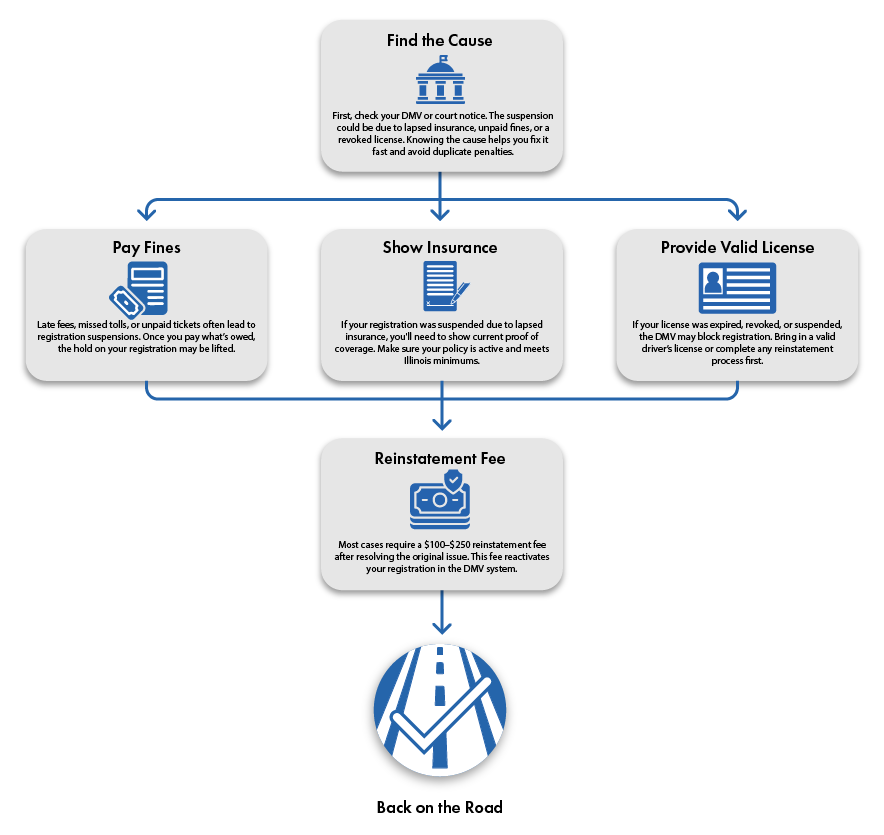
To get your car's registration reinstated with your DMV, you need to do the steps below.
Contact your state DMV to find out the reason why they suspended your registration
Get the state minimum in liability insurance (25/50/25 in Illinois, 15/30/5 in California, 30/60/25 in Texas),
Ask your insurer to add on SR-22 filing
Pay the DMV the required fees (that's a minimum of $70, but can be up to $500 depending on what you did wrong)
Send in proof of state minimum insurance coverage to get your registration reinstated.
Insurance Navy specializes in high-risk auto insurance for drivers with suspended registrations in Illinois, Texas, California, Indiana, Wisconsin and Nevada.
We work with a large network of different carriers like Progressive, Infinity, EMC National Life, Stillwater, and Bristol West to get you driving again.
Rates can be as low as $49 a month for liability only auto insurance policies. Get a quote online or call us at 888-949-6289.