
A texting while driving ticket is a moving violation that appears on a driver's motor vehicle record. One texting while driving ticket raises auto insurance premiums 33% on average, or $839 a year. The surcharge stays on a policy for 3 years at most insurers. According to NHTSA, an estimated 315,167 people suffered injuries in distraction-affected crashes in 2024. That injury count explains why insurers price distracted driving as high-risk behavior. Surcharge size varies by state and by carrier, from 12% in Wyoming to 56% in Vermont. Insurance Navy helps drivers compare auto insurance quotes across the United States. This guide explains texting while driving ticket costs by state, license points, insurer surcharges, and record timelines.
Table of contents
- Does a Texting While Driving Ticket Raise Car Insurance Rates?
- How Much Does a Texting While Driving Ticket Increase Auto Insurance Premiums?
- How Much Does Each Insurer Raise Rates for a Texting Ticket?
- How Long Does a Texting Ticket Affect Your Insurance?
- What Factors Change How Much Your Rate Goes Up?
- How Many Points Does a Texting While Driving Ticket Add to your Driver's License?
- Is a Texting and Driving Ticket a Moving Violation?
- Why Do Insurers Treat Texting as High-Risk?
- How Can you Avoid or Reduce the Insurance Increase?
- Frequently Asked Questions: Texting and Driving Tickets
- Is Texting While Driving Illegal?
- How much is a texting ticket?
- Does a texting ticket go on my record?
- How Long Does a Texting Ticket Stay on My Record?
- How Can I Avoid an Insurance Rate Increase after a Texting Ticket?
A texting while driving ticket increases auto insurance premiums by 33% on average, or about $839 a year, according to Insurance.com's 2026 rate analysis.
The size of the increase depends on your state and your insurer. The surcharge stays on your rate for 3 years at most insurers.
Texting while driving is illegal for all drivers in 49 states and Washington, D.C. Montana is the only state without a statewide texting ban. Most states treat a texting ticket as a moving violation, so the ticket brings a fine, license points in states that use a point system, and a higher premium at your next renewal. Insurers price distracted driving as high-risk behavior.
Does a Texting While Driving Ticket Raise Car Insurance Rates?
A ticket for texting and driving will increase your car insurance rates because insurance providers consider distracted driving behavior a high risk, increasing the likelihood of accidents.
The amount of the rate increase will depend on the auto insurance company and state. Most insurance companies treat texting and driving violations like minor moving violations and raise rates at renewal.
Also, a texting and driving offense will get you a fine, which varies by state. Beyond the fine, it will also impact your motor vehicle record (MVR), which insurance companies use to assess risk and determine premiums.
Multiple offenses or more severe distracted driving offenses can lead to even higher car insurance rates or non-renewal of your policy.
How Much Does Each Insurer Raise Rates for a Texting Ticket?
Every major insurer surcharges a texting ticket, and the size of the surcharge varies by carrier. In Insurance.com's 2026 data, State Farm applies the smallest increase at 18% and Nationwide the largest at 48%. GEICO adds 35%, raising an average premium from $2,159 to $2,917 a year. Progressive adds 38%, Farmers 39%, Travelers 43%, Allstate 27%, and USAA 20%. That spread makes re-shopping your policy at renewal the most effective response to a texting ticket. A driver facing the largest surcharge can remove most of that increase by moving to a carrier at the low end of the range.
How Long Does a Texting Ticket Affect Your Insurance?
The insurance surcharge and the driving record run on separate clocks. Most insurers look back 3 years at renewal, so the surcharge drops off after 3 years. The ticket itself stays on your motor vehicle record for 3 to 5 years depending on the state, and some states keep the conviction permanently after the points expire. Ask your insurer to re-rate the policy once the ticket leaves the look-back window, because the increase does not always come off automatically.
Record clocks differ across the states where Insurance Navy writes policies. Illinois keeps the conviction on the driving record. California keeps most violation points for about 3 years. Indiana points stay active for 2 years from the conviction date. Nevada demerit points expire 12 months after conviction, and the conviction stays on the permanent record. Georgia counts points over a rolling 24-month window. Texas records the conviction on your Department of Public Safety driving record.
What Factors Change How Much Your Rate Goes Up?
Your state. State law decides whether an insurer can surcharge a first texting ticket and how large that surcharge can be. See the state table above.
Your insurer. The carrier you choose sets the size of the surcharge. See the insurer figures above.
A crash at the scene. A texting ticket written at an accident scene is rated as an at-fault accident plus a violation, which raises the premium more and for longer.
Your driving record. Insurers rate a first texting ticket as a minor violation. Insurers rate a second ticket inside the look-back window more heavily.
Your age. Insurance.com's 2026 data puts an 18-year-old with a texting ticket at $9,427 a year, compared with $3,417 at age 40.
Enforcement type. Texting is a primary offense in Illinois, Texas, California, Indiana, Nevada, and Georgia, so an officer can stop a driver for texting alone. In a secondary-enforcement state, the officer writes the texting ticket only alongside another violation.
How Many Points Does a Texting While Driving Ticket Add to your Driver's License?
Most states that use a driver's license point system add points for a texting ticket, because a texting ticket is a moving violation. The point value depends on the state. Colorado adds 4 points for a cell phone ticket, Kentucky adds 3 points, and Alabama adds 2 points. Texas assigns no points for any moving violation, because Texas repealed its Driver Responsibility Program in 2019. Points expire after a state-set period if you stay violation-free, and too many points in a short window trigger a suspension. Nevada suspends a license at 12 points in 12 months. Georgia suspends at 15 points in 24 months. Illinois suspends after 3 point-assigned convictions in 12 months.
Driver's license points can also affect car insurance since your auto insurance company is in contact with your state's DMV.
That's why it's essential to look at your state's laws regarding cell phone and hands-free device usage while driving. A mobile phone ticket can cause much more trouble than they are worth.
Is a Texting and Driving Ticket a Moving Violation?
A moving violation is a traffic offense committed by a driver while in motion. It can include speeding, reckless driving, a DUI, and failure to heed traffic signs. Some states count not using your turn signal as a moving violation.
This should highlight the severe potential damage of taking your eyes off the road and talking on a cell phone while driving. You don't want to be seen by our insurance carrier as a high-risk driver.
Why Do Insurers Treat Texting as High-Risk?
Insurers surcharge texting tickets because the crash data supports the risk rating. NHTSA counted 3,275 deaths in distraction-affected crashes in 2023, 8% of all traffic deaths, and notes that the true count is likely higher because drivers rarely admit phone use after a crash. IIHS research puts the crash risk while texting or handling a phone at 2 to 6 times the risk of undistracted driving. Drivers aged 16 to 24 have the highest rate of hand-held device use at 7.7%. A texting ticket places a driver in that risk group.
Distracted drivers can't see sudden changes in traffic, like a car stopping or a pedestrian stepping out.
To stay safe on the road, eliminate distractions like texting and driving, holding your phone during conversations, or applying makeup behind the wheel. Stay focused and avoid dangerous behavior to protect yourself and others.
How Can you Avoid or Reduce the Insurance Increase?
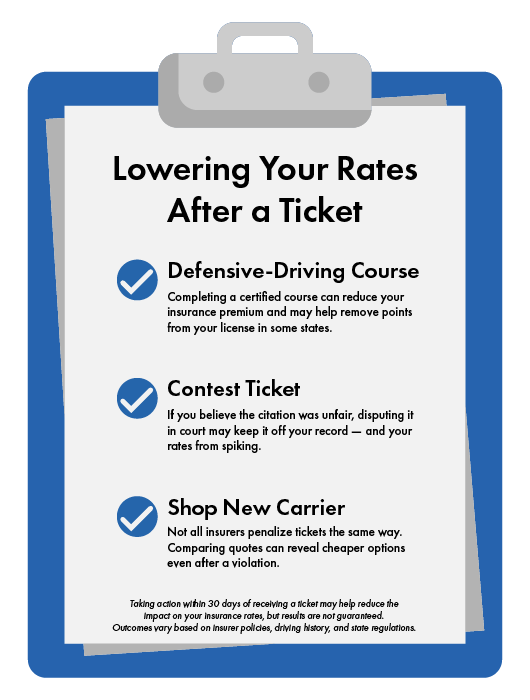
Ask about traffic school or court supervision before you pay the ticket. Many states let a first-time offender keep the conviction off the record by completing an approved course. Illinois court supervision and Texas deferred disposition work this way for eligible drivers. A ticket that never becomes a conviction cannot be surcharged.
Take a defensive driving course. Indiana credits 4 points for its Driver Safety Program, Nevada removes 3 points for a DMV-approved course, and Georgia removes up to 7 points once every 5 years. Some insurers also apply a course discount.
Shop the policy at renewal. The carrier you pick controls more of the increase than any other factor you can change.
Ask your insurer for a re-rate once the ticket leaves the look-back window.
Contest the ticket if the stop was for a hands-free or emergency call that your state's law allows.