
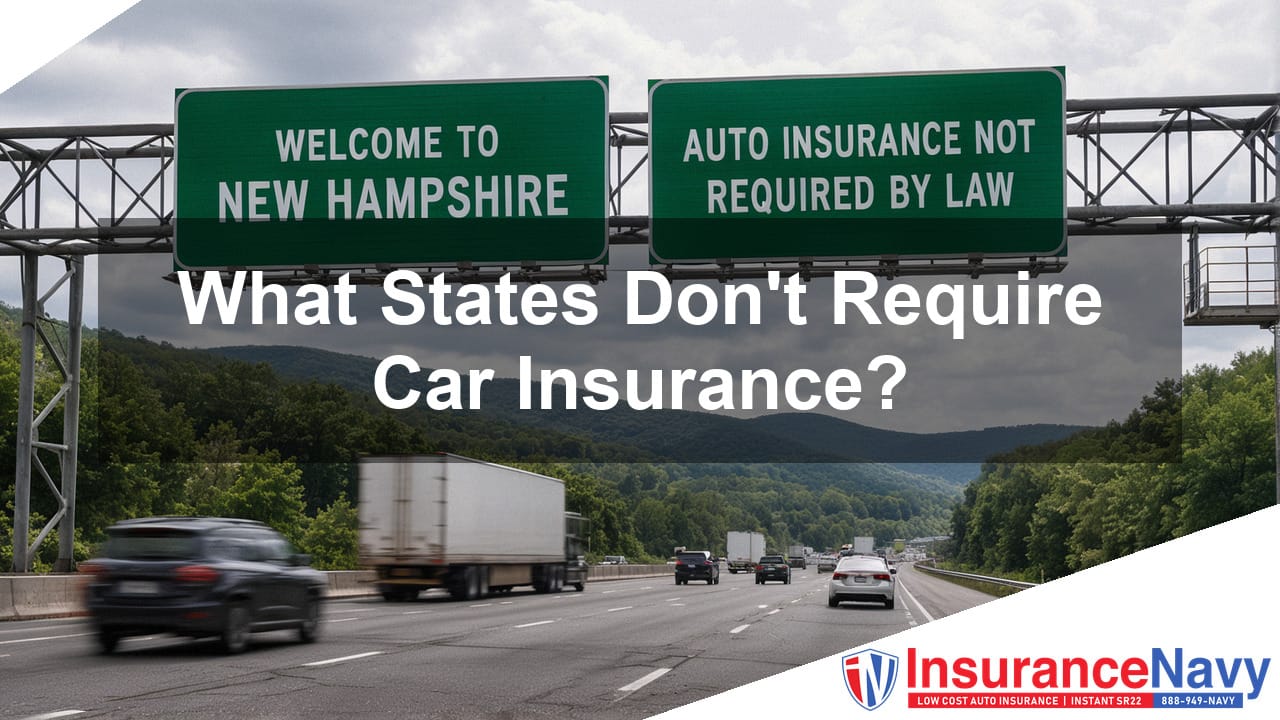
States that do not require car insurance include only New Hampshire. All 49 other states require drivers to carry minimum liability coverage. Driving without car insurance creates three main risks: license suspension, registration suspension, and personal liability for accident costs. The Insurance Research Council reported that 33.4% of drivers across the United States were uninsured or underinsured in 2023. That figure equals one in three drivers. New Hampshire requires drivers to prove financial responsibility of $100,000 per vehicle instead of car insurance. Insurance Navy helps drivers find the right car insurance at the right price. This guide explains states that do not require car insurance, the bond alternative, financial responsibility, and minimum liability limits.
Table of contents
- States With No Auto Insurance Requirement
- New Hampshire Insurance Requirements
- Who has to carry Auto Insurance in New Hampshire?
- The Bond Alternative to Insurance Coverage
- States with the Lowest Auto Insurance Requirements
- Florida's Minimum Coverage Requirements
- Louisiana's Minimum Coverage Requirements
- Minimum Car Insurance Requirements by State
- At-Fault vs. No-Fault States
- Proof of Financial Responsibility for Uninsured Drivers
- What are the Average Minimum Insurance Limits that Most States Require?
- Bodily Injury Liability
- Property Damage Liability
- Personal Injury Protection and Medical Payments Coverage
- Uninsured/Underinsured Motorist Coverage
- Frequently Asked Questions
- Do you need insurance in all 50 states?
- What state has the strictest auto insurance laws?
- What state has the most drivers without insurance?
New Hampshire is the only state that does not require car insurance. All 49 other states require drivers to carry at least minimum liability coverage. Virginia became the most recent state to require car insurance when Virginia ended its uninsured-vehicle fee option on July 1, 2024.
States With No Auto Insurance Requirement
New Hampshire is the only state with no auto insurance requirement. New Hampshire drivers must still meet the state's Motor Vehicle Financial Responsibility Requirements.
New Hampshire Insurance Requirements
Drivers in New Hampshire can meet the state's Motor Vehicle Financial Responsibility Requirements by showing a financial responsibility of $100,000 per vehicle.
However, you are still financially responsible for any damages you cause in an accident. New Hampshire sets that floor at $25,000 for bodily injury per person, $50,000 for bodily injury per accident, and $25,000 for property damage per accident. These are the same 25/50/25 limits that New Hampshire requires of drivers who do carry a policy.
Your driver's license and vehicle registration will be suspended if you can't cover these costs.
To prove financial responsibility, you can submit a receipt from the state treasurer showing a deposit of the required amount in cash or legally acquired securities into a bank account.
The receipt must then be sent to the New Hampshire Department of Safety. Securities must be lawfully purchased by a savings bank or designated for a trust fund.
Drivers who carry a policy in New Hampshire must also have at least $1,000 in medical payments coverage and uninsured motorist coverage that matches the policy's liability limits.
Who has to carry Auto Insurance in New Hampshire?
If you can't afford to meet the Financial Responsibility Requirements, you must get a standard auto insurance policy. Those who finance or lease a vehicle usually need insurance that includes collision and comprehensive coverage.
Auto insurance is mandatory for those with an SR-22 filing, which is for drivers convicted of driving while intoxicated (DWI), leaving the scene of an accident, being responsible for a major at-fault accident, or committing a second offense of Reckless Driving.
The Bond Alternative to Insurance Coverage
A bond is a form of proof of financial responsibility that some states accept in place of a car insurance policy. Accepted forms include a surety bond, a liability bond, and a cash deposit in a designated amount.
You buy a bond that provides financial protection in case of an at-fault accident. If an at-fault accident occurs, the bond covers up to the limit, but you have to repay the full amount plus interest.
Unlike car insurance, a bond is tied to the driver, not a specific vehicle, so you can legally drive any car.
While this might seem appealing, it comes with substantial financial risks. Even minor accidents can cost thousands of dollars, including vehicle repairs, medical bills, and legal fees, all of which you are personally responsible for.
States with the Lowest Auto Insurance Requirements
Florida and Louisiana have the lowest auto insurance requirements of any state. Florida is the only state that does not require bodily injury liability coverage. Bodily injury liability coverage pays for injuries to other people in an accident that the policyholder causes.
Most states require a total liability coverage of $100,000, typically $25,000 in bodily injury liability coverage per person, $50,000 per accident, and $25,000 in property damage coverage.
Louisiana has the lowest minimum bodily injury liability limits of any state that requires bodily injury liability coverage.
Both Florida and Louisiana have some of the highest auto insurance premiums in the country, and this is due to the legal headaches caused by low coverage limits.
When a policyholder's insurance company doesn't cover the full extent of damages and injuries, lawsuits are filed to recover additional costs, which add to the overall premium.
Other factors, like Florida's no-fault state insurance laws and frequent natural disasters, also drive up insurance costs in these states.
Florida's Minimum Coverage Requirements
Florida requires $10,000 in property damage liability per accident and $10,000 in personal injury protection (PIP) per person and accident.
Louisiana's Minimum Coverage Requirements
Louisiana requires $15,000 in bodily injury liability per person, $30,000 per accident, and $25,000 in property damage liability per accident. Louisiana's total minimum liability coverage is $70,000.
Minimum Car Insurance Requirements by State
Every state except New Hampshire sets a minimum liability requirement, usually written as 3 numbers: bodily injury per person, bodily injury per accident, and property damage per accident. Here is where each state sets that floor.
California: $30,000 / $60,000 / $15,000
Florida: no bodily injury liability required; $10,000 in property damage liability and $10,000 in personal injury protection (PIP)
Georgia: $25,000 / $50,000 / $25,000
Illinois: $25,000 / $50,000 / $20,000
Indiana: $25,000 / $50,000 / $25,000
Louisiana: $15,000 / $30,000 / $25,000
Nevada: $25,000 / $50,000 / $20,000
New Hampshire: no insurance required; drivers who buy a policy must carry $25,000 / $50,000 / $25,000
Texas: $30,000 / $60,000 / $25,000
At-Fault vs. No-Fault States
In an at-fault state, the driver who causes an accident pays for the other party's injuries and vehicle damage. The at-fault driver's liability insurance pays those costs. In a no-fault state, each driver files an injury claim with that driver's own insurer first, regardless of who caused the accident.
No-fault states require drivers to carry personal injury protection (PIP). Personal injury protection pays the policyholder's own medical expenses after an accident. Florida, Michigan, and New York are examples of no-fault states. Florida's no-fault law explains why Florida requires personal injury protection instead of bodily injury liability coverage.
Proof of Financial Responsibility for Uninsured Drivers
Proof of financial responsibility is documentation that shows you can pay for damages you cause in an accident. Drivers who do not carry auto insurance must carry proof of financial responsibility, just as insured drivers must present insurance cards.
Instead, you must carry documentation verifying your bond or other financial responsibility and present it when pulled over or in an at-fault accident.
Not providing proof of financial responsibility can result in severe consequences, including registration and license suspension, plus an uninsured motorist fee.
To reinstate your driving privilege, you may be required to get auto insurance or an alternative form of financial responsibility requirement.
In some states, repeat offenders must carry traditional insurance for a mandatory period, such as 3 years.
What are the Average Minimum Insurance Limits that Most States Require?
Most states require average minimum limits of $25,000 in bodily injury liability per person, $50,000 in bodily injury liability per accident, and $10,000 in property damage liability per accident. Liability car insurance is the only type of car insurance that most states require. Liability car insurance is sometimes called basic car insurance, basic coverage, or mandatory car insurance.
This liability insurance covers any damage and injuries you cause in an accident. Any damage or injuries in the same accident would be covered if you had full car insurance or comprehensive coverage. State minimum requirements combine 4 coverage types: bodily injury liability, property damage liability, personal injury protection or medical payments coverage, and uninsured/underinsured motorist coverage.
Bodily Injury Liability
Bodily injury liability insurance per person is the amount of coverage you have for injuries to one person that you cause in an accident.
The coverage includes all aspects of medical transport and treatment.
Bodily injury liability per accident is the amount of coverage you have for injuries to everyone in the other vehicle in an accident that you cause. Medical treatment and expenses are included.
Property Damage Liability
Property damage liability insurance is the amount of coverage you have for damage that you cause to another vehicle and other property in an accident. Property damage liability covers repair and replacement costs.
Personal Injury Protection and Medical Payments Coverage
Personal injury protection (PIP) pays the policyholder's own medical expenses and related costs after an accident, regardless of fault. No-fault states require personal injury protection. Medical payments coverage pays medical bills for the policyholder and the policyholder's passengers after an accident. The only state that mandates medical payments coverage is Maine.
Uninsured/Underinsured Motorist Coverage
Suppose you are hit by a driver who is at fault but not insured or underinsured and can't pay for your medical bills or vehicle repairs. In that case, uninsured/underinsured motorist coverage will cover the gap.
This coverage is divided into liability coverage, which covers bodily injury to uninsured/underinsured motorists, and property damage coverage for uninsured/underinsured motorists.
It will pay for medical bills for you and your passengers and vehicle repairs after an accident.
Some states require uninsured motorist coverage for bodily injury liability, so you are financially protected if an at-fault driver doesn't have sufficient insurance coverage. These states are:
Connecticut
Illinois
Kansas
Maine
Maryland
Massachusetts
Minnesota
Missouri
Nebraska
New Hampshire
New York
North Carolina
North Dakota
Oregon
South Carolina
Vermont
Virginia
West Virginia
Wisconsin
Some states require uninsured motorist coverage for property damage liability, which will pay for vehicle repairs in an accident with an uninsured driver. These states are:
Maryland
New Hampshire (if you have auto insurance)
North Carolina
South Carolina
Vermont
Virginia
West Virginia
Washington, D.C.
Remember that legally, minimum coverage amounts to driving on public roads vary from state to state. It is recommended that you carry auto insurance coverage well beyond the minimum insurance requirements.
Each state has a different minimum standard for liability insurance, and some mandate the purchase of additional insurance, including uninsured motorist coverage, underinsured motorist coverage, or personal injury protection.
The most common types of auto insurance that states do not require are collision coverage and comprehensive coverage.
If you finance a car, your lender will likely require you to buy higher coverage limits from your auto insurance company than the law mandates.
The only state that mandates medical payments coverage is Maine.
Insurance Navy can help you find the most affordable auto insurance rates.
Get free car insurance quotes online today or call us at 888-949-6289. Our expert insurance agents will help you get high-quality car insurance coverage at low prices.
Frequently Asked Questions
Do you need insurance in all 50 states?

What state has the strictest auto insurance laws?
The Top 10 States for the strictest auto insurance laws are:
Arizona
Florida
Illinois
Indiana
Kentucky
Nevada
South Dakota
Virginia