
An Illinois driving record is a certified state record that lists a driver's license details, convictions, crashes, and suspensions. The Illinois Secretary of State issues two driving record abstracts: the Public Driving Record Abstract and the Court Purposes Abstract. Traffic convictions raise car insurance rates and can trigger a license suspension. The Federal Highway Administration counted 8,799,495 licensed drivers in Illinois in 2024. Car insurance companies use the Public Driving Record Abstract to set premiums. Other states across the United States accept a certified abstract as proof of driving history. Insurance Navy helps Illinois drivers find the right insurance at the right price. This guide explains Illinois driving record costs, ordering methods, abstract types, violation points, and retention periods.
Table of contents
- How Much Does an Illinois Driving Record Cost?
- What Information Does the Driving Record Include?
- Important Contact Details and License Status
- Traffic Demerits Like Violations and Accidents
- Two Types of Illinois Driving Record Abstracts
- 1. Public Driving Record Abstract
- 2. Affected Driving Record Abstract (Court Purposes Abstract)
- How to Get Your Illinois Driving Record: 3 Ways
- Online: Instant PDF for $21
- By Mail: About 10 Working Days
- In Person: Same-Day at a Secretary of State Facility
- How Long Do Violations Stay on an Illinois Driving Record?
- Can Someone Else Order My Illinois Driving Record?
- Best Strategies for Keeping a Clean Driving Record
- Regular Driver Record Monitoring
- Quickly Pay Tickets and Attend Court Appearances
- Ask About Court Supervision
- Don’t Let Insurance Coverage Lapse
- Find the Best Rates at Insurance Navy Today
- Frequently Asked Questions
- Who Can Order a Copy of My Records?
- Can I Get Reckless Driving Violations Removed From My Driving Documentation?
- Is My Bad Driving Record the Same in Every State?
- How Long Does an Illinois Driving History Last?
- Can I Check My Illinois Driving Record for Free?
- Can I Reprint My Illinois Driving Abstract?
- Is an Illinois Driving Record the Same as an MVR?
An Illinois driving record abstract is a certified copy of a driver's history from the Illinois Secretary of State. The abstract costs $20. Drivers order the abstract online for $21 and print it immediately, in person at a Driver Services facility the same day, or by mail in about 10 working days.
Insurers call the driving record abstract a motor vehicle report (MVR). Insurers use the MVR to price a car insurance policy. Insurance Navy offers free online quotes that show how a driving record affects the rate.
How Much Does an Illinois Driving Record Cost?
An Illinois driving record costs $20 for 1 certified abstract. The Illinois Secretary of State adds a $1 payment processor fee to every credit or debit card payment, so an online order totals $21.
How you order | Cost | How you pay | When you get it |
|---|---|---|---|
Online | $21 ($20 + $1 processor fee) | Visa, Mastercard, American Express, Discover | Immediately, as a PDF |
Online, both abstracts | $41 ($20 each + $1) | Same cards | Immediately, as PDFs |
In person at a Driver Services facility | $20 (+ $1 if paying by card) | At the counter. Cards add $1. | Same visit |
By mail | $20 | Check or money order payable to Secretary of State | About 10 working days |
The Illinois Secretary of State lists no free option for adult drivers. The Secretary of State does not refund an online order after the purchase. Every abstract carries the same Secretary of State certification under every ordering method.
What Information Does the Driving Record Include?
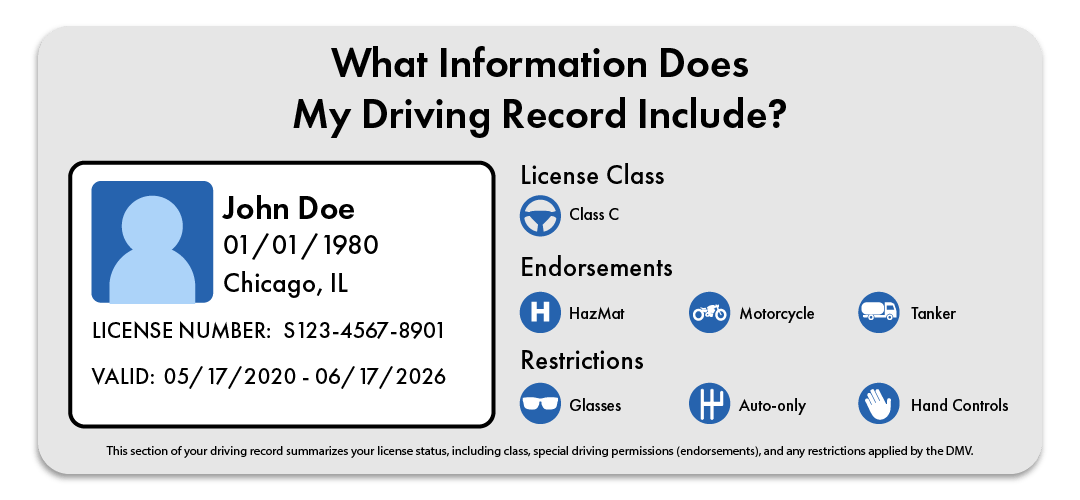
An Illinois driving record lists license details, traffic convictions, crashes, and any suspensions or revocations. Ordering a copy should reveal the following information. The Illinois driving record helps insurance providers accurately assess your driving risk.
Important Contact Details and License Status
The document copies all the information on your driver's license. This includes the name, license number, gender, and basic information about how you look. It helps insurance agencies properly identify you.
The documentation shows detailed license information, too. It goes beyond basic data like the issue date and expiration.
It provides the license class and whether the driver can operate basic vehicles or more advanced options like semi-trucks.
This includes any endorsements or restrictions. For example, it reveals a qualification that allows for the transportation of hazardous waste.
Traffic Demerits Like Violations and Accidents
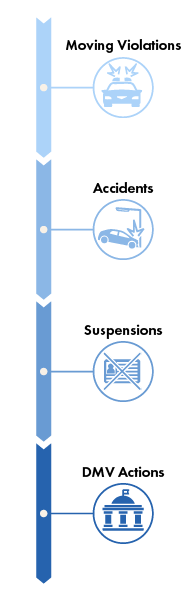
Why are most drivers and insurance companies interested in driving records? They contain the person’s history of accidents, traffic violations, and other infractions. This includes the following information:
Law enforcement considers running red lights, speeding, and not using a turn signal as moving violations.
Stationary infractions are parking violations, expired registration tabs, and broken tail lights.
Conviction records detail the date of any convictions, basic information about the crime, and the classification (felony or misdemeanor). This includes driving under the influence.
The documentation shows any reported accident regardless of cause. It goes into more detail about your at-fault crashes.
The record contains the date and reason when a driver has their license suspended or revoked.
Administrative actions include warnings for violations that didn’t result in a ticket, failure to appear in court, or neglecting to pay a fine.
Illinois assigns each moving violation a point value from 5 to 55. The Illinois Secretary of State suspends a license after 3 point-assigned convictions in any 12 months. The threshold for a driver under 21 is 2 point-assigned convictions in 24 months. The point total sets the length of the suspension.
Violation | Points |
|---|---|
Speeding 1 to 10 mph over | 5 |
Speeding 11 to 14 mph over | 15 |
Speeding 15 to 25 mph over | 20 |
Speeding more than 25 mph over | 50 |
Disregarding a traffic-control device | 20 |
Following too closely | 25 |
Reckless driving | 55 |
DUI, driving on a suspended license, and driving without insurance carry 0 points. Each of these 3 offenses triggers a suspension or revocation on its own.
Two Types of Illinois Driving Record Abstracts
Illinois issues 2 driving record abstracts: the Public Driving Record Abstract and the Affected Driving Record Abstract. Courts and attorneys call the Affected Driving Record Abstract the Court Purposes Abstract.
1. Public Driving Record Abstract
The Public Driving Record Abstract is the version that insurance companies and employers buy. The Public Driving Record Abstract lists the driver's history, including convictions for traffic violations, suspensions, and revocations. Order the Public Driving Record Abstract when an insurer, an employer, or another state's licensing office asks for a driving record.
2. Affected Driving Record Abstract (Court Purposes Abstract)
The Affected Driving Record Abstract shows every action on the driving record. The Affected Driving Record Abstract includes confidential entries that never appear on the Public Driving Record Abstract, such as court supervision dispositions. The Illinois Secretary of State releases the Affected Driving Record Abstract only to the affected driver, the driver's attorney, prosecutors, law enforcement officers, and the courts. Order the Affected Driving Record Abstract for a traffic case, a reinstatement hearing, or an attorney who asks for a Court Purposes Abstract. Keep the Affected Driving Record Abstract private. An employer or insurer that receives the Affected Driving Record Abstract sees information that the state does not release to employers or insurers.
How to Get Your Illinois Driving Record: 3 Ways
The Illinois Secretary of State offers 3 ways to get an Illinois driving record: online, by mail, or in person at a Driver Services facility. The online Driving Record Abstract system is the fastest method, because the certified PDF is ready when the payment clears.
Online: Instant PDF for $21
The online Driving Record Abstract system runs 24 hours a day. The online system also serves commercial driver's license (CDL) holders.
Don’t fall for scam websites that seek payment but never send your papers. Visit the Illinois Secretary of State’s site to find everything in one convenient place.
Follow these steps:
Gather your license details. The online system asks for the driver's license number, date of birth, last 4 digits of the Social Security number, license issue and expiration dates, license class, height and weight as printed on the license, and the DD number printed on the card.
Open the official system. Go to the Driving Record Abstract page on ilsos.gov and select Begin. The application runs on apps.ilsos.gov/drivingrecord.
Affirm the request. Check the box that confirms the request is for your own record. Type your name exactly as the name appears on the license. The online system sells a driver only the driver's own record.
Choose the record type. Select the Public Driving Record Abstract, the Court Purposes Abstract, or both.
Pay the $21 total. The online system accepts credit and debit cards. Prepaid cards work. Electronic checks do not work.
Save and print the PDF. The driving record opens immediately. The Illinois Secretary of State cannot email or mail an online order, so save the PDF when the driving record first opens.
By Mail: About 10 Working Days
Why do people request their records through the mail? This option offers a viable alternative if they don’t use credit cards, worry about internet security, or can't conveniently access a printer. It uses a similar process as applying online.
Print and complete the Abstract Request Form from the Illinois Secretary of State website. Include the driver's full name, date of birth, sex, and Illinois driver's license number. Add a check or money order for $20 payable to Secretary of State. Mail the form and the payment to:
Secretary of State, Driver Analysis Section 2701 S. Dirksen Pkwy. Springfield, IL 62723
The Secretary of State processes a mail request in about 10 working days.
In Person: Same-Day at a Secretary of State Facility
Do you prefer talking to people in person? Consider heading to your local Illinois Secretary of State Facility.
Many people prefer to complete the application beforehand. You can also ask for a request form at the site if you don’t want to print it off.
Complete the Abstract Request Form and pay the $20 fee. The facility issues the certified driving record during the same visit. The in-person method is the fastest option for a driver who cannot print a PDF at home.
How Long Do Violations Stay on an Illinois Driving Record?
Most moving violations stay on an Illinois driving record for 4 to 5 years from the date of conviction, according to the Illinois Secretary of State. Serious entries stay longer.
Entry | Time on your Illinois driving record |
|---|---|
Moving violations (speeding, disregarding a traffic light, improper lane usage) | 4 to 5 years from the conviction date |
A ticket that led to a suspension or revocation | At least 7 years from the reinstatement date |
Alcohol and drug offenses, including DUI | Lifetime |
Illinois does not publish a date when points expire. Each conviction stays on the Illinois driving record for the full period in the table.
Can Someone Else Order My Illinois Driving Record?
Yes. Any person or company can buy another driver's Public Driving Record Abstract in Illinois for the same $20 fee. The requestor orders at a Driver Services facility or mails an Abstract Request Form.
The Illinois Secretary of State protects the driver with a notification step. The Secretary of State mails the driver a notification letter with the requestor's name and the date of the request. The Secretary of State then waits 10 days before releasing the abstract. A request made at a facility takes 11 to 15 working days to reach the requestor. The requestor sees convictions, withdrawals, and crash information. The Secretary of State never releases the driver's address or other personal details.
An immediate family member in Illinois can pick up the driving record of an out-of-state driver at a Driver Services facility. The family member needs the driver's notarized, written permission.
Best Strategies for Keeping a Clean Driving Record
A clean Illinois driving record comes down to 4 habits: check the driving record yearly, resolve every ticket, ask about court supervision, and keep car insurance active.
Regular Driver Record Monitoring
Even minor errors on a driving record can increase a person’s insurance rates. Order a new Illinois driving record abstract every year and check every entry.
Correcting the contact information or eye color doesn’t require much effort. An incorrect entry about a violation or infraction may require a court hearing. For an error on the driving record, call the Illinois Secretary of State Driving Record Unit at 217-782-2720 on weekdays.
Quickly Pay Tickets and Attend Court Appearances
Some traffic violations simply require paying a fine. More serious ones involve court cases and a legal process. Never ignore the consequences no matter how inconvenient or severe.
Late payment can add court penalties. Points come from the conviction, not from late payment. Since July 1, 2021, Illinois no longer places failure-to-pay stops on driving records.
Ignoring a court date has more drastic results. The judge can automatically rule against the driver and may charge them with contempt of court.
Ask About Court Supervision
A judge can grant court supervision for an eligible traffic ticket. A court supervision disposition stays off the Public Driving Record Abstract that insurers and employers buy.
A driving class improves driving habits and helps a driver avoid future violations. Never miss an assigned class when a judge orders it.
Don’t Let Insurance Coverage Lapse
Driving without auto insurance in Illinois results in serious consequences. The minimum fine for driving uninsured in Illinois is $500. The fine rises to $1,000 for driving on license plates that were already suspended for an insurance violation. A conviction for driving uninsured leads directly to a suspension, and the suspension appears on the Illinois driving record. If insurance coverage expires without a new policy in place, avoid driving.