
FR-44 is a certificate of financial responsibility that proves a driver carries higher-than-minimum liability coverage after a DUI conviction. An FR-44 applies only to drivers in Florida and Virginia. An SR-22 proves state minimum liability limits in every other state. A DUI conviction suspends a driver's license and raises annual premiums by approximately $500. According to NHTSA, 11,904 people died in alcohol-impaired driving crashes across the United States in 2024. Florida requires 100/300/50 liability limits, and Virginia requires 100/200/50 liability limits. Insurance Navy helps high-risk drivers compare FR-44 quotes. This guide explains FR-44 cost, filing rules, coverage limits, and SR-22 differences.
Table of contents
- What is an FR-44 Form?
- Who needs an FR-44?
- How much does an FR-44 cost?
- Difference between SR-22 and FR-44 Insurance
- FR-44 requirements in Florida and Virginia
- Florida FR-44 requirements
- Virginia FR-44 requirements
- What is an SR-22 Form?
- When Will You Need an SR-22 or FR-44?
- Can you get an FR-44 without a car?
- What is State Minimum Liability Coverage?
- What is The Process of Getting an SR-22 and FR-44?
- Is There a Different Process For FR-44 Filing than SR-22?
- What Happens If Your SR-22 or FR-44 Lapses?
- When Can You Stop Filing an SR-22 or FR-44?
- Does an SR-22 or FR-44 Increase Your Car Insurance Rates?
- How to Get Affordable SR-22 or FR-44 Insurance
- Frequently Asked Questions
- How long do you have to carry an FR-44?
- Is an FR-44 the same thing as an SR-22?
- Is an SR-22 for high-risk drivers?
- Does an SR-22 or FR-44 affect your rates?
The main difference between an SR-22 and an FR-44 is the amount of liability coverage each certificate proves. An SR-22 proves a driver carries the state minimum liability coverage. An FR-44, used only in Florida and Virginia, proves higher-than-minimum coverage after a DUI conviction.
Both are proof of financial responsibility: certificates your insurer files with the state, not insurance policies. A driver may need an SR-22 or FR-44 certificate to keep or restore driving privileges after a DUI or DWI conviction, and must maintain continuous coverage for the full filing period, usually three years.
What is an FR-44 Form?
An FR-44 is a certificate of financial responsibility that proves a high-risk driver carries higher-than-minimum liability coverage after a serious driving offense, usually a DUI. Only Florida and Virginia use the FR-44.
Drivers often call the FR-44 "DUI insurance." The FR-44 is a certificate, not an insurance policy. Some drivers search for "SR-44 insurance." SR-44 is a common misspelling of FR-44, the DUI filing in Florida and Virginia.
It’s the policyholder's auto insurance company that is responsible for filing the FR-44 certificate. The company will submit the required documents to the state regulatory agency, such as the Department of Motor Vehicles (DMV).
Who needs an FR-44?
Virginia also requires the FR-44 after a maiming-while-intoxicated conviction or after driving on a license forfeited for a prior conviction. The FR-44 requirements in Florida and Virginia section below lists the exact limits and triggers for each state.
How much does an FR-44 cost?
The filing fee for an FR-44 certificate is usually between $15 and $25. The cost of an FR-44 policy depends on the driver's age, location, and vehicle type. An FR-44 policy costs more than a standard policy because Florida and Virginia require higher liability limits.
Since individuals who need an FR-44 are considered high-risk drivers, they are required to carry higher minimum coverage limits, which means higher insurance premiums.
Difference between SR-22 and FR-44 Insurance
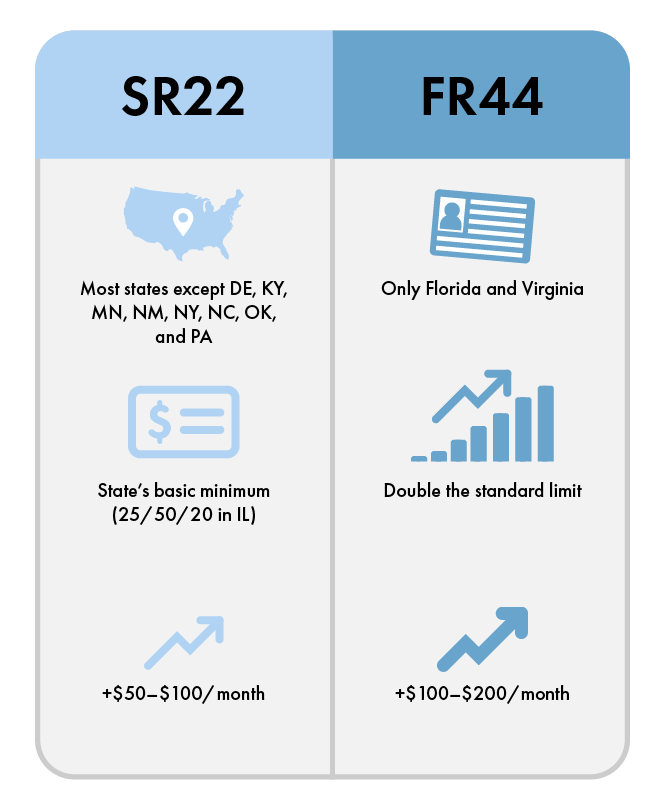
The key difference is the required coverage level: an SR-22 certifies state-minimum liability limits, while an FR-44 certifies elevated limits (100/300/50 in Florida and 100/200/50 in Virginia).
Florida's standard requirement is $10,000 in personal injury protection (PIP) and $10,000 in property damage liability. Florida has no general bodily injury liability requirement. The FR-44's 100/300/50 limits raise coverage far above what most Florida drivers carry. The higher required limits make an FR-44 more expensive than an SR-22.
FR-44 requirements in Florida and Virginia
FR-44 requirements differ between Florida and Virginia, the 2 states that use the certificate. Florida fixes the FR-44 limits in statute. Virginia sets the FR-44 limits at double the Virginia state minimum, so the Virginia FR-44 limits change whenever the Virginia base minimum changes. Insurers call these FR-44 limits high-risk coverage limits.
Florida FR-44 requirements
Florida requires 100/300/50 liability coverage for an FR-44: $100,000 in bodily injury liability per person, $300,000 per crash, and $50,000 in property damage liability. Fla. Stat. §324.023 sets these limits. A DUI conviction under Fla. Stat. §316.193 triggers the FR-44 requirement. The Florida Department of Highway Safety and Motor Vehicles (FLHSMV) requires the FR-44 for 3 years. The insurer files the FR-44 certificate electronically with FLHSMV. Florida also allows a $350,000 certificate of deposit in place of an FR-44 policy. Almost every driver uses an insurance policy instead.
Virginia FR-44 requirements
Virginia requires FR-44 limits that are double the SR-22 limits in Code of Virginia §46.2-472. For policies effective on or after January 1, 2025, the Virginia base minimum is 50/100/25, so the FR-44 limits are 100/200/50: $100,000 in bodily injury liability per person, $200,000 per accident, and $50,000 in property damage liability. The Virginia DMV requires an FR-44 after a conviction for driving under the influence of intoxicants or drugs, maiming while under the influence, or driving while the license is forfeited for a prior conviction. The doubling rule applies to convictions on or after January 1, 2008. Virginia drivers usually carry the FR-44 for 3 years.
What is an SR-22 Form?
An SR-22 is not a type of insurance, it is a certificate for high-risk drivers to prove they carry the minimum required liability insurance their state requires.
The SR-22 stays on file with their state's DMV for a period of time, usually three years, while their license is reinstated.
SR-22 certification is a nationwide practice because nearly every state requires drivers to carry liability insurance.
When Will You Need an SR-22 or FR-44?
You will need an SR-22 or FR-44 after a serious driving offense such as a DUI or DWI, driving uninsured, or driving on a suspended license, whenever the state requires proof of financial responsibility before restoring your driving privileges. These violations often lead to driver's license suspension and marks on a driving record.
These driving violations that lead to SR-22 requirements are listed below.
Driving under the influence (DUI)
Driving without insurance
Driving without a license
Several speeding tickets or traffic violations and reckless driving
Car insurance fraud
Cases of vehicular manslaughter
Can you get an FR-44 without a car?
Yes. A driver who does not own a vehicle buys a non-owner car insurance policy. The insurer files the FR-44 on the non-owner policy. The non-owner policy must still carry the FR-44 limits for the driver's state, because the state checks the coverage level, not vehicle ownership. Non-owner FR-44 coverage is the usual route for a driver whose license was suspended after a DUI and who needs the filing to reinstate the license before buying a vehicle. The same non-owner route exists for the SR-22 in every other state.
What is State Minimum Liability Coverage?
One last prerequisite to be aware of is how much the liability coverage requirements of your state are.
In most of the United States, drivers are required to carry auto insurance coverage that can pay for damages and injuries they cause to another driver in an at-fault accident.
This state mandatory liability insurance is often referred to as basic car insurance.
For example, according to the Virginia DMV, Virginia requires drivers to carry $50,000 in bodily injury liability coverage per person, $100,000 in bodily injury liability per accident, and $25,000 in property damage liability coverage per accident (50/100/25) as of January 1, 2025.
Check your state's Department of Motor Vehicles (DMV) website for more information on how much basic car insurance you must buy from auto insurance companies to drive legally.
What is The Process of Getting an SR-22 and FR-44?
The process is a three-way effort between you, your insurance provider, and your DMV. The steps below cover what to do and what to expect when filing an SR-22 or FR-44 certificate.
A violation that results in license suspension can be any of the violations listed in the previous section. The most common are driving uninsured or under the influence.
Insurance company may cancel auto insurance policy - In addition to a license suspension from the DMV, your car insurance provider may cancel your auto policy outright. At the very least, you can expect your auto insurance costs to rise significantly after something as serious as a DUI.
Purchase SR-22 insurance from an insurance company - You purchase SR-22 Insurance with your old insurance company or shop around for another. Insurance agents and companies specialize in high-risk driver coverage, so getting as many quotes as possible is best.
High-risk insurance is purchased, and SR-22 is filed with DMV. Your insurance provider will take it from here once you have a policy and an SR-22 certifying that you do. It may seem redundant, but it's necessary so that high-risk drivers don't commit fraud. The auto insurance company then files the SR-22 or FR-44 with the DMV.
DMV reinstates licenses, and SR-22 is required for up to three years. With the SR-22 on record, the DMV reinstates your license, given that you maintain your financial responsibility coverage and SR-22 for the next three years. During that time, the best you can do is to become a safer driver and pay your insurance premiums on time.
Is There a Different Process For FR-44 Filing than SR-22?
No. The FR-44 filing process in Florida and Virginia matches the SR-22 filing process in other states. The driver's license is suspended, they get new high-risk insurance along with an FR-44, then have it filed with the state's DMV.
The only practical difference is the coverage level the certificate proves. The FR-44 requirements in Florida and Virginia section above lists the limits and statutes for each state.
What Happens If Your SR-22 or FR-44 Lapses?
An SR-22 or FR-44 lapse restarts the filing requirement. Your insurer notifies the state when your policy lapses. The DMV then suspends your license again. You restart the full filing period from the beginning, usually 3 years. You may also owe a license reinstatement fee. Keep continuous coverage and pay your premium on time for the entire filing period to avoid a lapse.
When Can You Stop Filing an SR-22 or FR-44?
You can stop filing an SR-22 or FR-44 after you hold the filing continuously for the full required period, usually 3 years, with no lapses. Ask your insurer to remove the filing at that point. Do not cancel the filing yourself before the period ends, because an early lapse restarts the requirement and can suspend your license again. Your insurance rates often drop after the filing is removed, because your insurer no longer classifies you as a high-risk driver.
Does an SR-22 or FR-44 Increase Your Car Insurance Rates?
Yes. The violation behind the filing marks you as a high-risk driver, so insurers charge higher premiums for the same coverage. Those with a suspended license or DUI report an insurance average rate increase of around $500 for their coverage.
To put this in perspective, say you paid $570 annually for liability insurance coverage. After something like a DUI, your new annual premium will be around $1,150. At the same time, another cost for being issued an SR-22 or FR-44 is the license reinstatement fee that the state DMV charges.
When your coverage, policy, and SR-22 certification are filed, you'll be issued your license back after paying a reinstatement fee in the range of $145 to $220 according to the Virginia DMV.
The filing fee itself is small. Some insurers charge the filing fee again at each policy renewal while the certificate stays on file. The premium is the larger cost. Maintain a clean driving record and avoid insurance lapses to bring your rates back down.
SR-22 certification is similar to FR-44 certification. Both can just be equally as expensive, but it is required to have your driver's license reinstated.
How to Get Affordable SR-22 or FR-44 Insurance
Compare quotes from several insurers that write high-risk auto insurance. The filing fee itself is small, usually $15 to $25, so the real savings come from the underlying policy price. You can lower the underlying policy price with 3 steps:
Keep continuous coverage for the full filing period, because a lapse restarts the requirement.
Maintain a clean driving record from the conviction date forward.
Ask about defensive-driving or DUI-program discounts where insurers offer them.
Insurance Navy files SR-22 and FR-44 certificates and quotes high-risk coverage in minutes.
Ready for a Fast SR-22 or FR-44 Quote?
Get a Free Online Quote for Affordable Car Insurance, or visit one of our many convenient locations nationwide.