
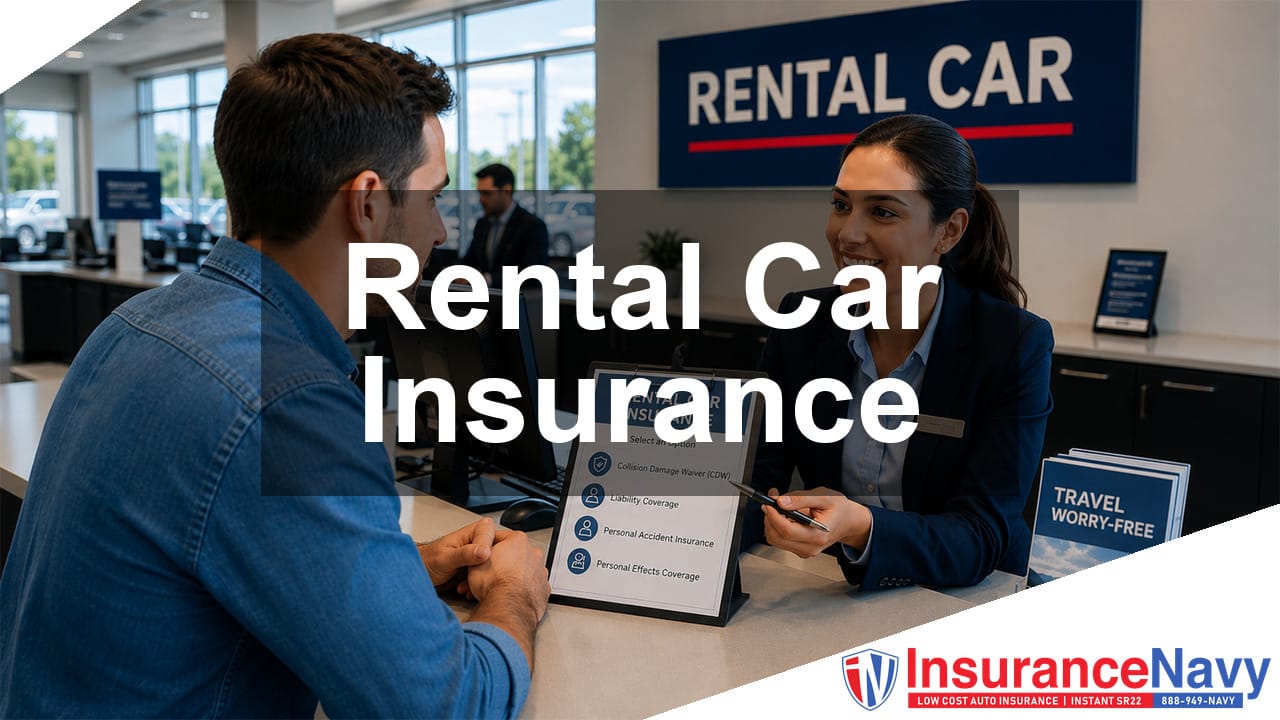
Rental car insurance is a set of optional coverages that rental companies sell at the counter. Rental car insurance includes a damage waiver, supplemental liability insurance, personal accident insurance, and personal effects coverage. Renters without coverage pay for rental car damage, theft, towing, and loss-of-use fees. U.S. car rental revenue totaled an estimated $40.6 billion in 2025, according to Auto Rental News. A personal auto policy, a credit card, or a standalone rental policy can replace the counter coverage. Renters need coverage, cost, and exclusion information to decide at the rental counter. Insurance Navy helps drivers find the right insurance at the right price. This guide explains rental car insurance sources, coverage types, daily costs, and exclusions.
Table of contents
- Does Your Car Insurance Cover Rental Cars?
- How Does Rental Car Insurance Work?
- Where Can You Get Rental Car Insurance?
- Your Personal Car Insurance Policy
- Credit Card Coverage
- The Rental Company's Policy
- A Standalone Rental Car Policy
- What Types of Rental Car Insurance Can You Buy?
- Supplemental Liability Insurance (SLI)
- Collision Damage Waiver (Loss Damage Waiver)
- Personal Accident Insurance
- Personal Effects Coverage
- Other Policies That May Pay After a Rental Car Accident
- Health Insurance
- Homeowners or Renters Insurance
- Travel Insurance
- What Coverage Can You Buy as a Frequent Renter?
- Non-Owner Car Insurance
- Rental Car Insurance vs. Rental Reimbursement
- How Much Does Rental Car Insurance Cost?
- When Should You Buy Rental Car Insurance?
- When Do You Not Need Rental Car Insurance?
- What Is Not Covered by Rental Car Insurance?
- Rental Car Insurance FAQ
- What insurance do I need when renting a car?
- Is it worth getting rental coverage on car insurance?
- Should you take out extra insurance when renting a car?
No. You do not have to buy the rental counter's coverage when your own auto policy, a credit card, or a standalone rental policy already covers the car you rent.
Rental car insurance is the group of optional protections a rental company sells at the counter: a damage waiver, supplemental liability insurance, personal accident insurance, and personal effects coverage. The Texas Department of Insurance says the damage waiver "isn't insurance." The damage waiver is an agreement that the rental agency won't charge you for damage to the car you rent.
Buy the counter coverage only when no policy or card you already hold covers the rental. Before you rent, ask your insurance agent whether you need the rental agency's liability policy and damage waiver.
Does Your Car Insurance Cover Rental Cars?
Yes, most personal auto policies cover accidents that happen while you drive a rental car, according to the Texas Department of Insurance. Your own policy may cover the rental under its liability, collision, and comprehensive coverages. Policy exclusions can limit that coverage. Ask your agent whether the policy covers a rental car you drive for work. If you use your own collision coverage, your collision deductible applies to the claim, the same as it does for your own car.
How Does Rental Car Insurance Work?
Your rental car coverage can come from 4 sources: your personal auto policy, your credit card, the rental company, or a standalone rental car policy. Each source pays for different costs. Check what each source covers before you reach the counter.
Where Can You Get Rental Car Insurance?
The 4 sources are:
Your Personal Car Insurance Policy
Your personal auto policy is the first source to check. When the policy covers the rental car, you can decline the counter's coverage, save the daily cost, and file any claim with an insurer you already know.
The rental car company's coverage is the right choice when your personal auto policy does not cover rental car accidents. Most personal auto policies cover you in other states and Canada, but not in Mexico, according to the Texas Department of Insurance. Check your policy before you rent in any other country.
A claim on your own policy for a rental car goes through your insurer's normal claim process for collision, property damage, or medical payments. Insurers often take longer to approve a claim for a car you do not own.
Credit Card Coverage
Many credit cards cover a rental car when you pay for the rental with the card. Most credit card rental benefits are secondary coverage, according to the III. Secondary coverage pays only after your own auto policy pays. Secondary coverage mostly pays the costs your policy leaves behind, such as your deductible. Primary coverage, where a card offers it, pays first, so you do not have to file a claim with your own insurer. Before you rely on a card, check whether the card requires you to pay for the whole rental with that card and to decline the counter's damage waiver.
Coverage details vary by card issuer. Most card benefits include theft and towing.
Card coverage typically lacks personal liability and medical payment coverage in a rental car collision. Credit card rental coverage caps collision damage payouts. Most credit cards cover rental car damage up to $50,000. Premium cards from Chase and Capital One cover rental car damage up to $75,000, according to CNN Underscored's 2026 review.
Most importantly, your credit card is best used as a coverage method during short rental periods. If your car rental is longer than two weeks, then you'll find your credit card may not be applicable.
There are also several exceptions regarding what the card company will cover. Certain credit cards may not cover luxury, exotic, or SUV cars.
American Express, Visa, and Mastercard offer rental car coverage on many of their cards. Mastercard provides rental car coverage through its MasterRental Coverage program. Mastercard includes this coverage on most World Mastercard and World Elite Mastercard cards, according to Capital One.
Credit card rental coverage excludes some countries. Many card issuers exclude Australia, Ireland, Israel, Italy, Jamaica, and New Zealand. American Express lists these six countries as excluded from its rental coverage, according to State Farm's 2026 guidance.
The Rental Company's Policy
The rental company sells its own coverage at the counter when you pick up the car. You can buy each coverage separately or as a package. See "When Should You Buy Rental Car Insurance?" below for the 4 cases where counter coverage is the best option.
A Standalone Rental Car Policy
Suppose you choose to opt out of the rental car insurance offered by the company. In that case, you can accept standalone auto insurance providers in the United States, like Allianz, Insure My Rental Car, and Bonzah. You can buy a standalone rental car policy before your trip. A standalone policy covers rental car damage up to a set limit. Bonzah covers rental car collision damage up to $35,000 per incident, according to Bonzah. Allianz Global Assistance covers rental car damage and theft up to $50,000 through its OneTrip Rental Car Protector plan, according to Allianz.
What Types of Rental Car Insurance Can You Buy?
Rental car companies sell 4 coverage types at the counter:
Supplemental Liability Insurance (SLI)
Supplemental liability insurance pays for injuries and property damage you cause to other people while you drive the rental. Supplemental liability insurance never pays for damage to the rental car itself. Rental companies must provide the state-required minimum amount of liability insurance, according to the Insurance Information Institute (III). Supplemental liability insurance is the extra liability coverage the counter sells on top of that minimum. The Texas Department of Insurance says you might not need the rental agency's liability policy when you drive a rental car for personal use, because your own auto policy may already cover you.
Collision Damage Waiver (Loss Damage Waiver)
A collision damage waiver (CDW), also called a loss damage waiver (LDW), is the rental company's agreement not to charge you when the rental car is damaged or stolen. The III says a waiver may also cover loss of use, towing, and administrative fees. Your own auto policy may not pay those fees. Rental companies use the CDW and LDW names differently. Read the rental agreement to see whether the waiver includes theft and loss of use. For prices and exclusions, see Insurance Navy's guide to the collision damage waiver.
Personal Accident Insurance
Personal accident insurance pays medical expenses for you and your passengers after an accident in the rental car. If your own auto policy includes personal injury protection (PIP) or medical payments coverage, that coverage may already pay these costs. PIP is mandatory only in no-fault states.
Personal Effects Coverage
Personal effects coverage pays for personal items and baggage stolen from your rental car or lost in a car theft. Some items are excluded, such as the cash in your wallet. Your homeowners or renters policy may already cover the same items (see "Homeowners or Renters Insurance" below).
Other Policies That May Pay After a Rental Car Accident
Other policies you already carry can pay some costs after a rental car accident. Neither health insurance nor homeowners or renters insurance pays for damage to the rental car itself.
Health Insurance
Health insurance pays your medical costs and those of the other people on your health plan. Health insurance does not pay for passengers outside your plan. The counter's personal accident insurance (above) covers those passengers.
Homeowners or Renters Insurance
Homeowners and renters insurance may cover belongings stolen from your rental car, minus your deductible. Check your policy's limits for property away from home.
Travel Insurance
Travel insurance bought for a trip may cover incidents involving rental cars. Check whether the policy is primary or secondary (see "Credit Card Coverage" above).
What Coverage Can You Buy as a Frequent Renter?
Non-owner car insurance is the option for frequent renters who have no auto policy, cannot use a credit card benefit, or decline the counter's coverage.
Non-Owner Car Insurance
Non-owner car insurance provides each state's minimum liability coverage. Non-owner car insurance costs between $200 and $500 per year on average, according to WalletHub's 2025 data. Non-owner insurance pays for injuries and damage you cause to other people. Non-owner insurance doesn't pay for your injuries or for damage to the car you're driving, according to the Texas Department of Insurance. Non-owner insurance can replace the counter's liability coverage, but not the damage waiver.
Rental Car Insurance vs. Rental Reimbursement
Rental car insurance and rental reimbursement are 2 different coverages. Rental car insurance protects you while you drive a rental car. Rental reimbursement is an add-on to your own auto policy that pays for a rental car while your car is in the shop.
The Texas Department of Insurance says rental reimbursement "pays for you to rent a car if yours is stolen or being repaired after an accident." Rental reimbursement does not pay for a rental during a mechanical breakdown or routine maintenance, because those events are not covered claims.
Rental reimbursement has a daily limit and a total limit. The NAIC gives the example of "$20 per day up to a total of $600." The III says the coverage is "available for a nominal extra amount with almost every auto insurance policy." See how towing and rental reimbursement coverage works on an Insurance Navy policy.
How Much Does Rental Car Insurance Cost?
The price of each rental car company's insurance policy varies depending on the type of vehicle and location. Supplemental liability insurance costs between $8 and $17 per day, according to Enterprise. A collision damage waiver costs between $15 and $42 per day for an economy vehicle, according to WalletHub's 2026 data.
Personal accident insurance costs less than the other coverage types. Personal accident insurance costs between $2.68 and $8.50 per day at Enterprise. Personal effects coverage costs between $5.99 and $15.67 per day at Enterprise, according to Enterprise. Getting rental car insurance can double your bill. An economy rental vehicle costs around $40 per day on average, according to 2026 industry estimates compiled by WalletHub.
A rental vehicle with full insurance from the rental counter costs between $70 and $90 per day, according to RentalCover.
Your total daily cost depends on the rental company and the location. Confirm the daily rate and the price of each coverage with the rental company when you book.
When Should You Buy Rental Car Insurance?
Buy the rental company's coverage in 4 cases: you have no auto policy, your policy or card doesn't cover rental cars, you rent outside the United States and Canada, or you keep the car longer than two weeks. Counter coverage also pays fees your own policy may not, such as loss of use, towing, and administrative fees, according to the III.
When Do You Not Need Rental Car Insurance?
Check your auto policy, your credit card benefits, and your homeowners or renters policy before you buy coverage from the rental company. You do not need the counter's coverage when one of those policies already covers the rental.
On a business trip, your employer's auto policy may cover the rental. Most personal auto policies exclude business driving (see "What Is Not Covered by Rental Car Insurance?" below).
Your need for rental car insurance depends on 4 things: the car you rent, where you rent it, how long you keep it, and the coverage you already have.
What Is Not Covered by Rental Car Insurance?
Every source of rental car coverage has exclusions. The rental agreement lists the rental company's exclusions. Read the agreement before you sign it.
Unlisted drivers: Coverage from the counter usually does not apply when a driver who is not on the rental agreement drives the car.
Impaired driving: Coverage usually does not apply when the driver is under the influence (DUI or DWI).
Business, ride-hailing, and delivery use: Most personal auto policies don't cover driving for business, for a ride-hailing service, or to deliver food or other items for a fee, according to the Texas Department of Insurance.
Mexico: Most personal auto policies stop at the border (see "Your Personal Car Insurance Policy" above).
Ask your insurance agent which of these exclusions apply to your policy before you rent.