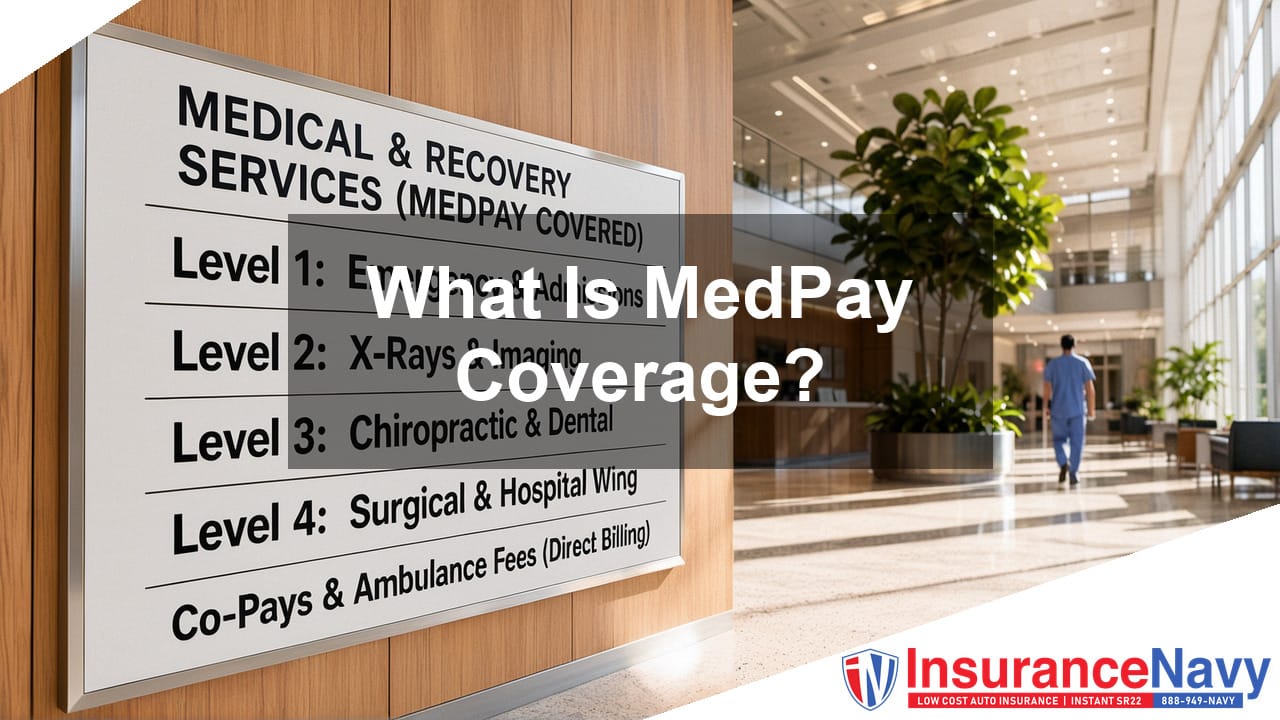
Medical payments coverage is a car insurance add-on that pays crash-related medical bills regardless of fault. Medical payments coverage applies to policyholders, family members, passengers, and pedestrians on many policies. Crash injuries create three main out-of-pocket costs: health insurance deductibles, ambulance fees, and funeral expenses. Traffic crashes injured approximately 2.42 million people across the United States in 2024, according to NHTSA. A liability-only auto policy excludes the policyholder's own medical bills. Maine, New Hampshire, and Pennsylvania require drivers to carry medical payments coverage. Insurance Navy helps drivers find the right insurance at the right price. This guide explains medical payments coverage costs, limits, exclusions, claims, and state requirements.
Table of contents
- What Is Medical Payments Coverage on Auto Insurance?
- What Does Medical Payments Insurance Cover?
- What Does Medical Payments Coverage Not Cover?
- How Does a MedPay Claim Work?
- MedPay vs PIP: What Is the Difference?
- How Much Does Medical Payments Coverage Cost?
- How Much Medical Payments Coverage Do I Need?
- Is Medical Payments Coverage Worth It?
- What States Require Medical Payments Coverage?
- What are the Limits on Medical Payments Coverage?
- Does Auto Insurance Pay for Medical Expenses?
What Is Medical Payments Coverage on Auto Insurance?
Medical payments coverage (MedPay) is a car insurance coverage option that pays medical and funeral bills for you, your passengers, and your family members after a crash, no matter who caused the crash.
MedPay is an add-on to a car insurance policy. Most states make MedPay optional, and 3 states require MedPay.
Insurance stacking is a policy option that combines the MedPay limits of each car on a policy. Some states and insurers allow stacking. Ask your insurance agent whether your policy allows stacking.
A policy that allows stacking and carries a $5,000 MedPay limit on each of 2 cars has a total MedPay limit of $10,000.
While Medical Payments coverage can cover you in ways health insurance might not, Med Pay shouldn't be used as a health insurance substitute.
What Does Medical Payments Insurance Cover?
MedPay pays crash-related medical and funeral expenses up to the MedPay limit you choose.
Who MedPay covers:
You and the members of your family on your policy
Passengers in your car
You when you ride in someone else’s car, or when you walk or bike
Pedestrians, on many policies
There are some additional medical costs like ambulance fees and x-rays that medical payments insurance pays for and regular health insurance plans won't. Specific things that this insurance coverage will pay for is listed below.
Personal injury treatment - More specifically, the types of personal injury treatment that Medical Payments coverage includes are medical, dental, surgical, and chiropractic in the event of a motor vehicle accident.
Health insurance co-pays - Medical payment coverage can work with health insurance claims by covering out-of-pocket medical expenses. This would be especially handy if your Medical Payments coverage limits are higher than your health insurance limits.
Additional hospital fees - X-rays, prostheses, doctor visits, hospital visits, and nursing are more forms of medical treatment covered by medical payments coverage or Med Pay.
Funeral costs - MedPay pays funeral expenses up to the MedPay limit when a covered person dies in a crash.
What Does Medical Payments Coverage Not Cover?
MedPay does not pay lost wages, car repairs, injuries you cause to other people, medical bills above your MedPay limit, or medical bills past a state time limit.
Lost wages and household services: Personal injury protection (PIP) pays lost wages in the states that offer PIP.
Car repairs: Collision coverage pays to repair your car after a crash.
Injuries you cause to other people: Bodily injury liability coverage pays for those injuries.
Medical costs past a state time limit: Maine and New Hampshire limit required MedPay to medical costs incurred within a set period after the injury.
How Does a MedPay Claim Work?
A MedPay claim is a request to your own insurer to pay your crash-related medical bills. The MedPay claim process has 4 steps:
Report the crash to your insurer and request MedPay coverage for your medical bills.
Keep every medical bill, plus every funeral bill if a covered person died, and send copies to your insurer.
Your insurer pays covered bills up to your MedPay limit.
Tell your insurer about any health insurance you carry. MedPay does not pay twice for the same bill.
MedPay vs PIP: What Is the Difference?
MedPay and PIP differ in scope. MedPay pays medical and funeral bills only. PIP pays medical bills, lost wages, and other related expenses.
Feature | MedPay | PIP |
|---|---|---|
Medical bills | Yes | Yes |
Funeral costs | Yes | Yes, in no-fault states |
Lost wages | No | Yes |
Pays no matter who caused the crash | Yes | Yes |
Where it is required | Maine, New Hampshire, Pennsylvania | The 12 no-fault states, plus add-on states such as Oregon and Delaware |
PIP is mandatory in the 12 no-fault states: Florida, Hawaii, Kansas, Kentucky, Massachusetts, Michigan, Minnesota, New Jersey, New York, North Dakota, Pennsylvania, and Utah. Kentucky, New Jersey, and Pennsylvania are “choice” states. Drivers in choice states pick a no-fault option or a traditional tort option.
How Much Does Medical Payments Coverage Cost?
MedPay costs $3 to $7 per month in states like California, Ohio, and Texas. MedPay at that price adds $36 to $84 per year to a car insurance policy.
Another significant part of medical payments coverage is how little it costs to increase your Med-Pay coverage limits. The standard levels of Med Pay coverage most drivers choose are $1,000 and $5,000.
However, some increase their Med-Pay coverage limits to $10,000 or even $100,000 if they have limited health insurance.
No government agency publishes an average price for MedPay alone. The National Association of Insurance Commissioners (NAIC) counts medical payments premiums inside its liability premium figures. A driver can price a higher MedPay limit by requesting quotes at 2 limits, such as $2,000 and $10,000.
How Much Medical Payments Coverage Do I Need?
You need enough MedPay to pay at least your health insurance deductible. Most health insurance plans make you pay a deductible or co-insurance before the plan pays in full.
First, look at your budget to see how much you can afford to put towards MedPay coverage. When comparing policies pay attention to these coverage limits:
Per person coverage limits: The most your insurer will pay for medical expenses for each injured person involved in the accident.
Per accident coverage limits: The total your insurer will pay for all medical expenses from one accident.
Know Your State’s Laws - Your state’s fault designation affects the need and value of MedPay:
At-fault states: The driver who causes the accident is liable for all damages. MedPay can add extra protection with medical expense coverage regardless of fault.
No-fault insurance states: Each driver’s insurance covers their own medical expenses, regardless of fault. In these states PIP is mandatory and MedPay is less comprehensive than PIP so MedPay may not be necessary.
If you live in a no-fault state, carrying MedPay with mandatory PIP may result in duplicate coverage and extra cost. In an at-fault state MedPay can be a valuable layer of protection.
To make sure you get the right amount of coverage, talk to an insurance agent. They can help you based on your financial situation, state laws and existing coverage.
Is Medical Payments Coverage Worth It?
Yes, MedPay is worth buying for 3 groups of drivers: drivers with limited health insurance or high co-pays, drivers with no health insurance, and drivers who often carry passengers. MedPay adds less value in no-fault states, where PIP is mandatory.
What States Require Medical Payments Coverage?
Maine, New Hampshire, and Pennsylvania require medical payments coverage on auto liability policies. MedPay is an optional add-on in most other states.
State | Required MedPay | Who it covers | Time limit on medical costs | Law |
|---|---|---|---|---|
Maine | $2,000 per person | The driver and passengers in the insured vehicle | Costs incurred within 1 year of the injury | 29-A M.R.S. § 1605-A |
New Hampshire | $1,000 per person | The driver and passengers in the insured vehicle | Costs incurred within 3 years of the injury | RSA 264:16 |
Pennsylvania | $5,000 medical benefit | Included in every auto liability policy | Not stated in § 1711 | 75 Pa.C.S. § 1711(a) |
New Hampshire: New Hampshire has no compulsory auto insurance law. Every auto liability policy sold in New Hampshire must still include MedPay. New Hampshire law lets the policyholder claim medical bills under MedPay, health insurance, or both. Health insurers in New Hampshire cannot coordinate benefits against MedPay.
Pennsylvania: Pennsylvania law calls this coverage a first-party “medical benefit.”
Oregon, Minnesota, and North Dakota: These 3 states require PIP.
Texas: Texas includes $2,500 of PIP in every auto policy unless the policyholder rejects PIP in writing. MedPay is optional in Texas. Texas drivers can carry MedPay with PIP or instead of PIP.
What are the Limits on Medical Payments Coverage?
Your MedPay limit is the maximum amount your insurance company will pay per person, per accident for medical expenses.
These limits are discussed when you first enroll and you have various coverage options to choose from. Make sure you choose the right limit because you will be responsible for any medical bills above your chosen limit.
Does Auto Insurance Pay for Medical Expenses?
No, liability auto insurance does not pay your own medical bills. Liability auto insurance which is required in most states includes property damage liability and bodily injury liability coverage to the other party if you are at fault in an accident.
Your passengers’ claims against your bodily injury liability coverage after a crash you cause depend on your state and your policy.
To make sure medical expenses for you and your passengers are covered, consider adding MedPay to your auto insurance policy.
Are you looking for cheap auto insurance? Insurance Navy can help you find the lowest rates!
Insurance Navy provides options for auto insurance policies that make being covered simple and affordable. Call us at 888-949-6289 for free cheap car insurance quotes today. Quotes are also available online via our website and mobile app.