A car insurance card is a proof-of-insurance document that confirms an active auto policy for one covered vehicle. Each car insurance card lists the policyholder, policy number, policy dates, insurer, and vehicle identification number. Drivers without proof of insurance face three main risks at a traffic stop: fines, vehicle impoundment, and license suspension. According to the Federal Highway Administration, registered motor vehicles in the U.S. totaled 297,525,836 in 2024. Insurers issue one car insurance card per covered vehicle. Most states require drivers to show proof of insurance at registration, after accidents, and during traffic stops. Insurance Navy helps drivers find the right insurance at the right price. This guide explains car insurance card details, digital card rules, traffic stop penalties, and replacement steps.
Table of contents
- What Is a Car Insurance Card, and Why Does It Matter?
- What Details Are on Your Proof of Insurance ID Card?
- When Must You Show Proof of Coverage?
- Common Myths About Car Insurance Cards
- How to Add a Digital Car Insurance Card to Your Phone's Wallet
- Can the Officer Look Through Your Phone When You Show a Digital Card?
- What Happens If you Can't Provide Proof of Coverage During a Traffic Stop?
- How Do You Get a Car Insurance Card, Digital or Physical?
- What Should You Do if You Lose Your Proof of Coverage?
- Car Insurance Card FAQs
- Is Registration the Same Thing as Proof of Insurance?
- Can You Use a Picture of Your Insurance Card If the Police Pull You Over?
- Can You Print an Insurance Card Online?
- Do You Need To Show Proof of Insurance to Another Driver in an Accident?
A car insurance card is the document your insurer issues to prove your vehicle carries an active auto insurance policy. It lists the policyholder, the covered vehicle's VIN, the policy number and the policy's effective and expiration dates.
You need the card at a traffic stop, after an accident, when you register a vehicle, and when you rent a car.
What Is a Car Insurance Card, and Why Does It Matter?
A car insurance card is also called a proof of insurance card or an insurance ID card. Your insurer issues 1 card for each covered vehicle on the policy. Illinois caps a card's effective-to-expiration span at 12 months by statute.
Just as you’d need a certificate of insurance for a business, you must also have a proof of insurance card for your car. It’s against the law to drive without an active auto insurance policy in Illinois and other states.
There are two types of proof of insurance you can get: a physical card and a digital document. Here are the differences:
Physical card: Your insurance company will mail you this card within a few days of buying or updating a policy. The card may be paper or plastic. You can usually download and print a temporary card to use until your new card arrives.
Electronic card: Most insurers let you open a digital insurance card in their mobile app or from your online account on a phone or tablet. Forty-nine states, as well as Washington, D.C., permit you to show an electronic proof of insurance. New Mexico is the only exception.
It’s important to always carry your proof of insurance with you when driving. Your current declarations page usually won’t serve as proof of insurance in most states. Neither will insurance payment receipts.
What Details Are on Your Proof of Insurance ID Card?
A car insurance card shows 5 details:
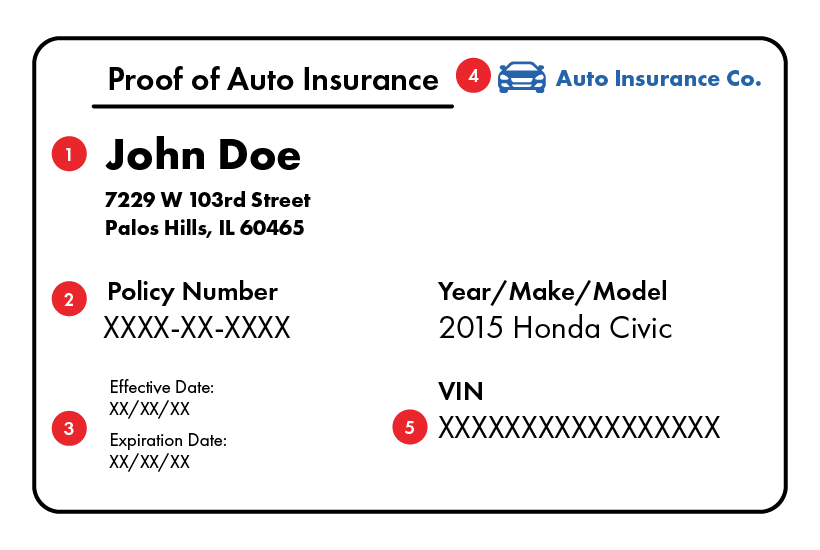
Name and contact details: This is the name and contact information for the policyholder. If that’s not you, the card might show your name as a covered driver.
Policy number: You must provide this number if you ever need to make an insurance claim.
Policy dates: The date your card was issued, as well as its expiration date.
Insurance company details: The name and phone number of your insurance company.
Vehicle information: Your car’s year, make, and unique Vehicle Identification Number (VIN).
When Must You Show Proof of Coverage?
You must show your car insurance card in 4 situations:
Vehicle registration: Most states ask you to show proof of insurance when registering a vehicle.
Car accidents: After a car accident, you’ll have to exchange insurance information with the other driver. Without this information, you won’t be able to file a claim.
Traffic stops: Police will usually ask for your driver’s license, registration, and proof of insurance during traffic stops with law enforcement. You may receive a ticket if you don’t have this information. Additionally, a police officer could have your car impounded, and you may face license suspension if you fail to show evidence of insurance.
Renting a car: You’ll usually need to show that you have insurance to rent a vehicle. This is so the rental company knows you’re covered if you have an accident. Some rental car companies will sell you temporary insurance while driving one of their vehicles. This auto insurance liability coverage protects you from having to pay for damages if you have an accident.
In Illinois, a card in the glove box is not the only check. The Secretary of State's electronic verification system, ILIVS, confirms every vehicle's liability policy with the insurer at least twice a year. If a check fails twice, the state mails a suspension letter. The owner then has 30 days to prove coverage. If the owner does not prove coverage in 30 days, the state suspends the plates and charges a $100 reinstatement fee. The card still matters at a traffic stop, because officers check the card, not ILIVS. Illinois law lists what counts as evidence: the insurer's card, a declarations page, a rental agreement, or an image on your phone. Illinois law also requires you to physically hand the evidence to a uniformed officer on request. See how ILIVS electronic verification works.
Common Myths About Car Insurance Cards
Here are some of the most common myths about proof of insurance:
Myth: Your proof of insurance always updates automatically after a policy change. Fact: You may need to request a new card after changing your policy.
Myth: You can use your policy document as proof of insurance. Fact: Your policy document isn’t sufficient for proof of insurance coverage. You’ll need a physical or electronic proof of insurance card.
Myth: An electronic copy of your insurance card isn’t good enough. Fact: Most states accept digital insurance cards and photos of your insurance card.
How to Add a Digital Car Insurance Card to Your Phone's Wallet
Save your digital car insurance card to your phone's wallet from your carrier's mobile app. The saved card loads without a cell signal. Most major carriers' apps support Apple Wallet. Google Wallet support depends on the carrier.
iPhone (Apple Wallet)
Install your insurance carrier's app and sign in.
Open your ID card.
Tap Add to Apple Wallet.
Preview the card, then tap Add in the top right corner.
Android (Google Wallet)
Open your carrier's app and go to your policy ID card.
Tap Add to Google Wallet. Older apps label the button "Save to Google Pay". The function is the same.
Can the Officer Look Through Your Phone When You Show a Digital Card?
In 4 of the 6 states Insurance Navy serves, the law says no. Illinois, Texas, California, and Nevada each state that handing over an electronic insurance card is not consent for the officer to look at anything else on the device. California limits the officer to viewing only the proof of insurance. California also places the risk of damage to the phone on the driver while the phone is in the officer's hands. Illinois takes the opposite position on damage and makes the officer immune. Georgia and Indiana accept a digital card but have no privacy clause, so nothing in the insurance law limits what an officer may view. The safest habit in every state is to open the card before you hand the phone over and to lock the rest of the screen.
State | Digital card accepted at a stop | Phone-privacy clause |
|---|---|---|
Illinois | Yes (625 ILCS 5/7-602) | Yes; officer immune from device damage |
Texas | Yes (Transp. Code 601.053) | Yes |
California | Yes (Vehicle Code 16028) | Yes; view-only, driver bears device risk |
Nevada | Yes (NRS 485.187) | Yes |
Georgia | Yes (O.C.G.A. 40-6-10) | No |
Indiana | Yes (IC 9-25-4-7) | No |
What Happens If you Can't Provide Proof of Coverage During a Traffic Stop?
Most states ticket a driver who cannot show proof of insurance at a traffic stop. Illinois, Texas, and Nevada charge the stop as driving uninsured until you prove coverage in court. Other states write a separate ticket for failure to provide proof of financial responsibility. An active policy does not cancel the ticket by itself. The penalties are listed below.
Ticket and fines. The fine depends on the state:
In Illinois, refusing to hand over your card when an officer asks is charged as driving uninsured. The fine is more than $500 and up to $1,000. The charge fails if you show the court you were insured at the time of the stop. If you were not insured at the stop but hold a policy by your court date, a first offense drops to a $100 fine with court supervision.
In Texas the first offense is a $175-$350 fine. Texas treats a stop without proof as driving without financial responsibility. Under Transportation Code 601.053, the officer must check the TexasSure database before writing the ticket, and the court dismisses the charge when you later show you were insured on the day of the stop.
In California the base fine is $100-$200 for a first offense under Vehicle Code 16029. The court adds state and county penalty assessments on top of the base fine.
In Georgia, driving without proof of coverage is a misdemeanor with a $200 to $1,000 fine. If you show the court you were insured when you were cited, the court caps the fine at $25 and sends nothing to your driving record. Georgia officers also check the state's insurance database at every stop. A lapsed policy shows up in the database even if you hand over a card.
In Nevada, driving without your evidence of insurance in the car, or refusing to surrender the evidence, carries a $600 to $1,000 fine per violation. The court cannot convict you if you show the insurance was in effect when the officer asked. A first offense drops to $100 if you buy a policy before sentencing.
Indiana has no roadside ticket for a missing card. If an officer asks and you cannot produce proof, the BMV sends a request and your insurer files a Certificate of Compliance electronically. Driving with no coverage at all is a Class A infraction with a 90-day to 1-year license suspension.
In Tennessee the fine is up to $300. The court dismisses a first violation without court costs if you prove you were insured at the time.
In New York City, the Traffic Violations Bureau charges $138 for failing to present your insurance card, with no points.
Having your car towed. In Tennessee they've been allowed to tow the car right there on the spot since 2016. In California a judge can decide to have the car towed "for good cause" after a conviction under VC § 16029(c)(1). Having the car towed and then having to pay for the storage is very costly before you can get your car back.
Extra court fees. If you can later sort out the insurance paperwork in court and prove that it was active on the day you got the ticket then the ticket is usually dismissed. You could be responsible for a dismissal fee. Florida clerks may charge up to $10. California dismisses the citation at no charge once you file written proof with the court clerk, in person or by mail.
How Do You Get a Car Insurance Card, Digital or Physical?
You get a car insurance card from your insurer, never from the DMV. A digital copy is available immediately in the carrier's mobile app or online account. Insurers issue a new card at 3 moments:
After a policy purchase: The carrier issues the first card when the policy starts.
At renewal: The carrier issues a new card for each covered vehicle at every renewal, so the dates on the card match the current policy period.
Policy changes: If you add a new driver or car to your policy, the insurance provider will typically send you a new auto insurance card.
What Should You Do if You Lose Your Proof of Coverage?
If you lose your card, download a replacement from your insurer's mobile app or online account and print it. Then call your insurance agent for a new mailed card. The new card arrives in a few days at no charge.
Tell your agent about any policy changes on the same call.
Keep the printed copy in your glove compartment until the mailed card arrives.