
Hot Shot Trucking Insurance: Costs, Types of Coverage, Costs, Liability limits
Hot shot trucking insurance protects owner-operators and small carriers from financial losses. This commercial insurance policy covers vehicles, cargo, and liability claims. Insurance Navy helps hot shot truckers find tailored commercial policies. According to the American Transportation Research Institute (ATRI), insurance premiums hit a record $0.102 per mile in 2024. This guide answers every critical question about hot shot trucking insurance. You will find cost data, coverage types, FMCSA requirements, and FAQs here. Read on to protect your trucking business effectively.
What is hot shot trucking insurance?
Hot shot trucking insurance is a commercial auto insurance policy for truckers hauling time-sensitive freight. Truck drivers typically use Class 3–5 trucks like a GMC Sierra 3500, Ford F-350, or Ram 3500. These Class 4 trucks and Class 5 trucks vehicles include gooseneck fifth wheel pickups and bumper pull trailers. Pick-up trucks are still the most common vehicles used in hotshot operations. Heavy equipment, cars, livestock, and RVs are the most common cargo types.
| Coverage Component | Description | Who It Protects |
|---|---|---|
| Primary Liability | Covers bodily injury and property damage | Third parties injured in an accident |
| Motor Truck Cargo | Covers freight lost or damaged in transit | Shipper and carrier |
| Physical Damage | Covers truck and trailer damage | Owner-operator's equipment |
| General Liability | Covers slip-and-fall injury and property damage | Clients and the public |
Hot shot insurance differs from standard commercial truck insurance. A single owner operator can get a quote online in a simple process. No two insurance policies are exactly alike, so carefully compare coverage options before buying.
What are the costs of hot shot trucking insurance?
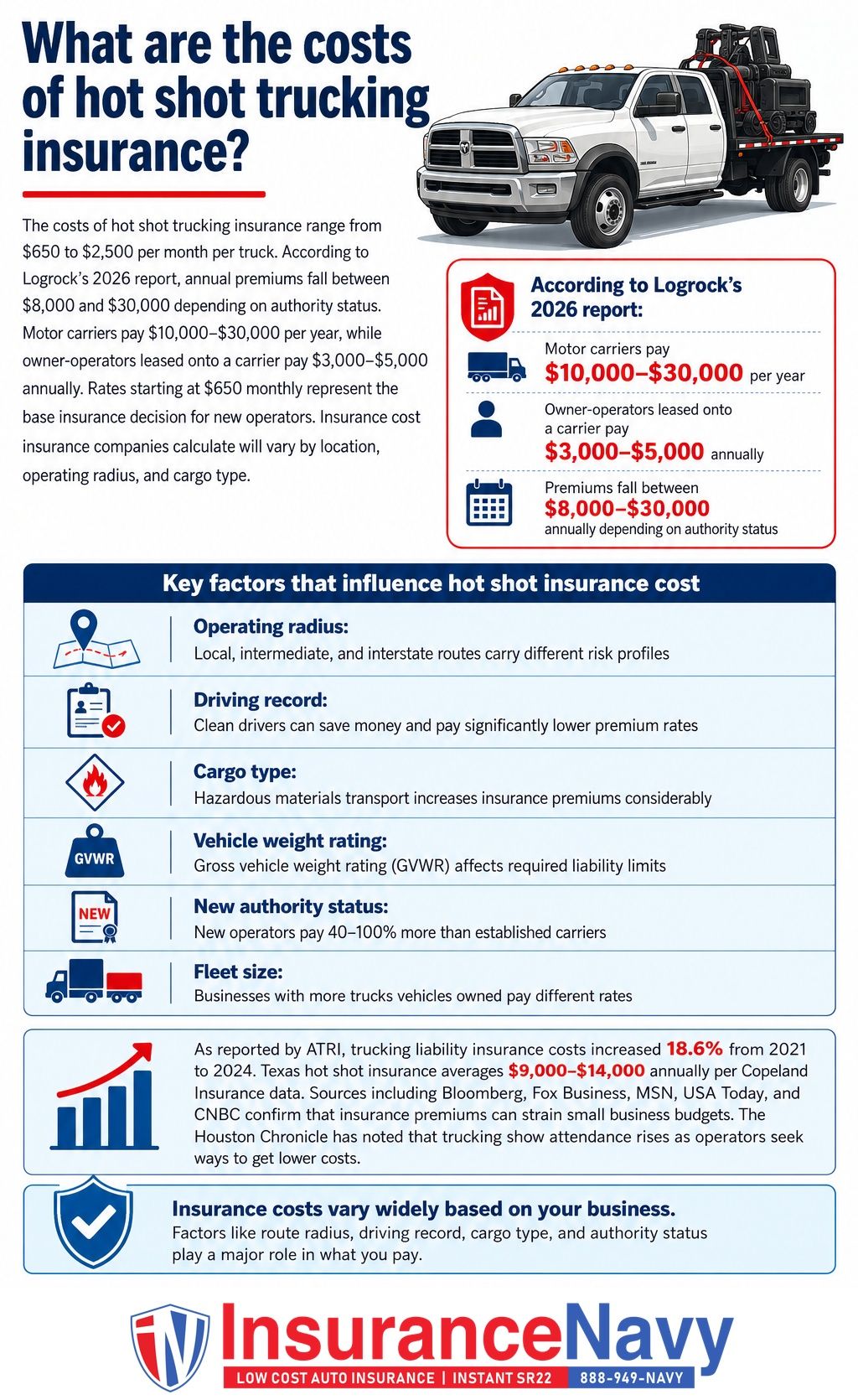
The costs of hot shot trucking insurance range from $650 to $2,500 per month per truck. According to Logrock's 2026 report, annual premiums fall between $8,000 and $30,000 depending on authority status. Motor carriers pay $10,000–$30,000 per year, while owner-operators leased onto a carrier pay $3,000–$5,000 annually. Rates starting at $650 monthly represent the base insurance decision for new operators. Insurance cost insurance companies calculate will vary by location, operating radius, and cargo type.
Key factors that influence hot shot insurance cost include:
Operating radius: Local, intermediate, and interstate routes carry different risk profiles
Driving record: Clean drivers can save money and pay significantly lower premium rates
Cargo type: Hazardous materials transport increases insurance premiums considerably
Vehicle weight rating: Gross vehicle weight rating (GVWR) affects required liability limits
New authority status: New operators pay 40–100% more than established carriers
Fleet size: Businesses with more trucks vehicles owned pay different rates
As reported by ATRI, trucking liability insurance costs increased 18.6% from 2021 to 2024. Texas hot shot insurance averages $9,000–$14,000 annually per Copeland Insurance data. Sources including Bloomberg, Fox Business, MSN, USA Today, and CNBC confirm that insurance premiums can strain small business budgets. The Houston Chronicle has noted that trucking show attendance rises as operators seek ways to get lower costs.
What are the Types of Coverage for hot shot trucking insurance?
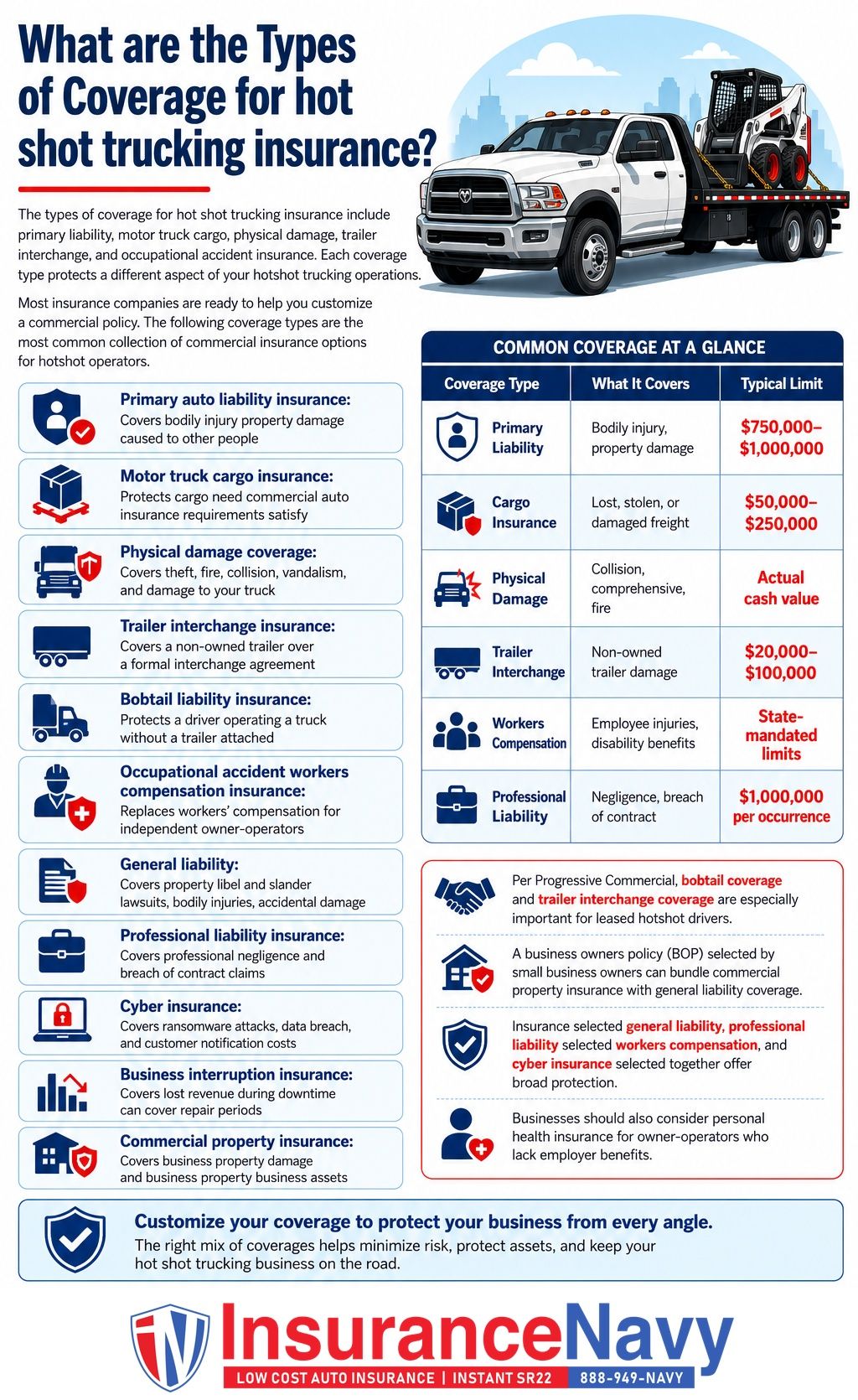
The types of coverage for hot shot trucking insurance include primary liability, motor truck cargo, physical damage, trailer interchange, and occupational accident insurance. Each coverage type protects a different aspect of your hotshot trucking operations. Most insurance companies are ready to help you customize a commercial policy. The following coverage types are the most common collection of commercial insurance options for hotshot operators.
Primary auto liability insurance: Covers bodily injury property damage caused to other people
Motor truck cargo insurance: Protects cargo need commercial auto insurance requirements satisfy
Physical damage coverage: Covers theft, fire, collision, vandalism, and damage to your truck
Trailer interchange insurance: Covers a non-owned trailer over a formal interchange agreement
Bobtail liability insurance: Protects a driver operating a truck without a trailer attached
Occupational accident workers compensation insurance: Replaces workers' compensation for independent owner-operators
General liability: Covers property libel and slander lawsuits, bodily injuries, accidental damage
Professional liability insurance: Covers professional negligence and breach of contract claims
Cyber insurance: Covers ransomware attacks, data breach, and customer notification costs
Business interruption insurance: Covers lost revenue during downtime can cover repair periods
Commercial property insurance: Covers business property damage and business property business assets
| Coverage Type | What It Covers | Typical Limit |
|---|---|---|
| Primary Liability | Bodily injury, property damage | $750,000–$1,000,000 |
| Cargo Insurance | Lost, stolen, or damaged freight | $50,000–$250,000 |
| Physical Damage | Collision, comprehensive, fire | Actual cash value |
| Trailer Interchange | Non-owned trailer damage | $20,000–$100,000 |
| Workers Compensation | Employee injuries, disability benefits | State-mandated limits |
| Professional Liability | Negligence, breach of contract | $1,000,000 per occurrence |
Per Progressive Commercial, bobtail coverage and trailer interchange coverage are especially important for leased hotshot drivers. A business owners policy (BOP) selected by small business owners can bundle commercial property insurance with general liability coverage. Insurance selected general liability, professional liability selected workers compensation, and cyber insurance selected together offer broad protection. Businesses should also consider personal health insurance for owner-operators who lack employer benefits.
What are the Liability Limits of hot shot trucking insurance?
The liability limits of hot shot trucking insurance start at $750,000 for interstate general freight carriers. The Federal Motor Carrier Safety Administration (FMCSA) regulations mandate $750,000 minimum primary liability coverage for vehicles weighing over 10,001 lbs. Hazardous materials transport requires $5,000,000 in liability coverage. A trucking company outside these limits cannot legally operate interstate.
Most freight brokers still require higher limits before tendering loads. Standard broker requirements include:
Auto liability: $1,000,000 minimum per occurrence for most freight brokers
Cargo insurance: $100,000 minimum, though some freight require cargo insurance motor truck limits of $250,000
General liability: $1,000,000 per occurrence recommended for all lines of coverage
Hazardous materials coverage: $5,000,000 liability limit required by federal law
Uninsured motorist: Liability uninsured motorist coverage protects drivers safe from underinsured parties
As noted by Logrock, New Jersey raised its state minimum liability to $1.5 million as of July 1, 2024. Texas, Oklahoma, and other states may follow this trend, raising insurance requirements for hot shot truckers nationwide. Carriers transporting auto haulers and car carrier loads must carry $1,000,000 in primary liability coverage. Hotshot truckers should carry primary liability insurance at a minimum that exceeds the federal minimum to satisfy broker contracts. Conditions vary state to state, so consult a licensed insurance agent for state-level requirements.
What are the benefits of hot shot trucking insurance?
The benefits of hot shot trucking insurance include financial protection, regulatory compliance, and business continuity. This commercial insurance policy protects your trucks, trailers, and revenue simultaneously. According to ATRI, the median nuclear verdict in trucking reached $36 million in 2022. Adequate liability insurance is the best choice for all hotshot drivers who want to protect their business.
| Benefit | How It Helps Your Business |
|---|---|
| Liability Protection | Pays bodily injury and property damage claims |
| Cargo Coverage | Reimburses lost income from damaged or covered cargo loss |
| Physical Damage Coverage | Funds truck and trailer repair costs |
| Downtime Coverage | Covers lost revenue; downtime can cover wages during repair |
| FMCSA Compliance | Enables legal interstate trucking operations |
| Accident Rental Reimbursement | Provides a replacement vehicle for a short period |
Hot shot insurance satisfies DOT number interstate trucking filing requirements. Workers' compensation insurance and occupational accident insurance protect employees injured while working. A BOP selected option can combine general liability, commercial property insurance, and business interruption insurance. These combined benefits make hot shot trucking insurance a smart business investment. Trucking can still operate profitably when the right insurance coverage is in place.
What cargo types affect hot shot trucking insurance rates?
The cargo types that affect hot shot trucking insurance rates include hazardous materials, oil pipeline equipment, construction equipment, and livestock. Insurers view certain commodities as higher-risk freight requiring elevated cargo insurance premiums. Hazardous materials are among the costliest cargo to insure, and oil rig operation equipment requires specialized policies. Some hot shot truckers specialize in deliveries of oversized or time-sensitive loads for a quick turnaround.
High-risk cargo categories that raise insurance premiums:
Hazardous materials: Oil, chemicals, and dangerous cargo trigger surcharges and special endorsements
Oil rig equipment: Entire oil rig components require specialized cargo coverage; days of oil exploration in Texas drive demand
Livestock: Animals need specific cargo insurance endorsements; fifth wheel livestock transport adds complexity
Heavy construction equipment: High-value loads increase cargo limit requirements considerably
Oversized loads: Wide or tall freight raises accident risk and premiums significantly
Tractor trailers and car carrier loads: Haulers car carrier operations face unique liability exposures
| Cargo Type | Risk Level | Coverage Impact |
|---|---|---|
| General Freight | Low | Standard cargo rates apply |
| Oil Pipeline Equipment | High | Surcharge + higher limits required |
| Hazardous Materials | Very High | $5M liability + endorsement required |
| Livestock/RVs | Medium | Specialty cargo policy needed |
Standard freight like construction materials carries lower rates. Hotshot truckers hauling oil or hazardous materials pay considerably more per policy term. Some freight brokers still require a certificate of insurance before a load is dispatched. Cargo insurance motor truck policies also protect against covered cargo loss due to vandalism, theft, fire, and collision coverage events.
Does hot shot trucking insurance require FMCSA compliance?
Yes, hot shot trucking insurance requires FMCSA compliance for all interstate motor carrier operations. The Federal Motor Carrier Safety Administration FMCSA requires carriers to file an MCS-90 endorsement proving minimum liability coverage. FMCSA have indicated that as of October 1, 2025, operating authority ties to USDOT numbers rather than MC numbers. Truckers operating vehicles across state lines must obtain a DOT number interstate trucking authority before hauling freight. A motor carrier can still do business after this transition by updating their DOT number at the state level.
FMCSA compliance requirements for hotshot truckers include:
USDOT number: Required for all interstate commercial trucking operations; need a DOT number before operating
Operating authority: Previously an MC number, now tied to your DOT number for transport authority
MCS-90 endorsement: Proves primary liability general coverage meets federal minimums
BMC-34 filing: Required for cargo insurance on household goods carriers; company must file this form
DOT medical card: Mandatory for drivers operating vehicles with GVWR over 10,000 lbs
Revenue reporting form: Required for certain motor carrier compliance filings
Commercial Driver's License (CDL): A CDL driver is required when GVWR exceeds 26,001 lbs
A commercial driver's license CDL is not always required for hotshot operations. Hot shot trucks liability and CDL insurance requirements depend on truck class and weight. Truckers federal regulations also require logging devices such as electronic logging device (ELD) compliance. A licensed agent can help you complete a free application and schedule a call with a Colonial Insurance Services expert agent for professional support.
What deductible should I choose for hot shot trucking insurance?
The deductible you should choose for hot shot trucking insurance depends on your cash reserves and risk tolerance. Higher deductibles will result in lower insurance premiums but increase out-of-pocket costs after a covered incident. As reported by ATRI, physical damage coverage costs jumped 14.9% in 2024. Payments and fees associated with higher deductibles can strain a business during early days of operation.
Consider these deductible factors before making a decision:
Physical damage deductible: Typically ranges from $1,000 to $5,000 per claim
Cargo insurance deductible: Usually set between $500 and $2,500 per loss event
Loan or lease gap coverage: Lenders may require a maximum deductible; carefully compare loan best options
Cash flow stability: Lower
Get a quote for hot shot trucking
We compare quotes for hot shot trucking across trusted insurance companies. Contact Insurance Navy today for a fast, accurate insurance quote built around your hot shot trucking business.