
Switching car insurance companies takes nine steps: review your current policy, get quotes from multiple insurers, weigh cancellation fees against new discounts, buy the new policy, notify your lender, obtain your proof of insurance card, cancel the old policy, confirm the cancellation and refund, and update your insurance information with your lender and DMV. Drivers switch insurers to get lower premiums, better coverage, or better customer service, yet 40% of people do not compare auto insurance quotes as often as they should. The best times to switch include policy renewal, a premium increase, a move, a marriage, the purchase of a new vehicle, the addition of a teen driver, a credit score improvement, or an age milestone such as 25, 30, or 55. The new policy must start before the old policy ends, because a coverage gap can trigger fines, license suspension, and higher premiums. Insurers typically allow 7 to 30 days to transfer coverage to a new vehicle, and lenders require collision and comprehensive coverage with proof sent to the lienholder on financed cars.
Table of contents
- Why Switch Car Insurance Companies?
- When to Switch Your Car Insurance?
- 1. Your Policy Is Up for Renewal
- 2. Your Current Insurer Increased Premiums
- 3. You Had a Bad Claims Experience
- 4. You're Buying a New Vehicle
- 5. You're Moving
- 6. You're Getting Married
- 7. You're Adding a Teen Driver
- 8. You've Changed Employment or Driving Habits
- 9. You Need to Change Coverage Levels
- 10. You've Hit a Life Milestone (Homeownership)
- 11. Your Insurer Dropped Coverage or Discounts
- 12. Your Credit Score Improved
- 13. You've Reached a Birthday or Age Milestone
- 14. You Want Better Service or Convenience Features
- How To Switch Car Insurance In 9 Steps
- Documents You Need to Switch Car Insurance Companies
- Step 1: Review Your Current Insurance Policy
- Step 2: Get Quotes from Multiple Insurers
- Step 3: Consider the Costs, Fees and Discounts Available
- Step 4: Buy Your New Insurance Policy
- Step 5: Notify Your Finance Company of Your New Policy
- Step 6: Get A Copy of Your Proof of Insurance Card
- Step 7: Cancel Your Old Policy
- Step 8: Check Your Policy Cancellation and Refund Status
- Step 9: Update Your Insurance Information
- Avoid a Gap in Coverage When You Switch Car Insurance Companies
- How to Switch Car Insurance to a New Car
- Do I Need Short-Term Insurance When I Transfer My Policy to a New Car?
- Can I Transfer My Insurance to a New Car Before Selling My Old One?
- Are There Fees for Transferring Insurance to a New Car?
- How to Switch Car Insurance When You Move to Another State
- Frequently Asked Questions
- Can I Change My Car Insurance Before the Renewal Date?
- Can I Change My Car Insurance at Any Time?
- How Much Does It Cost to Switch Car Insurance?
- What Happens to My Loyalty Discounts When I Switch Insurance Companies?
- Will Changing Car Insurance Affect My Credit Score?
- Are There Any Downsides to Switching Car Insurance After an Accident?
- Is It Bad to Switch Insurance Companies Too Often?
Switching car insurance companies is a 3-part process: compare quotes from several insurers at the same coverage limits and deductibles, buy the new policy with a start date on or before the day the current policy ends, then cancel the old policy and collect any refund of unused premium.
The order matters. Buy the new policy first. Cancel the old policy second. A 1-day gap between insurers can suspend your registration, cost a reinstatement fee, and raise your premiums. The 9 steps below cover the full process, including what to tell your lender, how to get the new proof of insurance card, and how to confirm that the old policy is cancelled. Drivers who bought a new car or moved to another state can jump to the sections on those topics further down.
Why Switch Car Insurance Companies?
Switching car insurance can be smart to get you the best coverage, service, and price.
Many people switch because their current insurance company no longer meets their expectations, whether it's rising premiums, bad service, or changing circumstances. Knowing the reasons to switch your auto insurance can help you decide if it's time to look around.
Cost savings are the main incentive for switching auto insurance policies. Switching car insurance companies can also get you:
Lower Premiums
Better Coverage to match your lifestyle
Flexible payment options
Mobile alerts for policy updates and claims tracking
Discounts for safe driving, vehicle safety features, or prior insurance history
Better Customer Service
By reviewing your car insurance policy and having Insurance Navy compare quotes from the top insurance companies, we can find you the best balance of cost, service, and coverage.
If your current insurer no longer meets your needs, now is the time to switch to Insurance Navy.
Insurance Navy can ensure you have the right policy for your changing circumstances, whether you want better service, lower cost, or improved coverage.
When to Switch Your Car Insurance?
You can switch car insurance anytime, but certain situations present the perfect opportunity for better rates, coverage, or service.
If any of the below applies to you, it's time to shop around for a better car insurance policy:
1. Your Policy Is Up for Renewal
Renewal periods are the best time to compare quotes from different auto insurers. A new insurer may offer lower rates, promotional discounts, or better benefits than your current car insurance policy.
2. Your Current Insurer Increased Premiums
Insurance companies adjust premiums periodically. If your insurer has increased your car insurance rates without a reason (e.g., at-fault accident or claim), it's time to shop for a better deal.
3. You Had a Bad Claims Experience
If you had slow claim processing, poor customer service, or an overall frustrating experience, switching to an insurer known for fast and supportive service can give you peace of mind.
4. You're Buying a New Vehicle
Buying a new car requires reviewing your insurance coverage, especially if you need Collision and Comprehensive coverage. Some insurance carriers even offer discounts for new vehicles, so this is a good time to compare policies.
Insurers determine policy rates based on many factors about the insured vehicle, including:
Year, make and model
Vehicle type (sedan, pickup truck, SUV, etc.)
Engine size and performance
Crash test ratings and built-in advanced safety features
Estimated maintenance and repair costs
Anti-theft devices and security systems
Other risk-related characteristics
Since your new vehicle will have different attributes than your old one, the insurer can't apply the same rates and coverage. They must reassess and adjust the car insurance policy to the new car's risk profile.
5. You're Moving
Relocating to a new state or city can impact your car insurance rates.
Location is a significant factor in pricing, so a move is a good time to check whether another insurer offers lower premiums. The How to Switch Car Insurance When You Move to Another State section below lists the steps.
6. You're Getting Married
Combining policies with your spouse can result in significant savings through multi-car and marriage discounts. If you and your partner are insured with different providers, consolidating under one policy can lower costs.
7. You're Adding a Teen Driver
Adding a teenage driver to your car insurance policy can cause premiums to skyrocket. Comparing auto insurance providers can help you find the best rates and car insurance discounts for young drivers.
8. You've Changed Employment or Driving Habits
If your job has changed, e.g., switched to remote work, retired, or significantly reduced your daily commute, you may be eligible for lower premiums based on fewer annual miles driven.
Some insurance companies will provide lower rates for driving fewer miles.
9. You Need to Change Coverage Levels
If your driving habits have changed, you may need to change your coverage levels. These could be retiring or just having a shorter commute to work. Shopping for a new provider that offers customizable policies can help you save money.
10. You've Hit a Life Milestone (Homeownership)
Buying a home may qualify you for additional discounts, especially if you bundle home and auto insurance. Insurers often reward customers with multiple policies, so this is a good time to shop around.
11. Your Insurer Dropped Coverage or Discounts
Sometimes, insurers discontinue certain insurance discounts or specific types of insurance coverage.
If this affects your current coverage negatively, you can switch to an insurer that offers those same benefits, or alternative discounts can save you money.
12. Your Credit Score Improved
Your credit score affects your car insurance rates. An improved credit history can qualify you for lower premiums, so compare quotes after the improvement.
13. You've Reached a Birthday or Age Milestone
Auto insurance rates change at certain age milestones, 25, 30, 55, and retirement. Reaching these milestones can mean lower auto insurance rates, so compare quotes to maximize savings.
14. You Want Better Service or Convenience Features
If your current provider lacks modern conveniences such as online insurance claims processing, easy mobile app access, digital ID cards, or 24/7 customer support, switching to an insurer with better features and customer service can make a big difference in your overall experience.
How To Switch Car Insurance In 9 Steps
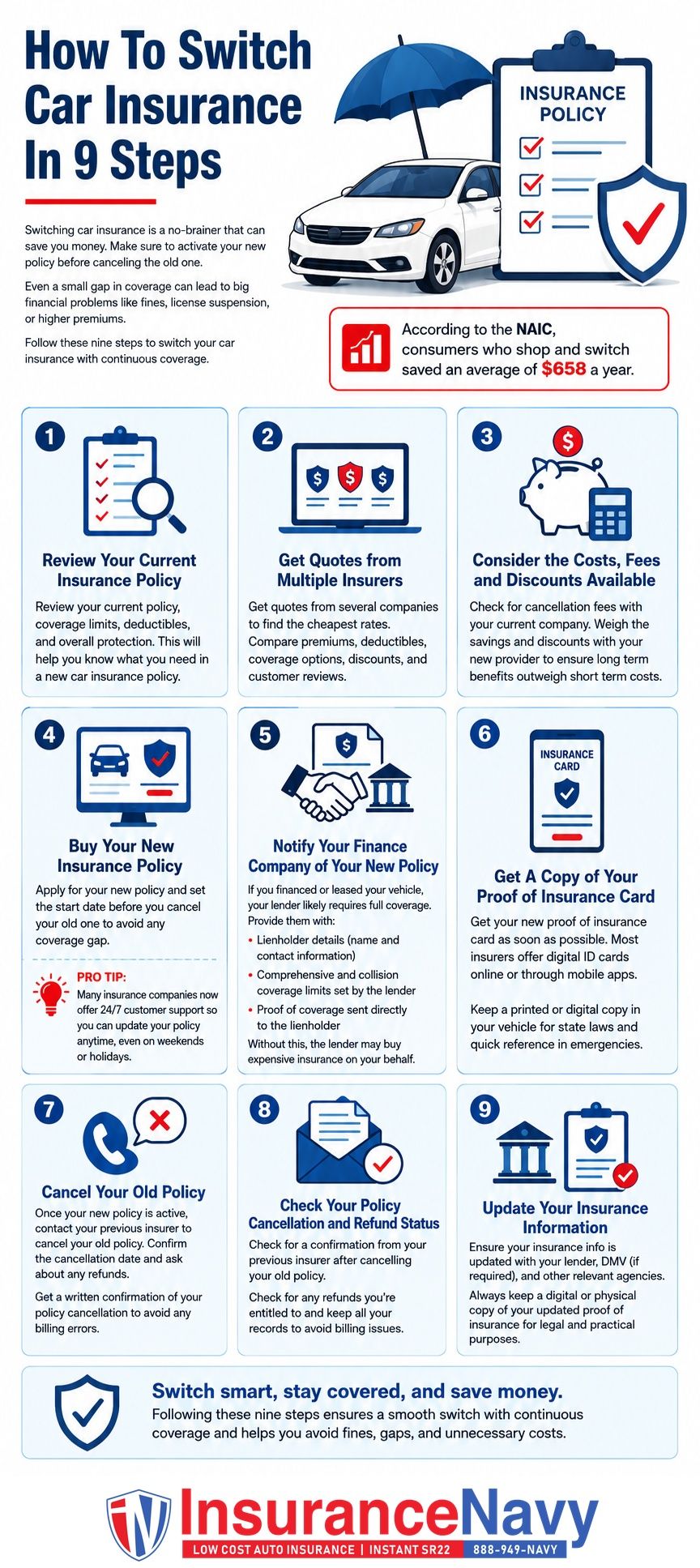
Switching car insurance saves money when the new policy starts before the old policy ends. The Avoid a Gap in Coverage When You Switch Car Insurance Companies section below lists the state penalties for a lapse.
Follow these 9 steps to switch your car insurance with continuous coverage..
Documents You Need to Switch Car Insurance Companies
Have these documents ready before you request quotes. Every insurer asks for the same set:
The current policy's declarations page. The declarations page lists the coverage limits, the deductibles, and the policy end date.
Driver's license numbers and dates of birth for every driver in the household.
The VIN, year, make, model, and current mileage of each vehicle, plus the registration.
The lienholder or leasing company name and address for any financed or leased vehicle.
Proof of prior insurance, such as the current ID card or the declarations page. Insurers use proof of prior insurance to confirm continuous coverage, which qualifies you for a prior-insurance discount.
Driving record details: any accidents, tickets, or claims in the past 3 to 5 years.
Step 1: Review Your Current Insurance Policy
Review your current policy, coverage limits, deductibles, and overall protection. This will help you know what you need in a new car insurance policy. Don't pay for add ons you don't need or miss out on important coverage.
Step 2: Get Quotes from Multiple Insurers
Get quotes from at least 3 car insurance companies. Quote the same coverage every time: identical liability limits, the same collision and comprehensive deductibles, and the same optional coverages, such as rental reimbursement or roadside assistance. Copy the limits and deductibles from the declarations page rather than from memory. A quote that looks cheaper because the quote drops the liability limits to the state minimum is not a saving. Beyond price, compare the discounts each new insurer applies, the new insurer's claims-handling reputation, and whether the new insurer offers the payment plan and app features you use.
Step 3: Consider the Costs, Fees and Discounts Available
Before you switch, ask your current insurer 2 questions: does the insurer charge a cancellation fee, and is the refund pro-rata or short-rate. A pro-rata refund returns every unused day of premium you have already paid.
A short-rate cancellation keeps a percentage of the unused premium as a penalty, so an early cancellation on a policy paid in full can cost a large share of the refund. Some insurers also charge a flat early-cancellation fee. Weigh those costs against what the new insurer offers: a safe-driver discount, a multi-policy bundle, a prior-insurance discount, or a lower base premium.
If the cancellation cost exceeds the savings for the rest of the current term, switch at renewal instead. At renewal there is no premium to refund and no fee to pay.
Step 4: Buy Your New Insurance Policy
Once you've found the best insurance company, apply for a new car insurance policy.
Use the documents listed above to complete the application. Set the new policy start date on or before the old policy's cancellation date. Most insurers can bind a new policy the same day, online or by phone, and many insurers offer 24/7 support, so you can time the start date precisely.
Step 5: Notify Your Finance Company of Your New Policy
If you financed or leased your new vehicle, the lender will likely require full coverage (collision and comprehensive coverage). The financing company or dealership will need proof of insurance before letting you take the car home.
To meet lender requirements, your insurance company will need:
Lienholder details (name and contact information of the financing company)
Comprehensive and collision coverage limits set by the lender
Proof of coverage sent directly to the lienholder
If you don't provide this information, the lender will often buy insurance at a much higher rate on your behalf.
Step 6: Get A Copy of Your Proof of Insurance Card
Get your new proof of insurance card from your insurance agent as soon as possible.
Most insurers offer digital ID cards online or through their mobile apps so that you can access them anywhere. Keep a printed or digital copy in your vehicle for state laws and quick reference in emergencies.
Step 7: Cancel Your Old Policy
Once the new policy is active, cancel the old policy in writing. Most insurers accept a signed cancellation request by email, through the app, or by mail. A few insurers accept a cancellation by phone. State the cancellation date, which should match the start date of the new policy.
Ask the insurer to confirm 3 things in writing: the effective date of the cancellation, the refund amount and whether the refund is pro-rata or short-rate, and that automatic payments have stopped. Do not stop paying instead of cancelling. A policy that lapses for non-payment is reported to the state as a lapse, not a cancellation, and the lapse appears on your record at the next quote.
Step 8: Check Your Policy Cancellation and Refund Status
Confirm that the written cancellation confirmation from Step 7 arrived. Check that the refund matches the amount the previous insurer quoted. Keep all records to resolve any billing dispute.
Step 9: Update Your Insurance Information
Ensure your insurance info is updated where needed by your lender, DMV (if required), and other relevant agencies. Always keep a digital or physical copy of your updated proof of insurance for legal and practical purposes.
Avoid a Gap in Coverage When You Switch Car Insurance Companies
There is no grace period between car insurance companies. Coverage ends the moment the old policy's cancellation takes effect. Coverage resumes only on the new policy's effective date. The state finds out. Insurers report cancellations and new policies electronically to the DMV or Secretary of State. Step 4 sets the new policy's start date on or before the old policy's cancellation date. A 1-day overlap costs 1 day of premium. A gap costs far more.
The cost of a lapse depends on the state. The penalties hit the vehicle registration before the driver's license:
Georgia counts a lapse when 10 or more days pass between the end of the old policy and the start of the new policy, or when no new policy is reported within 30 days of a cancellation. [GA Department of Revenue]
California suspends the vehicle registration when the DMV learns of a cancellation and receives no replacement policy within 45 days. Reinstatement requires proof of insurance and a $14 fee. [CA DMV]
Illinois suspends the license plates and charges $100 to reinstate the registration. Driving uninsured carries a minimum $500 fine. [IL Secretary of State]
Nevada charges reinstatement fees of $250 to $750 plus fines of $250 to $1,000 on a tiered scale. A first lapse of 1 to 30 days costs $250. A lapse of 91 days or more also requires an SR-22 for 3 years. [NV DMV]
Texas no longer adds a surcharge for a lapse. The Driver Responsibility Program was repealed in 2019. Driving without insurance remains a violation. [TX DPS]
Indiana sets the reinstatement fee individually on the driver record and requires a 180-day SR-22 if the driver cannot prove coverage. [IN BMV]
A lapse also ends the prior-insurance discount described in the documents list above. Most insurers price a driver with a coverage gap as a higher risk at the next quote. See the Insurance Navy guides to what happens when car insurance lapses and the penalties for driving without insurance.
How to Switch Car Insurance to a New Car
A car insurance policy insures a specific vehicle. Buying a car means updating or transferring the policy, whether you stay with the current insurer or switch. Most insurers cover a newly purchased vehicle under the existing policy for a window of 7 to 30 days while you update the policy. Do not wait out the window. A financed or leased car needs the lender's required coverage on the day of purchase. Step 5 above lists what the lender needs.
To transfer the policy, give the insurer the new car's VIN, year, make, and model, the safety and anti-theft features, and the sale and loan paperwork for a financed or leased car. Call the insurer to update the coverage and ask whether the lender requires added coverage, such as collision or comprehensive. Most insurers accept the update by phone, online, or through the mobile app. If the insurer cannot complete the transfer immediately, call your agent the next business day to finalize the update.
Do I Need Short-Term Insurance When I Transfer My Policy to a New Car?
No. The existing policy covers the new car during the insurer's update window, so short-term insurance is not needed.
Can I Transfer My Insurance to a New Car Before Selling My Old One?
Yes, you can transfer your insurance to your new car and keep short-term cover on your old one so both vehicles are covered during the transition.
Are There Fees for Transferring Insurance to a New Car?
Most insurers do not charge a fee to transfer a policy to a new car. Some insurers charge a small endorsement fee for any mid-term change. If the new car changes the premium, you pay the difference or receive a refund.
How to Switch Car Insurance When You Move to Another State
A move to another state is the right time to review car insurance coverage. If the current insurer does not operate in the new state, you must find a new insurer. Every state sets its own minimum liability limits and its own list of required coverages, so a policy written for the old state rarely meets the new state's requirements. Most states set a deadline, measured in days after the move, to register the car and buy a policy written in the new state. Get quotes in the new state before moving day. Start the new policy on the day you arrive. Cancel the old policy the same day, so you never carry 2 full policies or none. Update the address on the new policy. The state list in the Change Your Auto Insurance to Insurance Navy Today section below links to the minimum requirements for each of the 12 states where Insurance Navy has offices.
Change Your Auto Insurance to Insurance Navy Today!
Following these steps, switching car insurance can be easy.
Looking for personalized service, competitive rates, and customized coverage? Contact Insurance Navy today. Visit us online, call 888-949-6289, or find an agent near you to start saving and simplifying your insurance switch.
With over 20 years of experience and thousands of happy customers, Insurance Navy is a car insurance leader with personalized policies to fit your budget and coverage needs.
Stop by one of our offices to see what we have to offer:
State-specific minimum insurance requirements
Extra coverage options to add more protection
Discounts you may be eligible for
Benefits of choosing Insurance Navy
We're located in shopping centers and commercial offices in 12 U.S. states, so finding the right coverage for you has never been easier.
Are you looking to Switch Car Insurance Companies? Insurance Navy can help you find the cheapest car insurance rates!
Insurance Navy offers Cheap car Insurance coverage for all Cars and Drivers.
Get a free, cheap car insurance quote online and switch today. Our insurance agents are just one call away: 888-949-6289. Feel free to stop by one of our many storefronts. Insurance shouldn't be a hassle. Insurance Navy can help.