
Commercial Van Insurance: Types, Coverage, Classification, Factors, Premium, Costs
Commercial van insurance keeps business owners safe from big financial losses. In 2024 the typical cost for commercial van insurance is $227 per month or $2,726 per year. Vans used for work face risks that personal insurance just does not cover. If you use a van for business, a personal policy will leave you unprotected. To find the right coverage at a fair price, you need to know what your choices are. This guide helps you compare options, understand costs, and keep your work vehicles protected. Insurance Navy helps businesses find competitive van insurance quotes all across the country.
What is Commercial Van Insurance?
Commercial van insurance is a special policy for vans used in business. It is different from personal auto insurance because it covers business risks, like delivering cargo and having more than one driver. That difference matters a lot when it comes to your legal protection. A commercial policy covers liability, physical damage, and business-use needs. If you use your van for deliveries, services, or a trade, you need commercial auto insurance.
| Feature | Personal Auto Insurance | Commercial Van Insurance |
|---|---|---|
| Coverage Scope | Personal errands only | Business and delivery use |
| Liability Limits | Standard personal limits | Higher commercial limits |
| Cargo Protection | Not included | Available as add-on |
| Driver Eligibility | Named family drivers | Multiple employee drivers |
What are the types of Commercial Van Insurance?
There are several types of commercial van insurance. The main ones are liability-only, comprehensive, collision, and fleet policies. Each type fits different businesses and different levels of risk. Insurers build their policies to match the specific way a van is used.
Common types of commercial van insurance:
Liability-only policy: pays for property damage and injuries your van causes to someone else.
Comprehensive coverage: protects your van from theft, vandalism, and damage that is not from a crash.
Collision coverage: covers repair bills after your van is in an accident.
Cargo van insurance: what type of goods does your van carry? This coverage protects them during delivery.
Fleet policy: one plan that covers all your vans together, which saves time and often money.
Hired and non-owned auto: covers vans your company uses but does not actually own.
Before you pick a policy, take time to compare each type and see which one fits your business best.
What types of coverage are in Commercial Van Insurance policy?
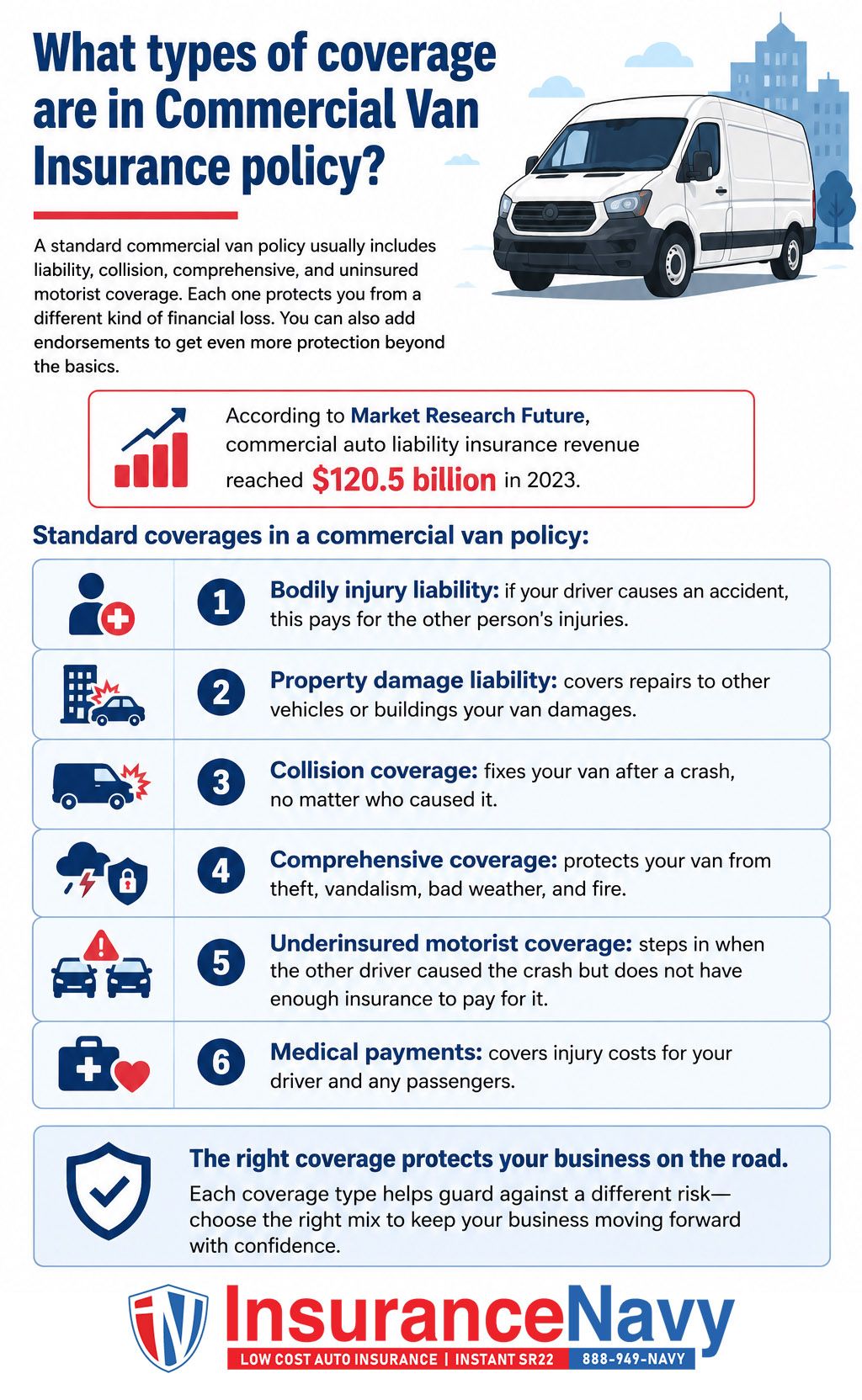
A standard commercial van policy usually includes liability, collision, comprehensive, and uninsured motorist coverage. Each one protects you from a different kind of financial loss. You can also add endorsements to get even more protection beyond the basics.
Standard coverages in a commercial van policy:
Bodily injury liability: if your driver causes an accident, this pays for the other person's injuries.
Property damage liability: covers repairs to other vehicles or buildings your van damages.
Collision coverage: fixes your van after a crash, no matter who caused it.
Comprehensive coverage: protects your van from theft, vandalism, bad weather, and fire.
Underinsured motorist coverage: steps in when the other driver caused the crash but does not have enough insurance to pay for it.
Medical payments: covers injury costs for your driver and any passengers.
According to Market Research Future, commercial auto liability insurance revenue reached $120.5 billion in 2023.
How does vehicle use classification affect Van insurance cost?
How you use your van has a direct effect on what you pay for insurance. Insurers look at whether your van runs personal errands, handles light deliveries, or does heavy commercial work every day. The riskier the use, the higher the premium.
| Use Classification | Risk Level | Typical Cost Impact |
|---|---|---|
| Personal van use | Low | Lowest premium rate |
| Occasional business errands | Moderate | Small cost increase |
| Daily delivery operations | High | Significant premium rise |
| Multi-driver fleet service | Very High | Highest cost tier |
Always report your van's real use to your insurer. If you say a commercial van is personal, a claim could be denied. Insurers check mileage data to confirm how a van is actually used.
Does Van insurance include cargo protection for businesses?
Yes, but you have to ask for it. Standard commercial van policies do not automatically cover the goods inside your van. You need to add a cargo endorsement or buy a separate cargo policy. Businesses that run delivery vans should look into inland marine or cargo coverage.
| Cargo Coverage Type | What It Covers | Best For |
|---|---|---|
| Cargo van endorsement | Goods during delivery transport | Small delivery businesses |
| Inland marine policy | High-value mobile property | Contractors, service firms |
| Motor truck cargo | Customer goods during transport | Freight and courier services |
| Business personal property | Equipment stored in the van | Tradespeople and technicians |
Ask your insurer to review your coverage and add cargo protection if you need it. Without it, a crash could leave you paying for lost or damaged goods out of your own pocket.
What liability limits should my Van insurance have?
For most businesses, your commercial van insurance should carry at least $500,000 in liability coverage per incident. If you run a delivery service or another higher-risk operation, you may need $1 million or more. AM Best reported that commercial auto liability insurance posted a $6.4 billion loss in 2024, which shows just how costly accidents can be.
Recommended liability limits for van insurance:
Minimum state requirement: this keeps you legal, but it will not fully protect you if a serious accident happens.
$300,000 per occurrence: a reasonable fit for service vans that do not drive much.
$500,000 per occurrence: the amount most commercial van owners should carry.
$1,000,000 per occurrence: needed for businesses with busy delivery routes or multiple drivers.
Umbrella policy add-on: gives you extra coverage on top of what your standard policy allows.
Liability coverage protects your business when one of your drivers causes an injury or damages someone else's property.
How does a named driver policy affect Van insurance?
A named driver policy only covers the specific drivers listed on it. Insurers use this type of policy to keep risk low and hold premiums down. If someone not on the list drives your van and gets into an accident, the claim may not be paid.
| Policy Type | Driver Eligibility | Premium Impact |
|---|---|---|
| Named driver policy | Listed drivers only | Lower premium cost |
| Any driver policy | All authorized drivers | Higher premium cost |
| Employer-listed policy | Employees named by company | Moderate premium range |
| Occasional driver add-on | Temporary named driver | Small additional charge |
If your business has more than one driver, list every employee on the policy. Adding a driver with a bad record will raise your commercial van insurance rate. Check your driver list once a year to make sure it is still accurate.
What deductible amount is best for Van insurance?
The right deductible keeps your monthly premium affordable without leaving you stuck with a bill you cannot pay after an accident. A higher deductible means lower premiums, but you pay more when something goes wrong. For context, CCC Intelligent Solutions found that the average bodily injury payout reached $27,373 per injured person in 2024.
Deductible selection guidelines for commercial van insurance:
$250 deductible: you pay very little after a claim, but your annual premium will be the highest.
$500 deductible: a common middle ground that works well for most small business vans.
$1,000 deductible: cuts your premium by a good amount, and it works best if you rarely file claims.
$2,500 deductible: makes sense only if your business has enough cash saved to cover that cost easily.
Mileage-based threshold: some insurers set deductibles based on how much you drive each year.
Pick a deductible amount your business can actually pay if a crash happens tomorrow.
Can a no-claims discount reduce my Van insurance rate?
Yes, a no-claims discount rewards businesses that have stayed accident-free. Insurers give lower rates to drivers who do not file claims, and those savings grow bigger each year you stay clean. According to Conning, commercial auto claim costs have climbed 64% since 2015, so a spotless claims record is worth a lot to insurers right now.
A no-claims discount usually saves you between 5% and 20% for each year you qualify. To protect that discount, many businesses pay for small repairs themselves instead of filing a claim. Shopping around and comparing quotes from multiple auto insurance companies helps you find the ones with the best no-claims discount programs. Insurance Navy can help you get a quote that reflects your clean history.
Is fleet coverage cheaper than individual Van insurance?
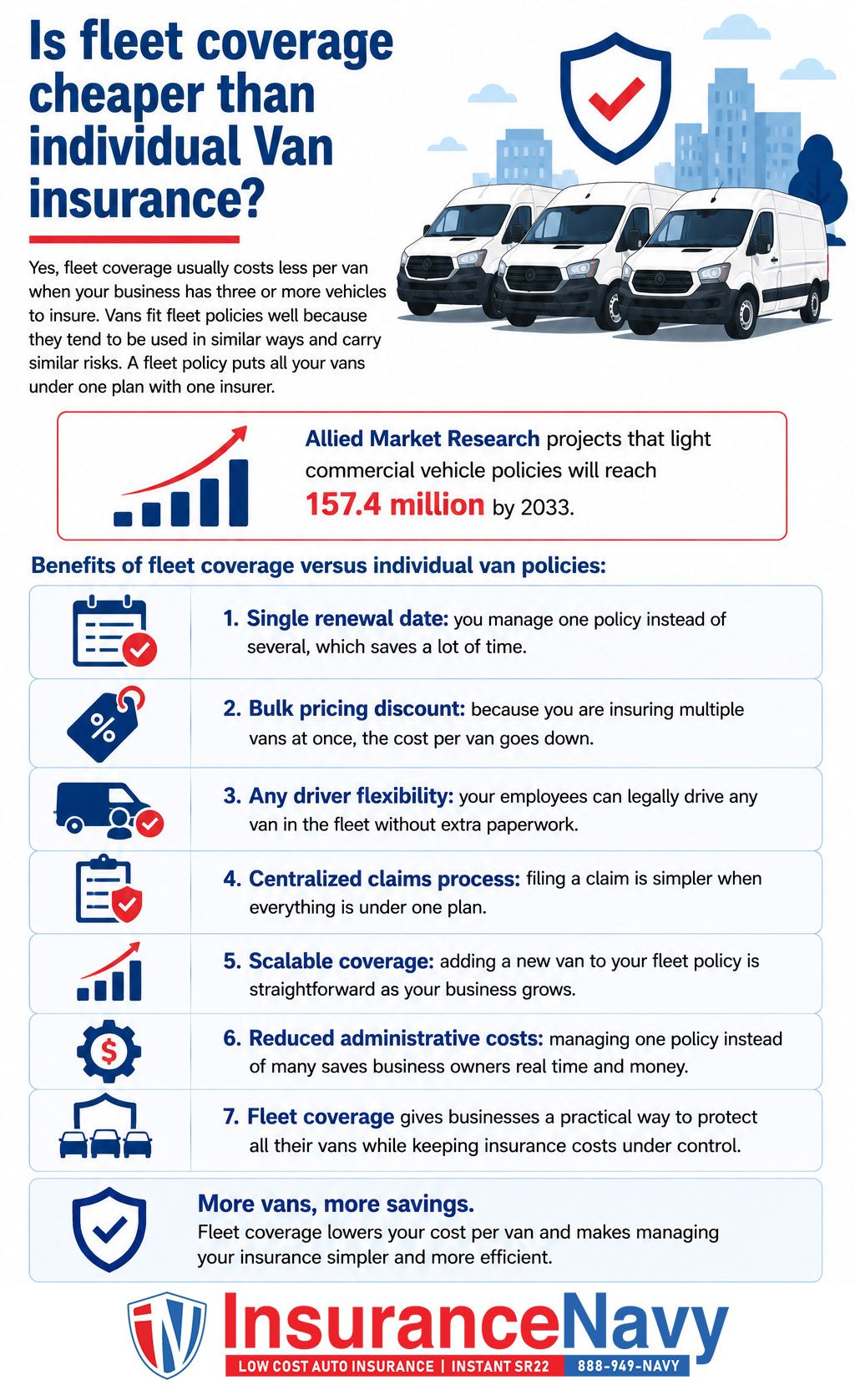
Yes, fleet coverage usually costs less per van when your business has three or more vehicles to insure. Vans fit fleet policies well because they tend to be used in similar ways and carry similar risks. A fleet policy puts all your vans under one plan with one insurer. Allied Market Research projects that light commercial vehicle policies will reach 157.4 million by 2033.
Benefits of fleet coverage versus individual van policies:
Single renewal date: you manage one policy instead of several, which saves a lot of time.
Bulk pricing discount: because you are insuring multiple vans at once, the cost per van goes down.
Any driver flexibility: your employees can legally drive any van in the fleet without extra paperwork.
Centralized claims process: filing a claim is simpler when everything is under one plan.
Scalable coverage: adding a new van to your fleet policy is straightforward as your business grows.
Reduced administrative costs: managing one policy instead of many saves business owners real time and money.
Fleet coverage gives businesses a practical way to protect all their vans while keeping insurance costs under control.