
Semi Truck Insurance: Coverage type, Costs, Deductibles, Factors
Semi truck insurance protects commercial trucking businesses from financial ruin. Every owner operator and fleet manager needs reliable coverage on the road. According to the American Transportation Research Institute (ATRI), insurance premiums hit a record $0.102 per mile in 2024. That figure represents roughly 10% of total operating costs. The trucking industry faces rising litigation, nuclear verdicts, and stricter federal regulations. Understanding semi truck insurance helps truckers manage costs and stay compliant. This guide answers every critical question about commercial truck insurance coverage, costs, and policy options for trucking businesses across the U.S.


What is Semi Truck Insurance?
Semi truck insurance is a specialized commercial insurance policy covering large trucks and trucking operations. It protects owner operators, motor carriers, and trucking companies from accident liability and physical damage. As reported by IBISWorld, the U.S. commercial auto insurance market reached $80.1 billion in 2025. This growth reflects increasing demand for customized trucking insurance solutions. Semi truck insurance provides financial protection unique to the commercial transportation industry.
What Coverage Types Does a Semi Truck Insurance Policy Include?
A commercial truck insurance policy includes multiple coverages tailored to trucking operations. There are several primary coverage types truck drivers and owner operators rely on daily. A policy can provide protection across a wide range of business needs, including liability, cargo, and physical damage.
Primary liability insurance, covers bodily injury and property damage to others
Physical damage insurance, covers your truck against accidents, theft, and weather
Motor truck cargo insurance, protects freight your truck hauls, including cargo damage
Trailer interchange insurance, covers a trailer under interchange agreements
Insurance general liability, protects against non-accident business claims
Motor truck general liability, covers premises and operations liability
Each coverage type protects a specific aspect of your trucking business. Owner operators should review all options with a licensed insurance agency to find the right insurance for their needs.
How Much Does Semi Truck Insurance Cost Monthly?
The monthly cost of semi truck insurance depends on truck type and authority. Per Progressive Commercial's 2024 policy analysis, the national average monthly cost ranged from $746 for specialty truckers to $954 for transport truckers. MoneyGeek's 2025 analysis shows semi-trucks average $639 monthly for $1 million liability coverage. HAZMAT tanker trucks reach $1,240 monthly. Operators under their own authority pay $1,167 to $1,833 per truck monthly. Leased operators pay $300 to $400 monthly.
| Operator Type | Monthly Cost | Annual Cost | Authority Status |
|---|---|---|---|
| Leased to motor carrier | $300–$400 | $3,600–$5,000 | Leased |
| Specialty trucker | $746 | ~$8,952 | Own authority |
| Transport trucker | $954 | ~$11,448 | Own authority |
| Under own authority | $1,167–$1,833 | $14,000–$22,000 | Own authority |
| HAZMAT tanker | $1,240 | ~$14,880 | Specialized |
What Deductibles Are Typical for Semi Truck Insurance?
Typical semi truck insurance deductibles for physical damage coverage range from $1,000 to $5,000. Higher deductibles lower your monthly premium payments significantly. Most trucking companies choose deductibles between $2,500 and $3,000 for physical damage insurance. Liability insurance deductibles typically start at $0 for primary liability policies. Your insurance company sets deductible options based on your operating radius and driving history. Operators with strong safety records qualify for better deductible structures and lower insurance costs.
What Factors Determine the Cost of Commercial Semi Truck Insurance?
Multiple factors determine the cost of commercial truck insurance and premium rates. As noted by MoneyGeek's 2025 analysis, premiums vary 227% depending on business industry. These key factors drive your insurance quote:
Driving history, accidents and violations raise rates significantly
Type of cargo, HAZMAT and high-value loads cost more to insure
Operating radius, longer hauls increase exposure and premium costs
Truck age and condition, newer trucks often qualify for lower rates
State of operation, New York averages $666 monthly versus Maine's $275 monthly
Years of experience, experienced drivers typically pay lower premiums
Inspection history, clean DOT inspection records reduce insurance costs
Insurance companies analyze all these data points before generating your commercial trucking insurance rate. A small business with clean records can save significantly by working with the right commercial insurance agency.
What Liability Limits Does Semi Truck Insurance Require?
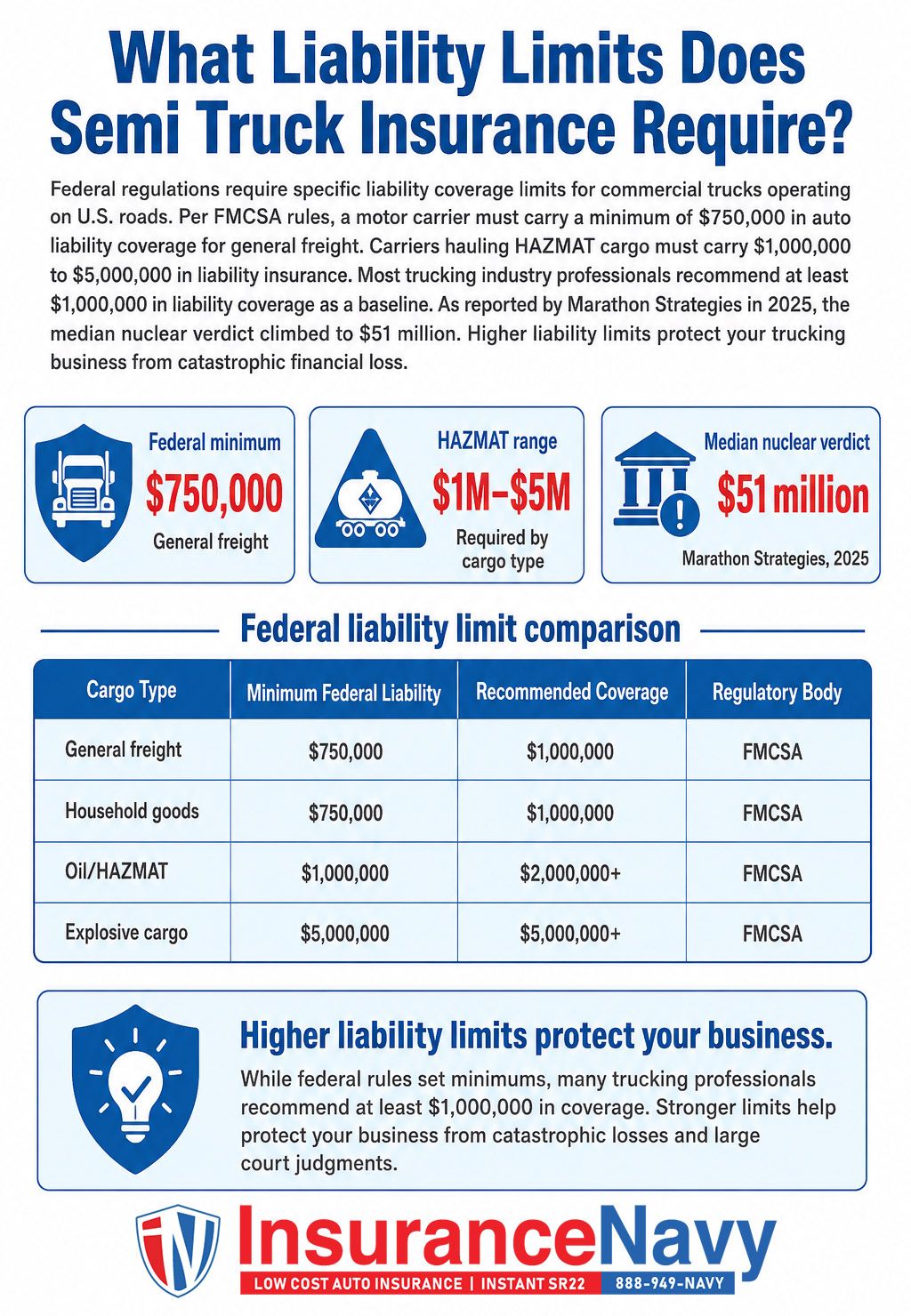
Federal regulations require specific liability coverage limits for commercial trucks operating on U.S. roads. Per FMCSA rules, a motor carrier must carry a minimum of $750,000 in auto liability coverage for general freight. Carriers hauling HAZMAT cargo must carry $1,000,000 to $5,000,000 in liability insurance. Most trucking industry professionals recommend at least $1,000,000 in liability coverage as a baseline. As reported by Marathon Strategies in 2025, the median nuclear verdict climbed to $51 million. Higher liability limits protect your trucking business from catastrophic financial loss.
| Cargo Type | Minimum Federal Liability | Recommended Coverage | Regulatory Body |
|---|---|---|---|
| General freight | $750,000 | $1,000,000 | FMCSA |
| Household goods | $750,000 | $1,000,000 | FMCSA |
| Oil/HAZMAT | $1,000,000 | $2,000,000+ | FMCSA |
| Explosive cargo | $5,000,000 | $5,000,000+ | FMCSA |
Does Semi Truck Insurance Cover Cargo Theft and Personal Use?
Yes, semi truck insurance covers cargo theft through motor truck cargo insurance policies. Cargo insurance owner operators rely on protects freight against accidents, theft, and fire damage. As reported by the Insurance Information Institute, cargo theft costs the U.S. trucking industry billions annually. A policy can be structured to cover personal use under certain conditions, but business use is the primary purpose. Most truck insurance policies will not cover personal use without a specific endorsement, so confirm this with your agent. Owner operators should ask whether their insurance cover personal use scenarios before they get a policy.
Some policies exclude theft during unattended parking, so read your insurance policy carefully. Your insurance agency can provide clarity on what is and is not covered under your plan.
How Does Driving Record Affect Semi Truck Insurance Rates?
Your driving record directly affects commercial truck insurance rates and premium costs. Insurance companies review accidents, violations, and claims history before issuing a truck insurance policy. Drivers with clean records can save money on monthly premiums across all coverage types. As stated by LogRock in their 2025 analysis, owner operators now average $11,000 to $17,000 annually. Poor driving history can push annual premiums well over $20,700.
These rate factors matter most:
At-fault accidents, each incident raises your truck insurance cost substantially
Moving violations, speeding and reckless driving increase carrier insurance rates
DUI convictions, most insurance companies refuse coverage or charge maximum rates
Claims frequency, multiple claims signal high risk to insurers
CSA safety scores, poor scores directly increase commercial trucking insurance premiums
A team of experienced agents at a reputable insurance agency can help you navigate your options even with a difficult driving history.
Does Semi Truck Insurance Meet FMCSA Regulatory Compliance Requirements?
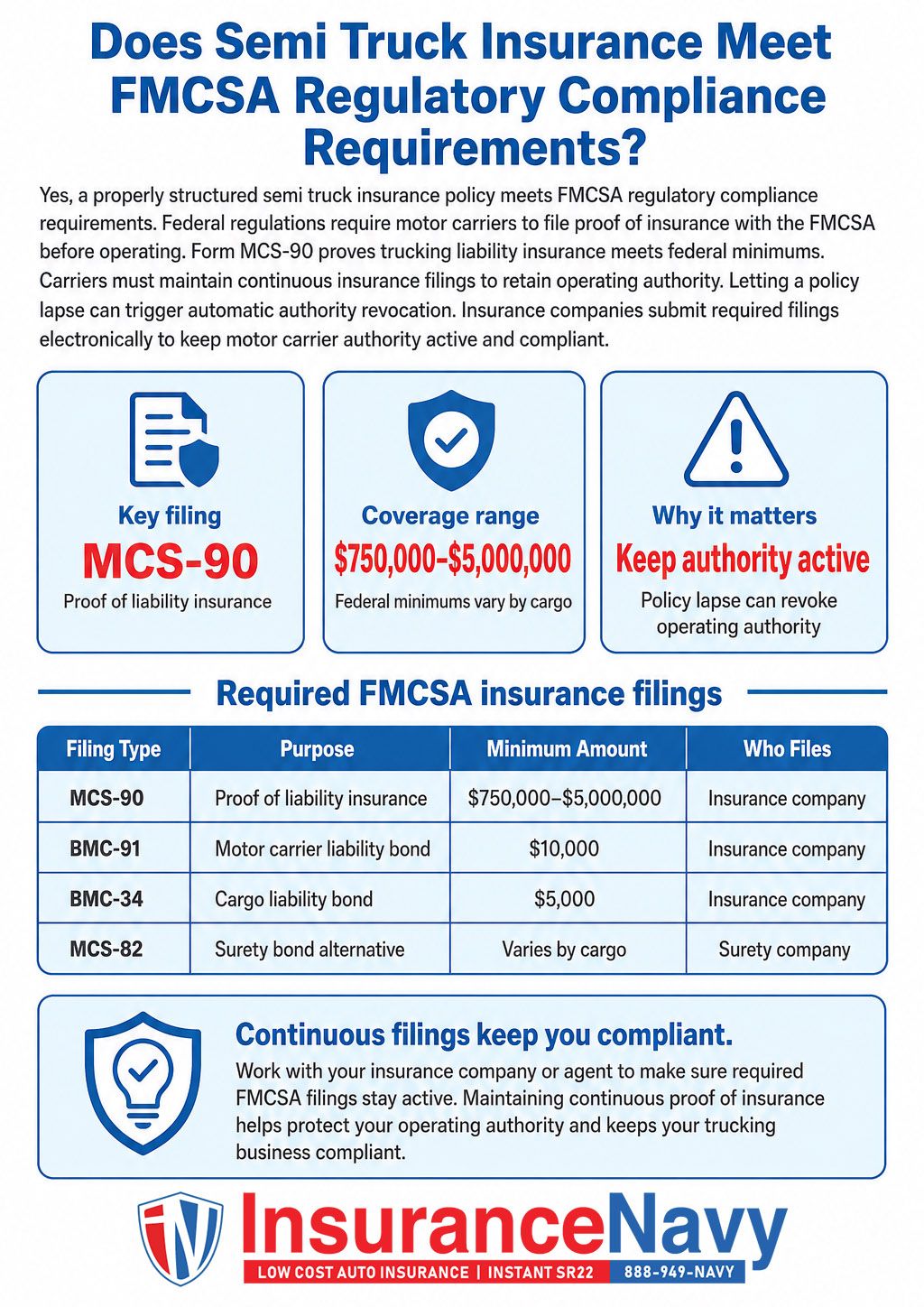
Yes, a properly structured semi truck insurance policy meets FMCSA regulatory compliance requirements. Federal regulations require motor carriers to file proof of insurance with the FMCSA before operating. These filings include Form MCS-90, which proves your trucking liability insurance meets federal minimums. As reported by the FMCSA, carriers must maintain continuous insurance filings to retain operating authority. Letting your policy lapse triggers automatic authority revocation. Your insurance company submits these filings electronically to keep your motor carrier insurance authority active and compliant.
| Filing Type | Purpose | Minimum Amount | Who Files |
|---|---|---|---|
| MCS-90 | Proof of liability insurance | $750,000–$5,000,000 | Insurance company |
| BMC-91 | Motor carrier liability bond | $10,000 | Insurance company |
| BMC-34 | Cargo liability bond | $5,000 | Insurance company |
| MCS-82 | Surety bond alternative | Varies by cargo | Surety company |
What is the Difference Between Owner-Operator and Fleet Semi Truck Insurance?
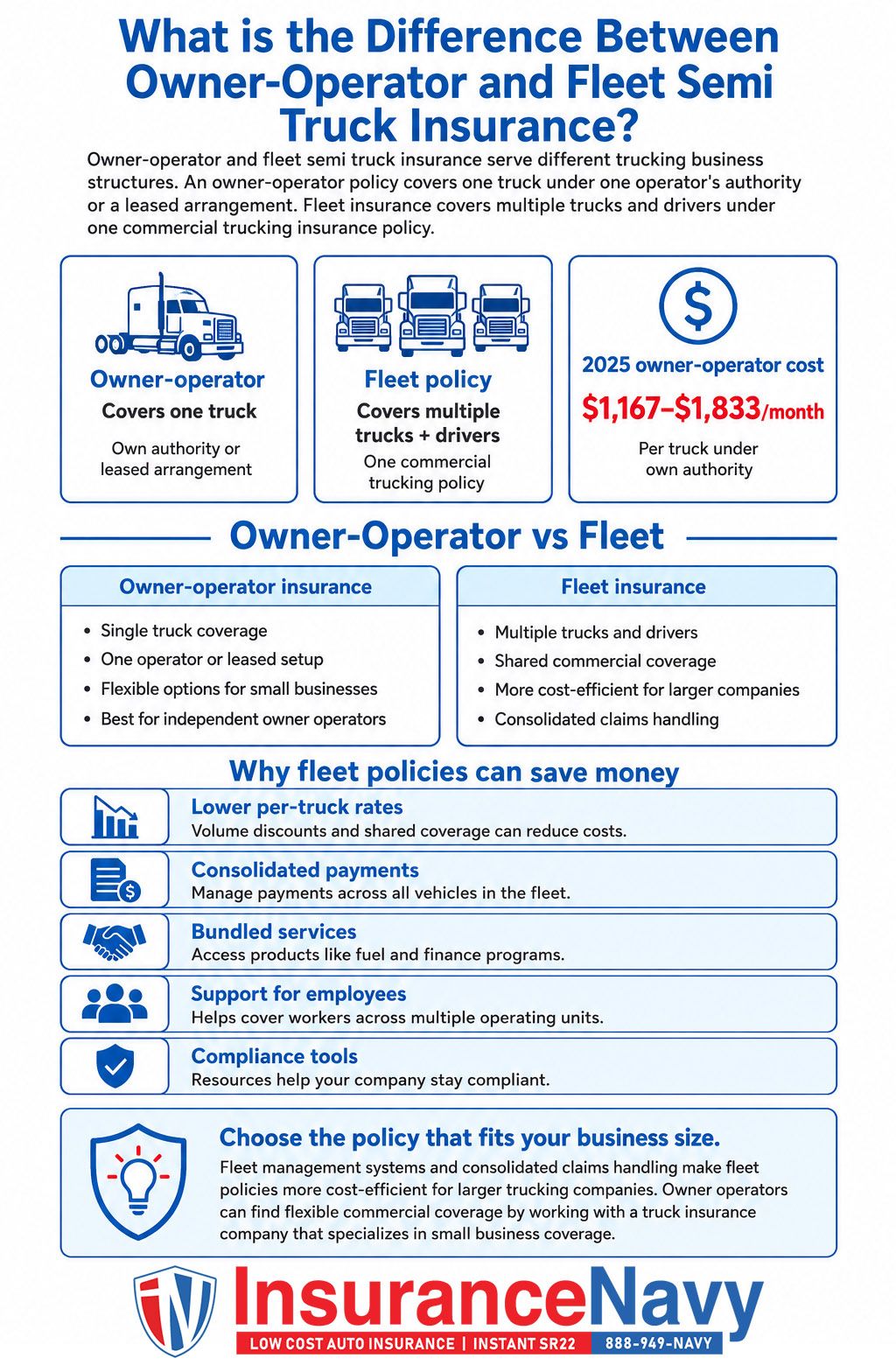
Owner operator and fleet semi truck insurance serve different trucking business structures. An insurance owner operator policy covers a single truck under one operator's authority or a leased arrangement. Fleet insurance covers multiple trucks and drivers under one commercial trucking insurance policy. Per Select Insurance Group's 2025 data, operators under their own authority pay $1,167 to $1,833 monthly per truck.
Fleet policies offer additional benefits worth considering:
Lower per-truck rates through volume discounts and shared coverage
Consolidated payment options across all vehicles in the fleet
Access to bundled products and services including fuel and finance programs
Support for employees and workers across multiple operating units
Resources and tools to help your own company stay compliant
Fleet management systems and consolidated claims handling make fleet policies more cost-efficient for larger trucking companies. Owner operators who need a commercial policy can find flexible insurance options by working with a truck insurance company that specializes in small business coverage.
Why Choose the Right Semi Truck Insurance Company?
Choosing the right commercial truck insurance partner helps your business moving forward. Truck drivers and owner operators need a truck insurance company that offers responsive customer service and fast can-do solutions. The right insurance agency will have a team that customers rely on for support when it matters most. You need a commercial partner who can give you clear answers and help you take care of claims fast.
When you are looking for semi truck insurance today, consider these factors:
Customer service quality, your insurer should assist you quickly after accidents
Insurance options available, look for a wide range of coverage products
Claims support, find out how fast can i get assistance after a breakdown or vehicle incident
Access to resources, the best agencies offer online tools so you can learn more and manage your policy
Payment options, flexible finance arrangements help small business owners stay covered
Contact Insurance Navy to get a Semi truck insurance quote today.