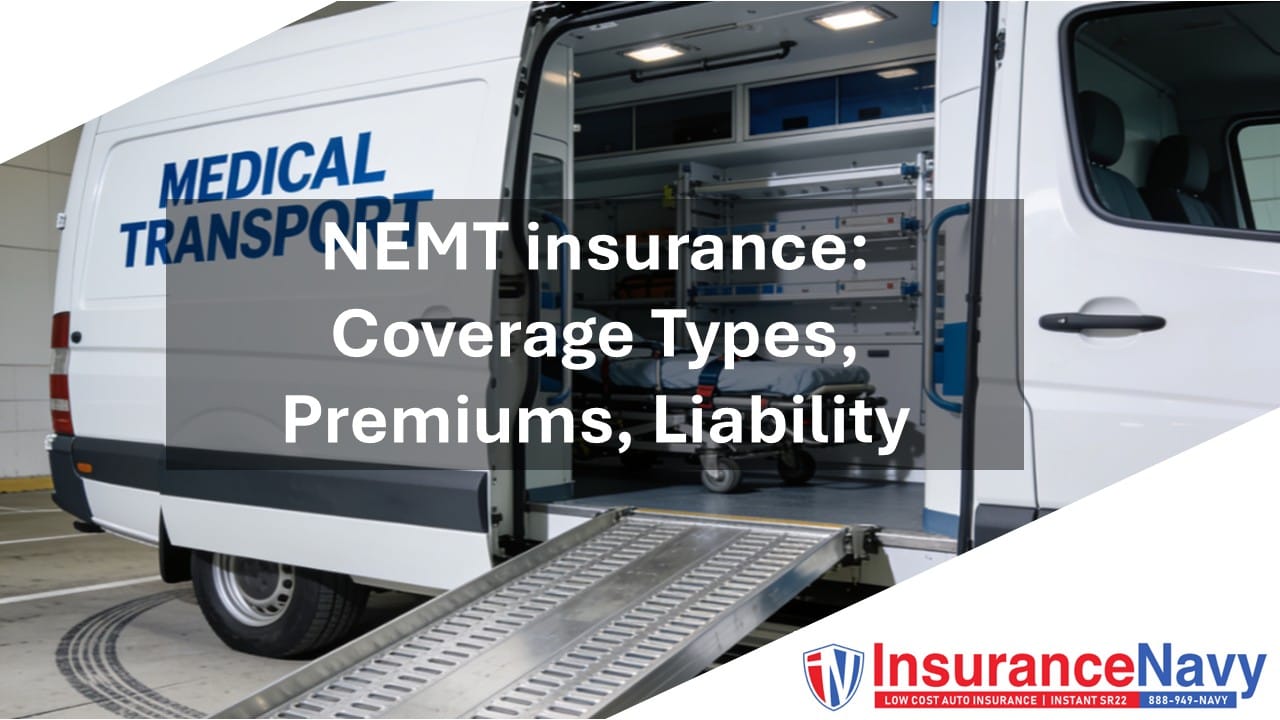
NEMT insurance: Coverage Types, Premiums, Liability Limits, Underwriting, and Compliance
Non-emergency medical transportation insurance protects drivers who carry patients to appointments. NEMT insurance covers vans, taxis, and stretcher vehicles across the country. Insurance Navy helps American transportation providers find the right insurance at the right price. This guide explains coverage types, premiums, liability limits, and state compliance rules. Every NEMT business needs general liability, commercial auto, and workers compensation protection. As stated by MACPAC, Medicaid NEMT utilization totaled 61.5 million ride-days in FY 2018. That scale shows why proper coverage matters for every transport provider looking to protect patients and staff. Read on to learn how NEMT insurance supports your business, your drivers, and your patients. Coverage extends to trips at home, at work, and on the road.
Table of contents
- What is NEMT insurance?
- What are the types of NEMT insurance?
- What is the benefit of NEMT insurance?
- How does NEMT insurance work?
- What is the importance of NEMT insurance?
- What vehicle types are covered under NEMT insurance?
- What are typical NEMT insurance premium costs?
- What liability coverage limits does NEMT insurance require?
- What underwriting requirements must NEMT insurance applicants meet?
- How does NEMT insurance relate to Medicaid broker contracts?
- Why is workers' compensation coverage included in NEMT insurance packages?
- How is NEMT insurance different from commercial auto insurance?
- What state regulations govern NEMT insurance requirements?
- What should you look for when choosing an NEMT insurance broker?
- How does NEMT insurance support risk management for transportation providers?
- Get a quote for NEMT insurance
What is NEMT insurance?
NEMT insurance is a policy that protects non-emergency medical transportation businesses. It combines auto, liability, and workers compensation coverage under one package. As per MACPAC, NEMT serves beneficiaries who need rides to medical care, not emergencies. The policy shields drivers, vehicles, and patients during every trip.
NEMT insurance differs from personal auto insurance in several ways. It covers commercial use, passenger transport, and higher liability exposure. Providers transport patients between home, clinics, and care facilities daily.
Protects drivers during patient transport
Covers medical transport vehicles and equipment
Shields the business from lawsuits and claims
Supports compliance with state Medicaid rules
Extends protection to trips between home and care facilities
What are the types of NEMT insurance?
The types of NEMT insurance include several distinct coverage categories. Providers typically combine these policies into one package. According to the research data, vans accounted for 46.0% of NEMT ride-days in FY 2018. Each vehicle type and risk factor requires specific coverage.
Many providers also carry commercial insurance riders for related business equipment and office operations. The table below lists common NEMT insurance categories and their purpose.
| Coverage Type | Primary Purpose |
|---|---|
| Commercial auto | Covers vehicle damage and accidents |
| General liability | Covers third-party injury claims |
| Workers compensation | Covers employee injury on the job |
| Professional liability | Covers errors in patient handling |
| Physical damage | Covers vehicle repair or replacement |
| Commercial insurance | Covers related business property and equipment |
Insurance Navy bundles these options for NEMT transport companies nationwide.
What is the benefit of NEMT insurance?
The benefit of NEMT insurance is comprehensive financial protection for transport businesses. As reported by the Gerontologist study, missed medical appointments harm older patients without transportation. Strong insurance coverage keeps NEMT providers operating safely and reliably.
NEMT insurance delivers measurable advantages to every transportation business, whether trips start at home or at a care facility.
Helps drivers stay protected during medical transport runs
Restores business stability after accidents or claims
Provides funds for vehicle repair and replacement costs
Strengthens trust between providers and Medicaid broker contracts
Creates a safety net for workers compensation claims
Extends coverage to general liability and property damage
Encourages compliance with state insurance requirements
How does NEMT insurance work?
NEMT insurance works by pooling premiums to pay covered claims. The provider pays a premium, and the insurer covers losses. In the words of MACPAC researchers, capitated brokerage is now the dominant payment model nationally. Insurers calculate premiums based on fleet size, claims history, and state rules.
The claims process follows a clear sequence of steps related to documentation and review.
The provider reports an accident or claim immediately.
The insurer reviews documentation and vehicle damage.
The insurer approves or denies the claim.
The provider receives payment for covered losses.
This process protects the business, the driver, and the patient riding to or from home.
What is the importance of NEMT insurance?
The importance of NEMT insurance lies in protecting vulnerable patients and providers. As noted by MACPAC, 3.2 million Medicaid beneficiaries used NEMT in FY 2018. Without insurance, one accident could bankrupt a small transport business. Dialysis patients and elderly riders depend on dependable, insured rides.
NEMT insurance also protects the broader healthcare system and the facilities it serves. Hospitals, clinics, and nursing homes rely on insured transport partners for steady patient flow.
Reduces financial risk for transportation providers
Protects patients during medical transport trips
Supports Medicaid broker contract compliance
Maintains public trust in healthcare transport services
Helps healthcare facilities maintain reliable patient access
Insurance Navy designs coverage that matches this critical responsibility.
What vehicle types are covered under NEMT insurance?
Vehicle types covered under NEMT insurance include vans, sedans, and stretcher vehicles. As cited by Wisconsin DHS data, ambulatory sedans and vans dominate NEMT fleets nationally. Wheelchair vans and stretcher vans require specialized coverage due to higher risk.
Vehicles providing transport between home, clinics, and healthcare facilities all need verified coverage. The table below shows common NEMT vehicle classes and coverage needs.
| Vehicle Class | Coverage Consideration |
|---|---|
| Ambulatory sedan | Standard commercial auto coverage |
| Wheelchair van | Higher liability and equipment coverage |
| Stretcher van | Specialized medical transport coverage |
| Taxi or rideshare vehicle | Hybrid personal and commercial coverage |
What liability coverage limits does NEMT insurance require?
Liability coverage limits for NEMT insurance depend on vehicle size and state rules. As referenced by FMCSA, interstate carriers must carry $5,000,000 for vehicles seating 16 or more. Smaller vehicles carrying 15 or fewer passengers require $1,500,000 in coverage. These federal floors apply specifically to for-hire interstate passenger carriers.
These federal limits set a baseline for many state programs related to passenger safety. Many states layer additional Medicaid broker requirements on top of these federal minimums.
| Vehicle Passenger Capacity | Minimum Liability Limit |
|---|---|
| 16 or more passengers | $5,000,000 |
| 15 or fewer passengers | $1,500,000 |
What underwriting requirements must NEMT insurance applicants meet?
Underwriting requirements for NEMT insurance applicants include safety records and vehicle inspections. As outlined by Virginia DMAS, wheelchair and stretcher vans need inspections twice annually. Drivers face restrictions after multiple chargeable accidents or violations. Stretcher crews must also complete first aid and bloodborne pathogen training.
Underwriters review several specific applicant factors before providing a quote.
Driver history and chargeable accident records
Vehicle inspection and maintenance documentation
Business licensing and Medicaid broker approval
Prior claims and loss history
Safe driving training programs for staff
Insurance Navy guides applicants through each underwriting step carefully.
How does NEMT insurance relate to Medicaid broker contracts?
NEMT insurance relates to Medicaid broker contracts through state procurement requirements. As stated by MACPAC, 20 states operated NEMT broker programs under the Deficit Reduction Act by 2018. Brokers require providers to carry verified insurance before contracting. This rule applies whether the broker model is statewide, regional, or managed care.
Medicaid broker contracts shape insurance needs in distinct ways.
Brokers set minimum coverage requirements for providers
States audit insurance compliance during contract renewal
Capitated payment models shift more risk to providers
Broker terminations can disrupt provider insurance continuity
Insurance Navy helps providers meet every broker contract requirement.
Why is workers' compensation coverage included in NEMT insurance packages?
Workers' compensation coverage protects employees injured while transporting patients. As per HMA research, NEMT drivers face daily physical and safety risks. Lifting patients, securing wheelchairs, and long shifts create injury exposure. Attendants on stretcher vans face additional strain-related injury risk.
Workers compensation coverage addresses several specific risks tied to driving and patient handling.
Covers medical bills for injured drivers and attendants
Replaces lost wages during employee recovery
Protects the business from workplace injury lawsuits
Supports compliance with state labor regulations
NEMT insurance packages bundle this coverage with general liability and auto policies.
How is NEMT insurance different from commercial auto insurance?
NEMT insurance differs from commercial auto insurance through specialized passenger and medical risk. As reported by HMA, NEMT carries higher risk than standard livery or taxi insurance. Standard commercial auto rarely covers wheelchair securement or stretcher equipment. Several underwriting companies have exited this niche, tightening market capacity.
The table below compares key differences between these two related policy types.
| Feature | Commercial Auto | NEMT Insurance |
|---|---|---|
| Passenger type | General public | Medical patients |
| Equipment coverage | Limited | Wheelchair and stretcher gear |
| Liability exposure | Standard | Elevated due to patient vulnerability |
| Medicaid compliance | Not required | Often required |
Insurance Navy structures policies that address these added NEMT risks.
What state regulations govern NEMT insurance requirements?
State regulations governing NEMT insurance vary by Medicaid program structure. As indicated by Washington State HCA, NEMT programs operate under specific federal matching rules. California and other states set their own minimum coverage standards. Some states use statewide brokers, while others use regional or in-house models.
States generally regulate NEMT insurance through these mechanisms related to safety and oversight.
Medicaid agency oversight and contract audits
Vehicle safety inspection mandates
Driver background check requirements and driving record reviews
Insurance verification before broker approval
Insurance Navy tracks state-specific rules across California and other markets.
What should you look for when choosing an NEMT insurance broker?
Choosing an NEMT insurance broker requires evaluating experience, coverage options, and service quality. As noted by industry data, underwriting capacity in this niche remains limited nationally. A knowledgeable broker helps providers avoid coverage gaps and compliance failures. Some providers must replace coverage quickly after an insurer exits the market.
Consider these factors when selecting an NEMT insurance broker providing reliable, long-term support.
Experience with medical transportation and healthcare clients
Access to multiple insurance carriers and quotes
Understanding of state Medicaid broker requirements
Responsive claims support and email communication
Insurance Navy provides tailored guidance for every transportation provider's needs. Submit your name email request through our home page for a free quote.
How does NEMT insurance support risk management for transportation providers?
NEMT insurance supports risk management by transferring financial risk away from providers. As cited by Washington State HCA, performance-based broker contracts reduce costs through incentives. Insurance complements these programs by covering accidents, injuries, and property damage. Strong insurance backing also reassures Medicaid brokers during contract renewal reviews.
Effective risk management combines insurance with strong safety practices related to daily operations.
Maintain detailed vehicle and driver inspection records
Train drivers on safe patient handling procedures
Review claims data regularly to spot risk trends
Partner with an insurance broker for ongoing guidance
Insurance Navy remains a trusted partner in transportation risk management.
Get a quote for NEMT insurance
NEMT insurance protects your drivers, vehicles, and patients every single day. Insurance Navy helps American transportation providers secure the right insurance at the right price. Our team understands commercial auto, general liability, and workers compensation needs. We guide you through underwriting, state compliance, and Medicaid broker requirements. Contact Insurance Navy today for a personalized NEMT insurance quote. Protect your business, your team, and the patients you serve at home and at every healthcare facility. Insurance Navy stands ready to support your transportation company's growth and safety.