
Pickup Truck Insurance: Types, Coverage, Factors, Cost, Liability Limits
On American roads, your pickup truck, your cargo, and your finances all need protection. That is what pickup truck insurance is for. Premiums differ from driver to driver based on where you live, what you drive, and how you use it. According to Insure.com (April 2026), full coverage truck insurance runs about $240 per month across the country. That is 31% less than the average cost for a standard car policy. Whether your truck hauls tools for a job site or just gets you to work each day, having the right policy is a big deal. This guide covers everything you need to know about pickup truck insurance, from what it costs to how you can pay less for it.


What is Pickup Truck Insurance?
Pickup truck insurance is an auto policy built for trucks used personally or for work. It works a lot like regular car insurance, but it accounts for things that make trucks different. A solid policy will include liability, collision, and comprehensive coverage suited to how truck drivers actually use their vehicles.Trucks and cars are not the same to insure. A basic auto policy may leave some truck-specific risks uncovered. Before you drive, check with an insurance agency to make sure your coverage fits your situation.
What Coverage Types Does Pickup Truck Insurance Include?
There are several types of coverage in a pickup truck insurance policy, and each one protects you from something different. Per Insure.com (April 2026), full coverage bundles these protections into one complete auto insurance policy. What is included can change based on your insurer, your state, and the truck you drive.
Standard pickup truck insurance coverages include:
Liability coverage pays for property damage and injuries you cause to other people.
Collision coverage takes care of damage to your truck after a crash.
Comprehensive coverage handles theft, storm damage, and other events that are not crashes.
Underinsured motorist coverage steps in when the other driver does not have enough insurance to cover your costs.
Uninsured motorist coverage, because sometimes the driver who caused the accident has no insurance at all.
Medical payments coverage pays your medical bills after a covered accident.
Each type covers a different situation. Think about how you use your truck before you decide which ones you need.
Which Truck Models Have the Cheapest Pickup Truck Insurance Policies?
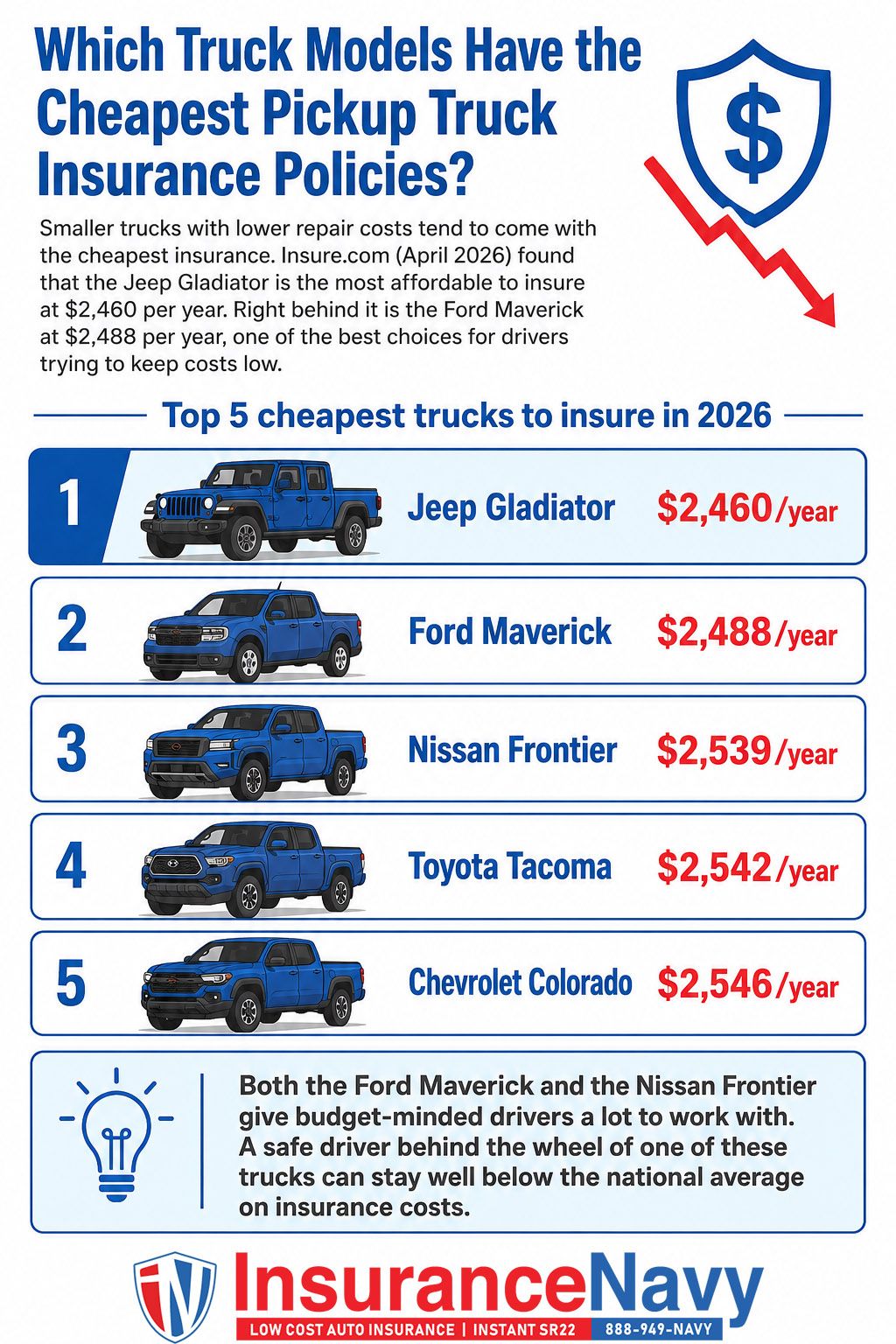
Smaller trucks with lower repair costs tend to come with the cheapest insurance. Insure.com (April 2026) found that the Jeep Gladiator is the most affordable to insure at $2,460 per year. Right behind it is the Ford Maverick at $2,488 per year, one of the best choices for drivers trying to keep costs low.
Top 5 cheapest trucks to insure in 2026:
Jeep Gladiator, $2,460/year
Ford Maverick, $2,488/year
Nissan Frontier, $2,539/year
Toyota Tacoma, $2,542/year
Chevrolet Colorado, $2,546/year
Both the Ford Maverick and the Nissan Frontier give budget-minded drivers a lot to work with. A safe driver behind the wheel of one of these trucks can stay well below the national average on insurance costs.
How Does Vehicle Classification Affect Pickup Truck Insurance Rates?
The class of your truck changes how insurers see your risk, and that changes your rate. Insure.com (April 2026) shows that a base Ford F-150 costs $2,696 per year to insure. The F-150 Raptor, by contrast, runs $3,004 per year. That $308 gap comes from the Raptor's performance rating and the fact that it costs more to fix.
| Truck Classification | Example Model | Average Annual Premium |
|---|---|---|
| Compact/Mid-size | Ford Maverick | $2,488 |
| Full-size base | Ford F-150 | $2,696 |
| Full-size performance | F-150 Raptor | $3,004 |
| Heavy-duty | Ram 2500 | $3,348+ |
Heavy-duty trucks like the Ram 2500 rank last, at 40th out of 40 pickup trucks, when it comes to affordability. MoneyGeek (2026) found that full coverage on a 2025 Ram 2500 averages $279 per month. Insurers treat these bigger trucks as higher-risk vehicles because accidents involving them tend to cause more damage.
Does Pickup Truck Insurance Cost More for Higher Payload Capacity?
Yes, trucks built to carry heavier loads cost more to insure. MoneyGeek (2026) notes that high-performance trims of heavy-duty trucks can reach $599 per month. Insurers see a higher payload capacity as a sign that claims will be bigger and accidents more serious.
A truck that carries heavy loads can do a lot more damage in a crash. That is why insurers charge more for them. Also worth knowing, if you haul loads for a business, a personal auto policy likely will not cover you. You may need a commercial auto insurance policy instead.
How Does Commercial Use Change Pickup Truck Insurance Requirements?
When you use your truck for business, the rules change. A personal auto policy will not cover a truck used mainly for work. Insurance.com (January 2026) reports that commercial pickup truck insurance costs businesses roughly $1,000 per month per vehicle. You need a commercial auto policy to be properly covered.
Key differences between personal and commercial truck insurance:
A personal auto insurance policy covers your daily commute and personal driving, nothing more.
Commercial auto insurance covers business use, hauling jobs, and for-hire work.
Business insurance is required any time your truck is used to earn income.
Fleet commercial insurance lets businesses cover several vehicles under one policy.
ConstructionCoverage.com (April 2026) puts commercial auto insurance for light-duty contractor vehicles at $250 to $400 per month. New businesses in this space usually pay 30 to 50% more than companies that have been operating for a while. Even businesses with clean records are seeing rate increases of 7 to 15% in 2026, mostly because lawsuits are getting more expensive.
What Deductible Should I Choose for Pickup Truck Insurance?
The right deductible depends on how much you have saved and how much risk you are comfortable carrying. Pick a low deductible and your monthly bill goes up, but you pay less out of pocket after a claim. Pick a high deductible and your monthly bill drops, but you will owe more when something goes wrong.
| Deductible Amount | Effect on Premium | Best For |
|---|---|---|
| $250 | Highest premium | Low savings buffer |
| $500 | Moderate premium | Average driver |
| $1,000 | Lower premium | Safe driver with savings |
| $2,000 | Lowest premium | Rarely claims drivers |
Only choose a deductible you could actually pay without it hurting your budget. If you have a clean record and some money set aside, a higher deductible is often the smarter long-term choice.
Does Pickup Truck Insurance Cover Cargo in the Bed?
No, your standard truck insurance policy does not cover what is sitting in the bed. Insurance Navy notes that basic auto policies leave out business cargo and personal property being hauled. If you regularly carry valuable tools or products, you will need to add coverage.
Cargo coverage options for pickup trucks:
Inland marine insurance covers tools and equipment riding in the truck bed.
Commercial cargo insurance is required if you haul goods for hire.
Riders added to a homeowners insurance policy may cover personal items kept in your vehicle.
Without a specific endorsement or added policy, your cargo is not covered. Business owners who haul tools or products regularly should get a commercial policy that includes cargo protection. Skipping this leaves you on the hook if something is stolen or damaged in a crash.
How Do Liability Limits Work in Pickup Truck Insurance?
Your liability limit is the most your insurer will pay out after an accident. The National Association of Insurance Commissioners (February 2026) reports that the average collision claim now costs $7,191. Choosing higher limits keeps your personal savings and assets safe if a judgment against you goes above that number.
Every state sets a minimum amount of liability coverage you must carry. Bodily injury liability covers the medical costs of people you hurt. Property damage liability pays for the cars or structures your truck hits.
Common liability limit structures:
State minimum is the least you can legally carry, but it leaves you with the most personal risk.
50/100/50 means $50,000 per injured person, $100,000 per accident, and $50,000 for property damage.
100/300/100 gives you a solid middle-ground option for personal protection.
Commercial limits often start at $1,000,000 or more for trucks used in a business.
Why Are Electric Pickup Trucks Typically More Expensive to Cover Under Pickup Truck Insurance?
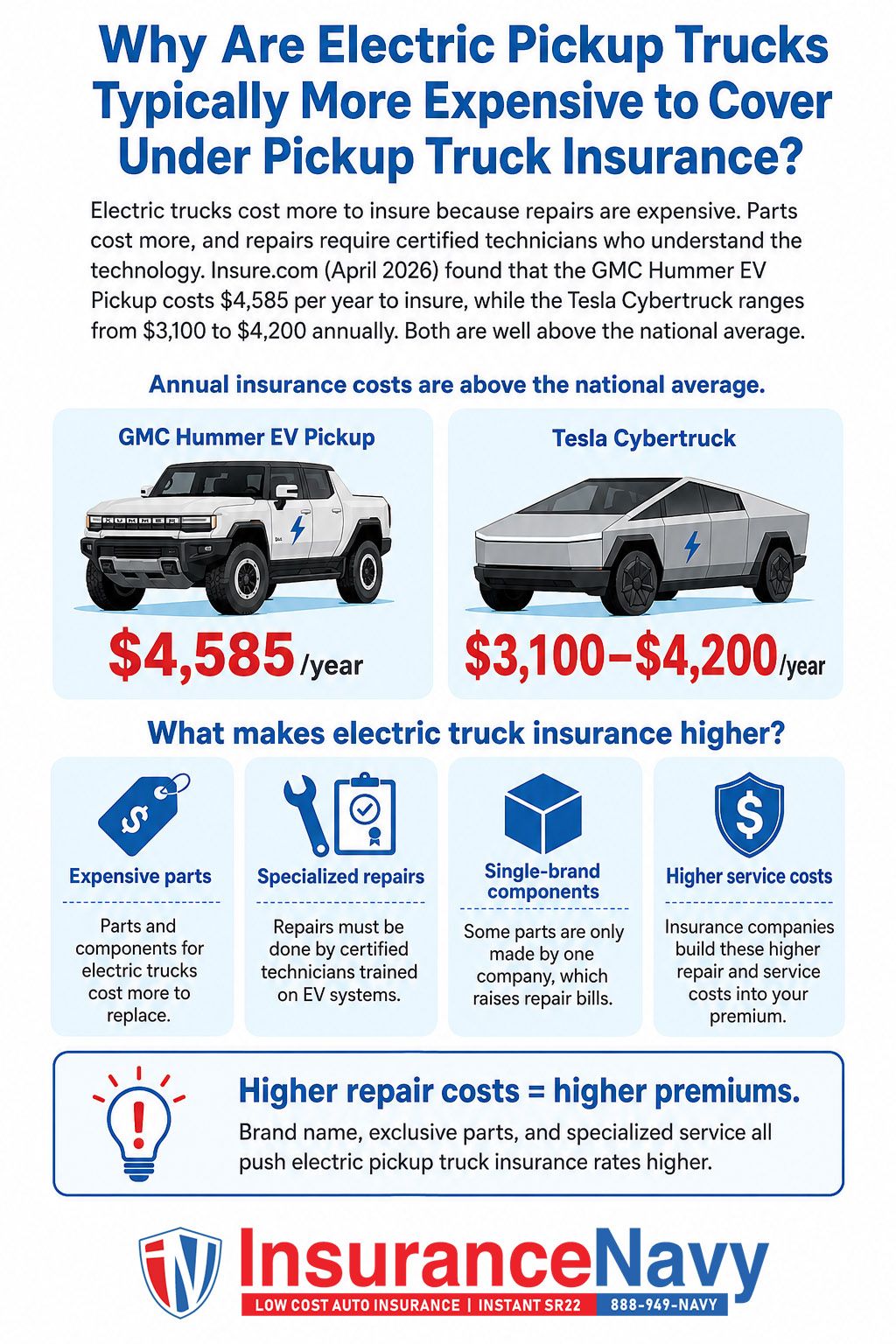
Electric trucks cost more to insure because fixing them is expensive. The parts are costly, and repairs have to be done by certified technicians who know the technology. Insure.com (April 2026) found that the GMC Hummer EV Pickup runs $4,585 per year to insure. The Tesla Cybertruck lands between $3,100 and $4,200 annually. Both sit well above the national average. A few things push electric truck insurance higher. Brand name, parts that only one company makes, and the need for specialized service all raise repair bills. Insurance companies build those higher service costs right into your premium.
How Can Drivers Save Money on Pickup Truck Insurance?
There are real ways to cut what you pay for truck insurance, and most of them are not complicated. A good insurance agency will walk you through every discount you might qualify for. Shopping online makes it easy to get a quote quickly and stack several rates side by side.
Common discounts available to pickup truck drivers:
A safe driving discount goes to drivers who have stayed out of trouble on the road.
A bundling discount cuts your costs when you combine your home and auto policies with the same company.
A low mileage discount helps if you do not drive very often.
An anti-theft device discount lowers your rate when your truck has a working security system.
A military community discount can mean big savings for veterans and those currently serving.
A loyalty discount rewards you for staying with the same insurer year after year.
An insurance agency can spot discounts you might miss on your own. Over time, the single best thing you can do to lower your rate is simply drive safely. Check your policy once a year to make sure it still fits how you live and how you use your truck.