
Box Truck Insurance: Types, Liability requirements, Factors, Costs, Weight Class, Coverage, Premiums
Box truck insurance protects commercial vehicles used for deliveries, moving services, and freight hauling across America. Operating a box truck exposes businesses to significant financial risks. Accidents, cargo damage, and liability claims can devastate unprotected operations. According to the National Safety Council, 5,472 people died in large-truck crashes in 2023. Understanding the right coverage helps operators protect their drivers, cargo, and business assets. This guide answers every critical question about box truck insurance costs, requirements, and coverage types, helping you choose the right policy for your commercial trucking operations.


What is Box Truck Insurance?
Box truck insurance is a commercial auto insurance policy that covers straight trucks with enclosed cargo compartments used for business operations. Box truck insurance provides financial protection for operators hauling goods, making deliveries, or transporting equipment commercially. This specialized trucking insurance covers physical damage, liability, and cargo losses. According to MoneyGeek, box trucks cost an average of $388 monthly to insure, significantly less than the $639 average for semi-trucks. A box truck insurance policy protects the vehicle, driver, and business from accident-related expenses. Businesses choosing this commercial insurance avoid catastrophic out-of-pocket costs. Unlike standard auto insurance, box truck insurance accounts for commercial use, vehicle weight, and cargo exposure.
What types of coverage are typically included in a box truck insurance policy?
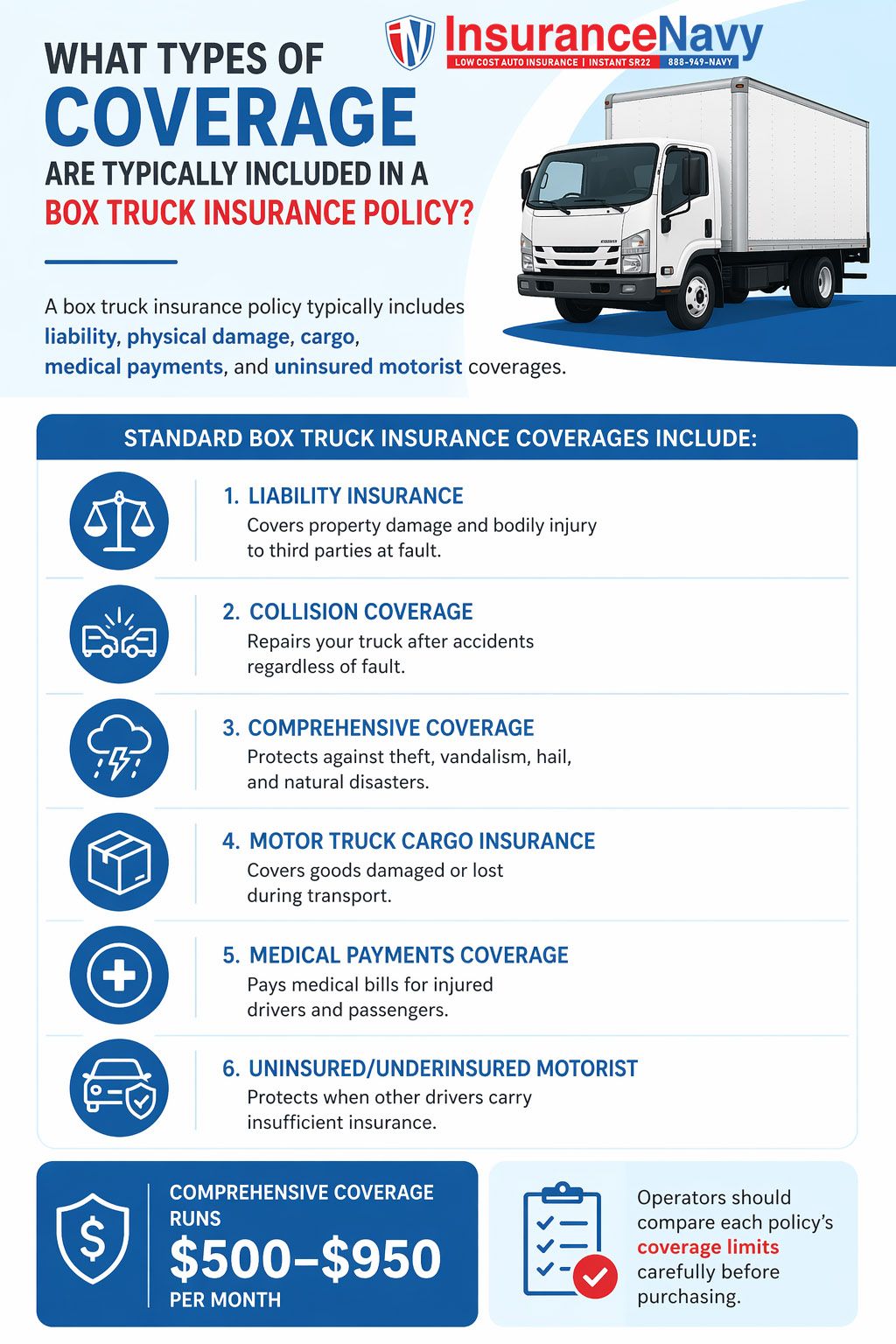
A box truck insurance policy typically includes liability, physical damage, cargo, medical payments, and uninsured motorist coverages.
Standard box truck insurance coverages include:
Liability insurance, covers property damage and bodily injury to third parties at fault
Collision coverage, repairs your truck after accidents regardless of fault
Comprehensive coverage, protects against theft, vandalism, hail, and natural disasters
Motor truck cargo insurance, covers goods damaged or lost during transport
Medical payments coverage, pays medical bills for injured drivers and passengers
Uninsured/underinsured motorist, protects when other drivers carry insufficient insurance
Comprehensive coverage runs $500–$950 per month. Operators should compare each policy's coverage limits carefully before purchasing.
What are the federal minimum liability requirements for box truck insurance?
The federal minimum liability requirements for box truck insurance are $300,000 for vehicles under 10,001 lbs and $750,000 for heavier trucks. As stated by FMCSA guidelines, vehicles with a GVWR over 10,001 lbs require $750,000 minimum liability. Motor vehicle and equipment haulers must carry $1,000,000. Hazardous materials carriers require $5,000,000 in liability insurance. The FMCSA also mandates minimum cargo insurance of $5,000 per vehicle and $10,000 per occurrence. As noted by AtoB, a proposed federal increase to $2 million could significantly raise insurance premiums for smaller operations. Box truck operators must meet these FMCSA requirements before operating commercially across state lines.
What factors influence the cost of box truck insurance premiums?
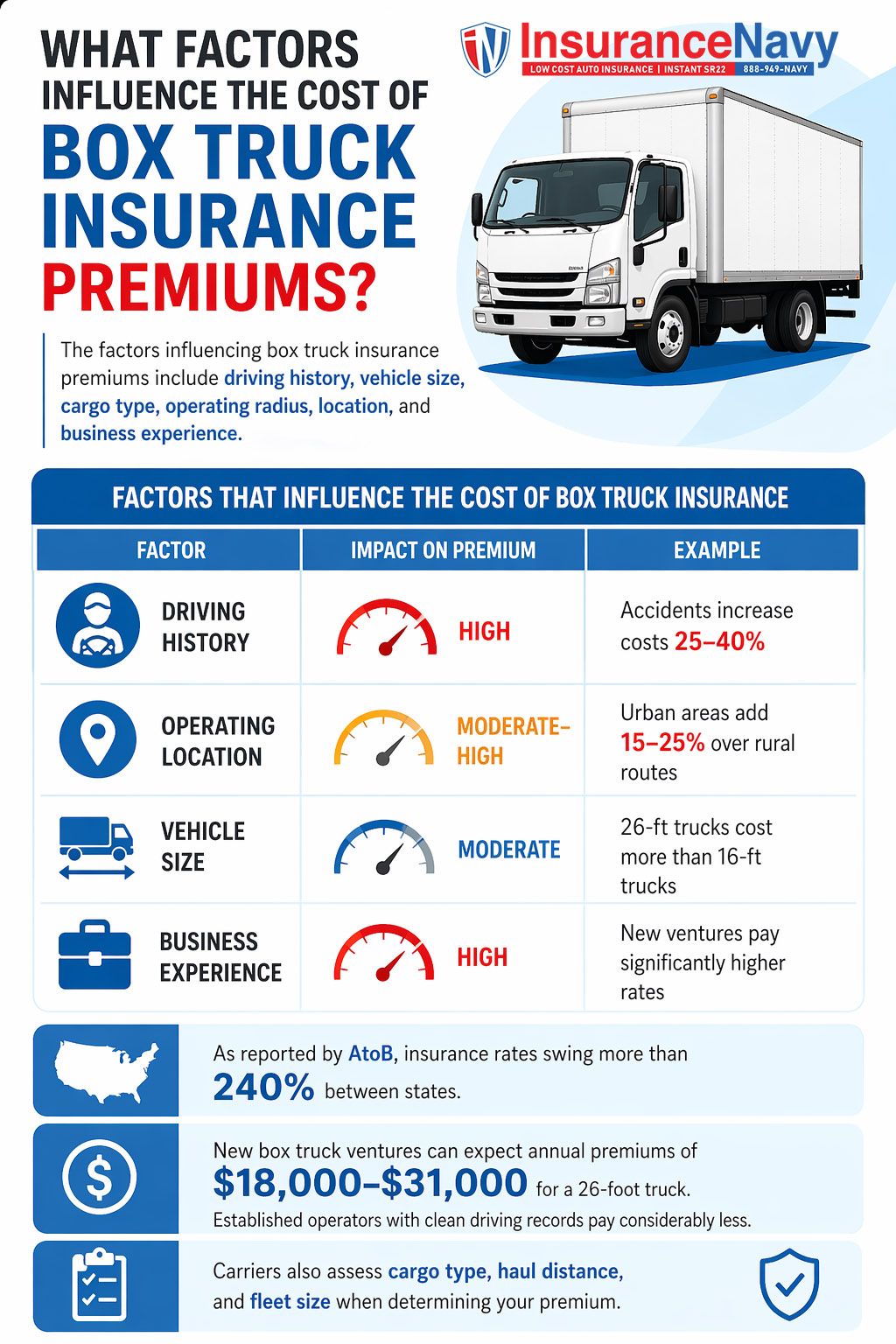
The factors influencing box truck insurance premiums include driving history, vehicle size, cargo type, operating radius, location, and business experience.
| Factor | Impact on Premium | Example |
|---|---|---|
| Driving history | High | Accidents increase costs 25–40% |
| Operating location | Moderate–High | Urban areas add 15–25% over rural routes |
| Vehicle size | Moderate | 26-ft trucks cost more than 16-ft trucks |
| Business experience | High | New ventures pay significantly higher rates |
As reported by AtoB, insurance rates swing more than 240% between states. New box truck ventures can expect annual premiums of $18,000–$31,000 for a 26-foot truck. Established operators with clean driving records pay considerably less. Carriers also assess cargo type, haul distance, and fleet size when determining your premium.
Does box truck insurance depend on vehicle weight class?
Yes, box truck insurance depends on vehicle weight class, with heavier trucks requiring higher liability limits and carrying higher premiums. Vehicle weight directly determines FMCSA insurance requirements and insurer risk calculations. 16-foot box trucks carry lower premiums at $216–$820 per month, while 26-foot box trucks cost $231–$946 per month. Heavier trucks cause more damage in accidents, which drives premiums higher. As per FreightWaves, 26-foot box truck owner-operators commonly see $550–$1,100 per month due to higher vehicle value and weight. Insurers classify trucks by Gross Vehicle Weight Rating (GVWR). Operators must know their truck's weight class to meet federal requirements and secure proper coverage limits.
How does the size of a box truck affect its insurance coverage requirements?
The size of a box truck affects its insurance coverage requirements by determining applicable FMCSA liability thresholds and influencing available coverage options. Larger straight trucks carry more cargo, pose greater accident risks, and require higher liability insurance limits. As stated by Trucking Insurance Services LLC, vehicles under 10,001 pounds need only $300,000 minimum liability. Trucks exceeding this threshold must carry $750,000. Size also affects physical damage coverage costs. Bigger trucks cost more to repair or replace, raising collision and comprehensive premiums. Operators hauling furniture, electronics, or high-value inventory in larger trucks should consider additional cargo protection. Reviewing size-specific coverage requirements helps businesses start with the right policy from day one.
Does box truck insurance cover cargo protection?
Yes, box truck insurance covers cargo protection through motor truck cargo insurance, which covers goods damaged, stolen, or lost during transport. Motor truck cargo insurance protects the freight operators haul for clients. Coverage applies when cargo is damaged due to accidents, theft, fire, or vandalism. As per FMCSA, minimum cargo insurance requirements are $5,000 per vehicle and $10,000 per occurrence. However, most commercial operators carry significantly higher limits. Businesses hauling high-value goods, including electronics, appliances, or plants, need robust cargo coverage. Without truck cargo insurance, operators pay out-of-pocket for lost or damaged client property. Choosing adequate cargo insurance limits protects your business reputation and ensures contract compliance with shippers.
What are box truck insurance liability limits by state?
Box truck insurance liability limits by state vary significantly, with state minimums often exceeding or matching federal FMCSA requirements depending on local regulations.
| State | Monthly Liability Cost | Annual Estimate |
|---|---|---|
| New York | ~$666 | ~$7,992 |
| New Jersey | Highest nationally | ~$20,763 |
| Louisiana | Second highest | ~$19,736 |
| Maine | ~$275 | ~$3,300 |
| Mississippi | Lowest nationally | ~$3,552 |
Premiums vary from $3,552 annually in Mississippi to $20,763 in New Jersey. AtoB confirms insurance rates swing more than 240% between states. Urban routes within any state add 15–25% over rural operations. Operators must verify state-specific liability requirements before selecting coverage limits.
How does box truck insurance differ from standard commercial truck insurance?
Box truck insurance differs from standard commercial truck insurance by focusing on straight trucks used for local deliveries rather than long-haul tractor-trailers.
Key differences between box truck and standard commercial truck insurance:
Vehicle type, box trucks are straight trucks; commercial truck insurance covers semi-trucks and tractor-trailers
Operating radius, box trucks typically operate locally; commercial trucking extends nationally
Premium levels, box trucks average $388/month vs. $639/month for semi-trucks per MoneyGeek
Cargo exposure, box trucks haul lighter loads with lower cargo insurance requirements
License requirements, most box trucks don't require a CDL, affecting risk profiles
According to industry averages,, specialty truckers pay $746 monthly on average compared to $954 for transport truckers. Businesses should confirm which policy type matches their specific operations.
What Businesses Need Box Truck Insurance?
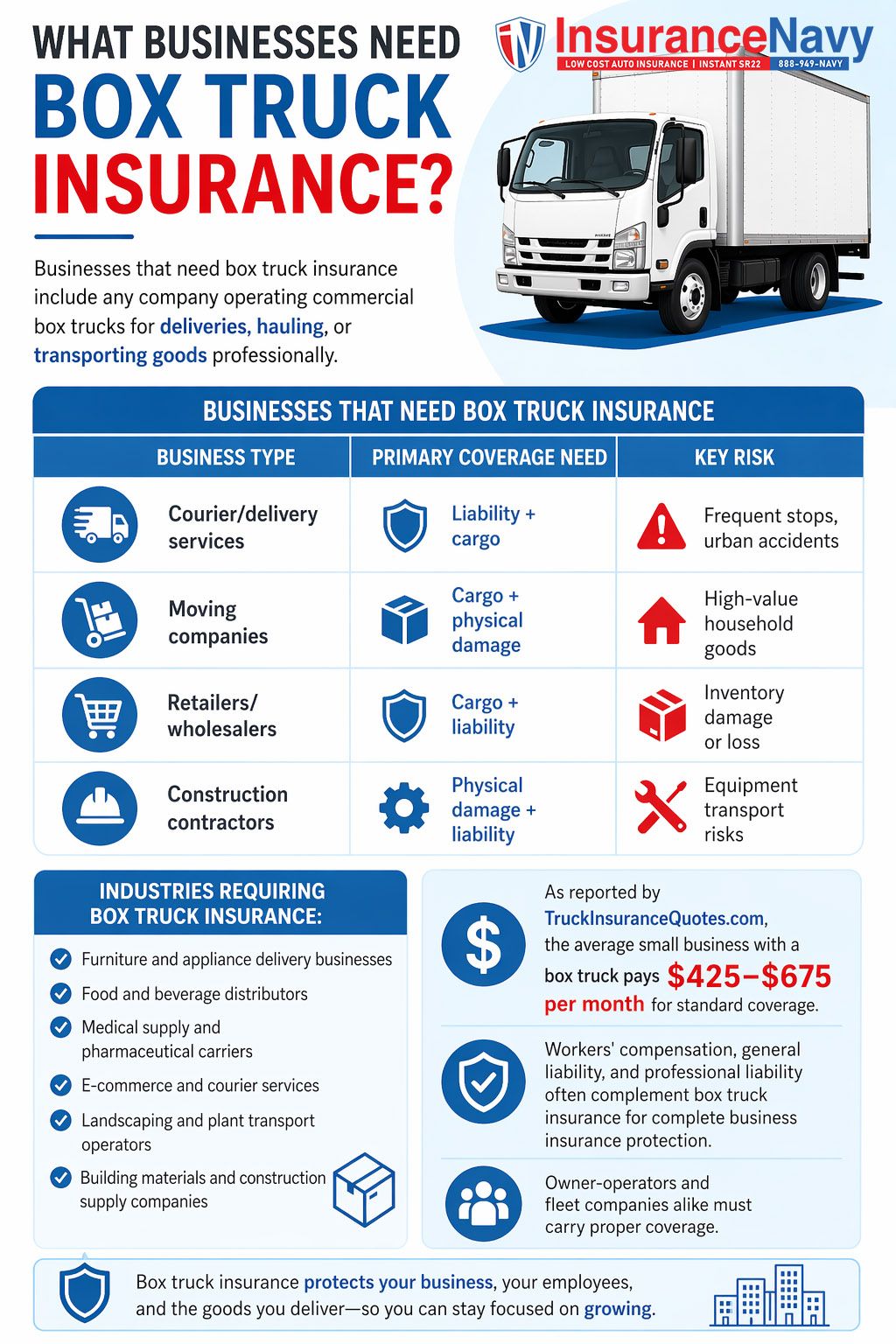
Businesses that need box truck insurance include any company operating commercial box trucks for deliveries, hauling, or transporting goods professionally.
| Business Type | Primary Coverage Need | Key Risk |
|---|---|---|
| Courier/delivery services | Liability + cargo | Frequent stops, urban accidents |
| Moving companies | Cargo + physical damage | High-value household goods |
| Retailers/wholesalers | Cargo + liability | Inventory damage or loss |
| Construction contractors | Physical damage + liability | Equipment transport risks |
Industries requiring box truck insurance:
Furniture and appliance delivery businesses
Food and beverage distributors
Medical supply and pharmaceutical carriers
E-commerce and courier services
Landscaping and plant transport operators
Building materials and construction supply companies
As reported by TruckInsuranceQuotes.com, the average small business with a box truck pays $425–$675 per month for standard coverage. Workers' compensation, general liability, and professional liability often complement box truck insurance for complete business insurance protection. Owner-operators and fleet companies alike must carry proper coverage.
Get the Right Box Truck Insurance Today
Box truck insurance protects your drivers, cargo, vehicles, and business from costly accidents and liability claims. According to Logrock, established operators pay $250–$950 monthly while higher-risk profiles pay $650–$1,600 or more. Insurance requirements vary by state, vehicle weight, and cargo type. Every business hauling commercially needs proper coverage in place before putting trucks on the road.
Insurance Navy helps businesses get affordable box truck insurance quotes fast. Our licensed professionals compare coverages from top carriers to find the right policy for your operations. Request your free insurance quote online today and protect your business with trusted, dedicated commercial insurance coverage.