
Semi Truck Insurance: Requirements, Coverages, Cost, Rates, Quotes
Semi truck insurance is a commercial auto insurance policy designed for Class 8 vehicles and large commercial trucks, serving owner-operators, leased-on drivers, and fleet owners. Coverage options include primary liability (with FMCSA minimums ranging from $750,000 to $5,000,000 depending on freight type), physical damage, motor truck cargo, and non-trucking liability. Owner-operators can expect to pay between $8,000 and $15,000 per year on average, with rates influenced by CDL experience, operating radius, authority history, credit score, vehicle value, and cargo type. Proper compliance with state and federal filing requirements like the BMC-91X is essential for interstate operations.


Table of contents
- What Is Semi Truck Insurance?
- Who Needs Semi Truck Insurance?
- Owner-operators with independent authority
- Leased-on drivers
- Fleet owners
- What Does Semi Truck Insurance Cover?
- Primary liability insurance
- Physical damage coverage
- Motor truck cargo insurance
- Non-trucking liability coverage
- How Much Does Semi Truck Insurance Cost?
- What Affects Semi Truck Insurance Rates?
- Driver’s CDL Experience
- States of Operation and Radius
- USDOT Operating Authority History
- Credit History
- Vehicle Features and Value
- Cargo Type
- State Availability & Compliance
- How to Get the Right Semi Truck Insurance Coverage
- Why Work With an Insurance Broker for Your Semi Truck Insurance?
- Get a Commercial Truck Insurance Quote Today
Semi truck insurance protects drivers, fleet owners, and owner-operators from the financial impact of accidents, cargo losses, and liability claims.
As a truck driver, you need something more than just insurance to check off on the compliance checklist; you need assurance that your loss of income is covered. The trucking industry depends on insurance policies that cover more than just the minimum requirements.
The amount of insurance you have is significant and will make or break you when it comes time to collect on your loss of income claim.
Below, we explain how commercial truck insurance works, who needs it, what it covers, and how to choose the right policy for your business.
What Is Semi Truck Insurance?
Semi truck insurance is a form of commercial truck insurance that falls under the commercial auto insurance category.
This insurance policy is primarily for Class 8 vehicles and other large commercial trucks that operate under state or federal authority.
Semi-truck policies cover multi-million-dollar liabilities, high-value cargo losses, and niche equipment.
Regulations and clients alike demand financial protection that personal insurance can't provide. Typically, it shields the truck, trailer, and load.
A semi truck can weigh 40 tons, so the risks are much greater than driving a passenger vehicle. Your semi-truck insurance policy will keep you from jeopardizing your entire business or company because of one accident.
Who Needs Semi Truck Insurance?
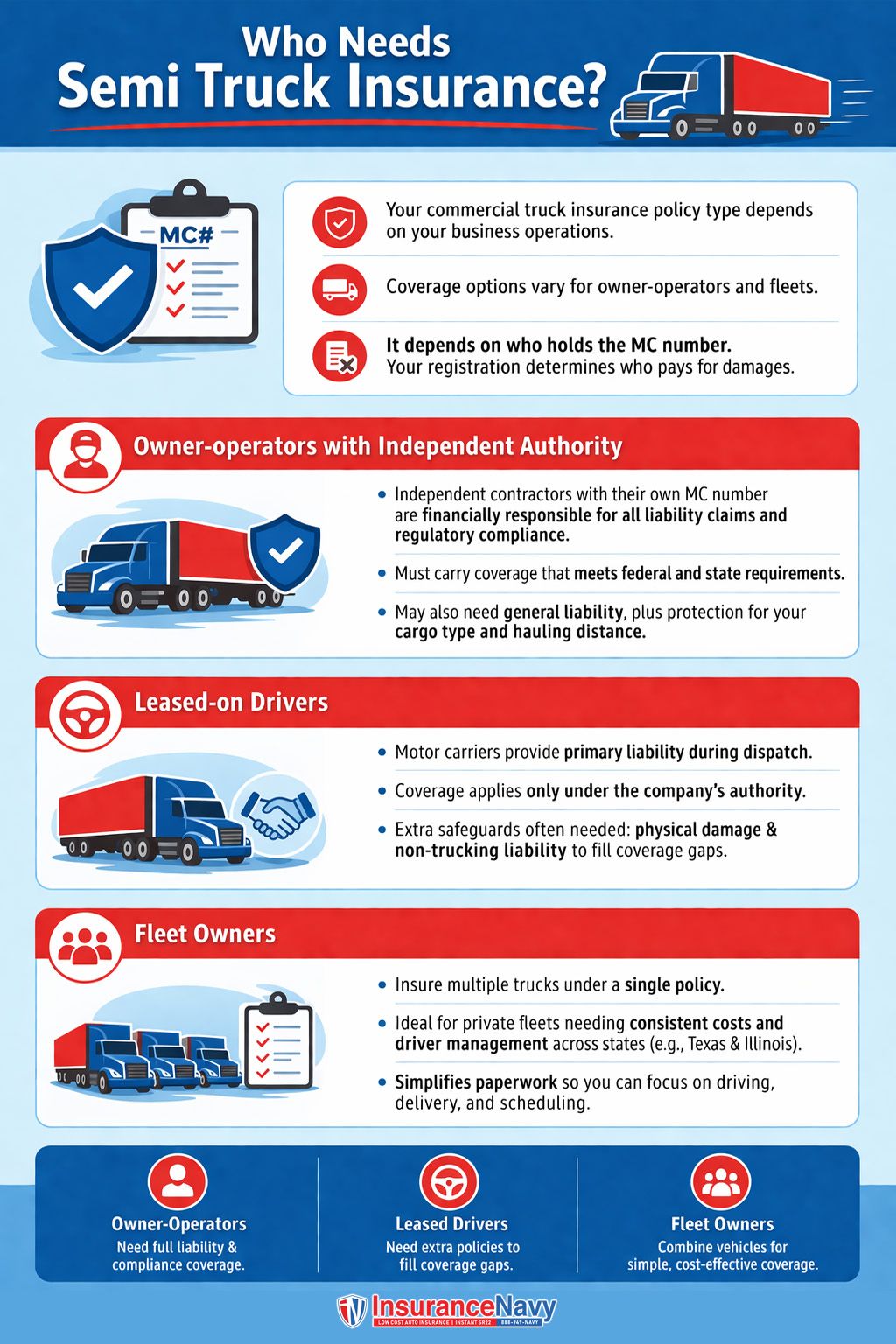
Your commercial truck insurance policy type depends on your business operations. There are different coverage options for owner-operators and fleets.
However, this depends on who holds the MC number. Your registration determines who pays for damages in the event of an accident.
Owner-operators with independent authority
Independent contractors with their own MC number are financially responsible for all liability claims and regulatory compliance. You must carry coverage that meets federal and state requirements.
Depending on your type of operations you may also need general liability coverage too. You’ll also need protection that reflects the type of cargo and the distance you haul.
Leased-on drivers
Most motor carriers provide primary liability during dispatch.
However, that protection applies only when you’re hauling under the company's authority. Leased drivers often need extra safeguards. Additional policies, such as physical damage or non-trucking liability, are often needed to close those gaps.
Fleet owners
Operating multiple trucks as a fleet presents some operational challenges. Fleet insurance allows all vehicles to be combined under a single policy.
This is especially valuable for private carriers who need consistent operating costs and driver management across states like Texas and Illinois.
It also reduces the paperwork required while allowing greater focus on driving, delivery, and scheduling.
What Does Semi Truck Insurance Cover?
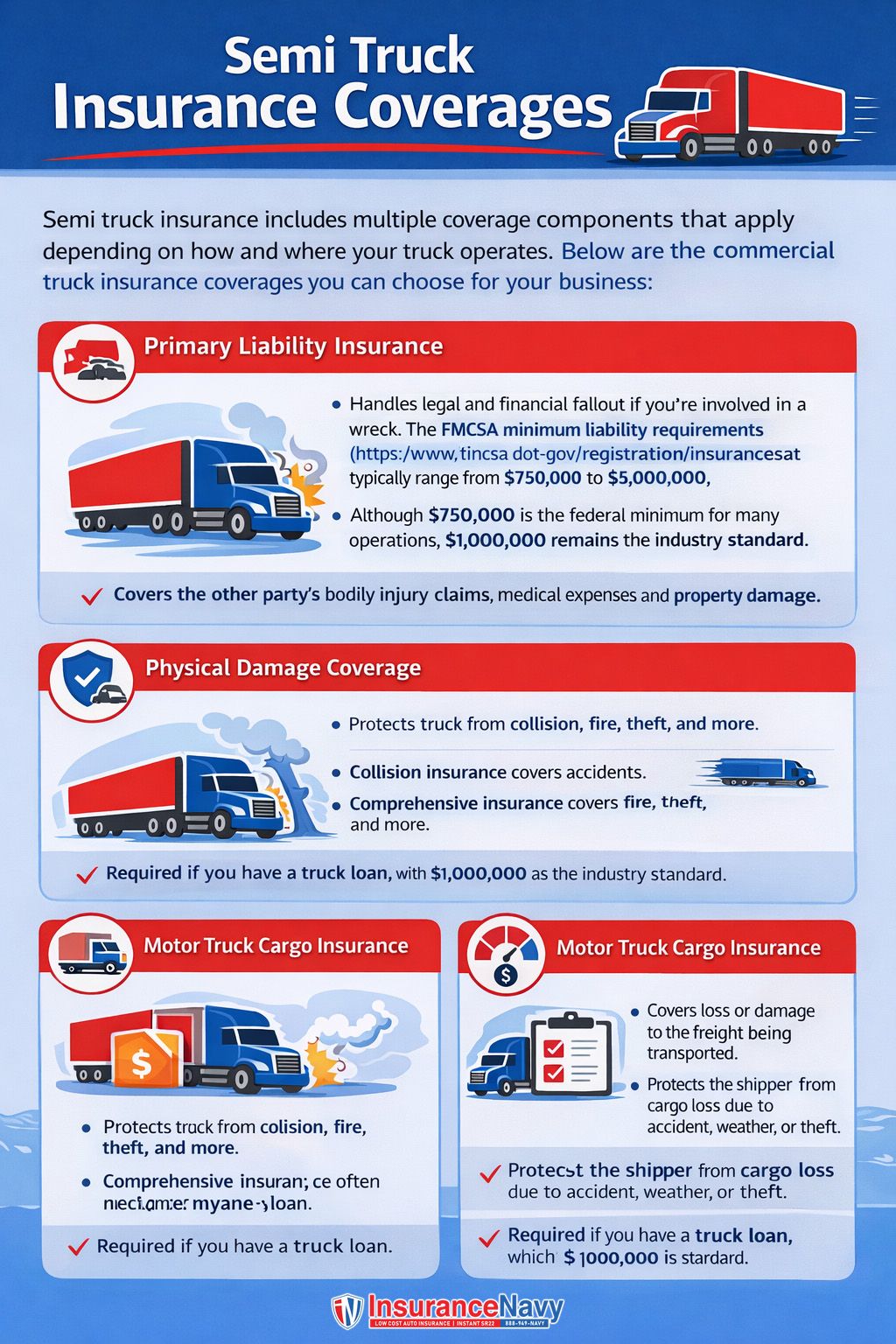
Semi truck insurance includes multiple coverage components that apply depending on how and where your truck operates. Below are the commercial truck insurance coverages you can choose for your business:
Primary liability insurance
This handles the legal and financial fallout if you're involved in a wreck. The FMCSA minimum liability requirements typically range from $750,000 to $5,000,000, depending on the type of freight being hauled.
Although $750,000 is the federal minimum for many operations, $1,000,000 remains the industry standard.
Shippers and brokers generally won't provide a rate contract without at least $1,000,000 in liability insurance for interstate trucking.
It settles the other party's bodily injury claims, medical expenses and property damage, ensuring that one accident doesn't end your business.
Physical damage coverage
Physical damage coverage protects your truck in two ways. Collision insurance covers crashes, and comprehensive covers things like fire, theft or hitting an animal on the road.
If you have a loan on your rig, your lender will typically require physical damage insurance to protect their interest and get it to a qualified repair shop to fix it.
Motor truck cargo insurance
In many cases, the value of the cargo being hauled exceeds the value of the truck itself. Motor truck cargo insurance provides coverage for loss or damage to the freight being transported.
Whether it is from accidents, weather events, or cargo theft, your truck is covered. This type of coverage protects the shipper, not you, as it prevents loss or damage to the cargo from becoming a direct claim against you.
Non-trucking liability coverage
A motor carrier’s policy usually ends when a driver is off dispatch or not conducting company-related business. Non-trucking liability covers owner-operators and truck drivers when they aren't working.
Operators who pull trailers owned by companies other than theirs may need trailer interchange coverage to protect equipment they don't own. It is mandatory when the equipment is held under an interchange agreement.
How Much Does Semi Truck Insurance Cost?
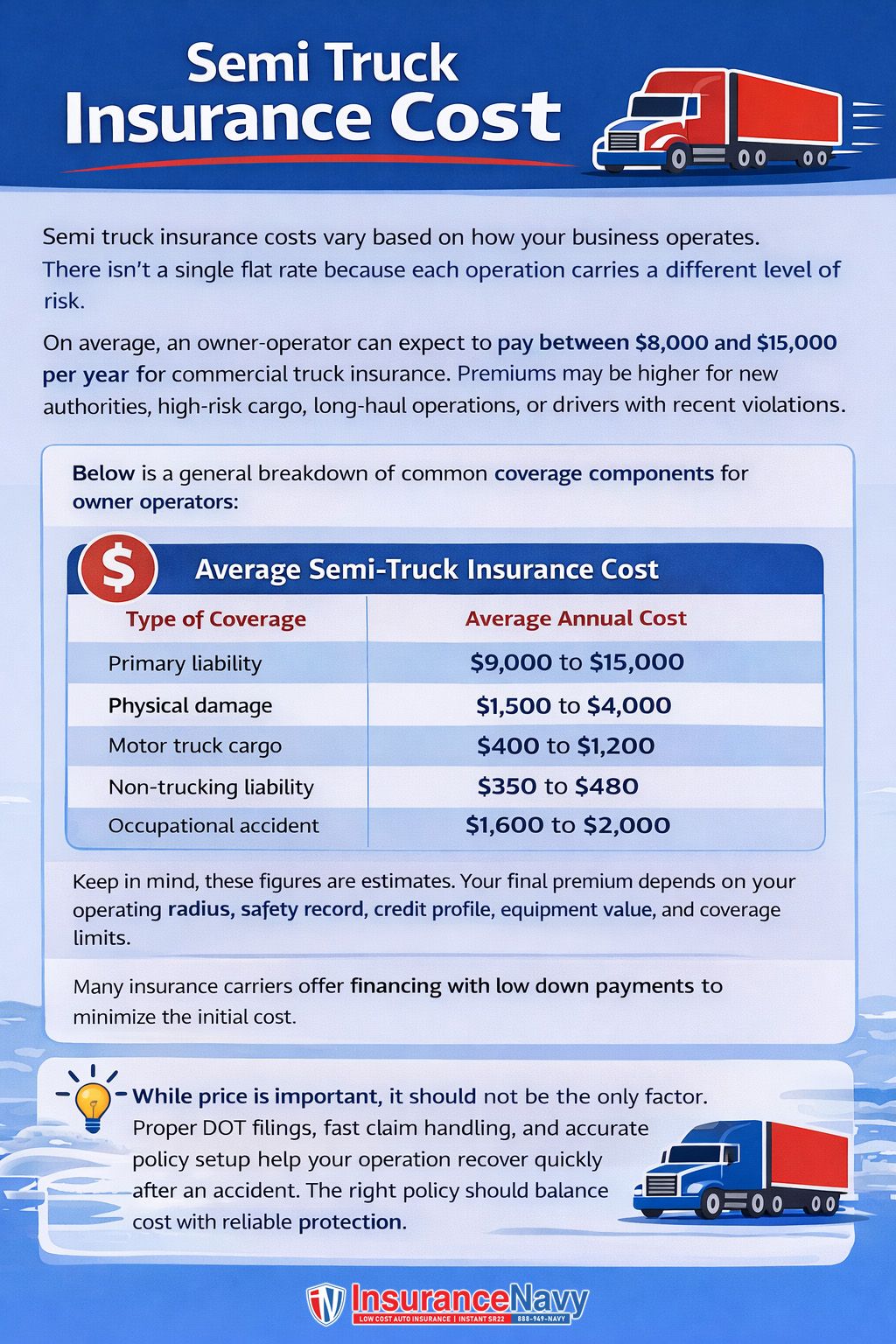
Semi truck insurance costs vary based on how your business operates. There isn’t a single flat rate because each operation carries a different level of risk.
On average, an owner-operator can expect to pay between $8,000 and $15,000 per year for commercial truck insurance. Premiums may be higher for new authorities, high-risk cargo, long-haul operations, or drivers with recent violations.
Below is a general breakdown of common coverage components for owner-operators:
Type of Coverage | Average Annual Cost |
|---|---|
Primary liability | $9,000 to $15,000 |
Physical damage | $1,500 to $4,000 |
Motor truck cargo | $400 to $1,200 |
Non-trucking liability | $350 to $480 |
Occupational accident | $1,600 to $2,000 |
Keep in mind, these figures are estimates. Your final premium depends on your operating radius, safety record, credit profile, equipment value, and coverage limits.
Many insurance carriers offer financing with low down payments to minimize the initial cost.
While price is important, it should not be the only factor. Proper DOT filings, fast claim handling, and accurate policy setup help your operation recover quickly after an accident. The right policy should balance cost with reliable protection.
What Affects Semi Truck Insurance Rates?
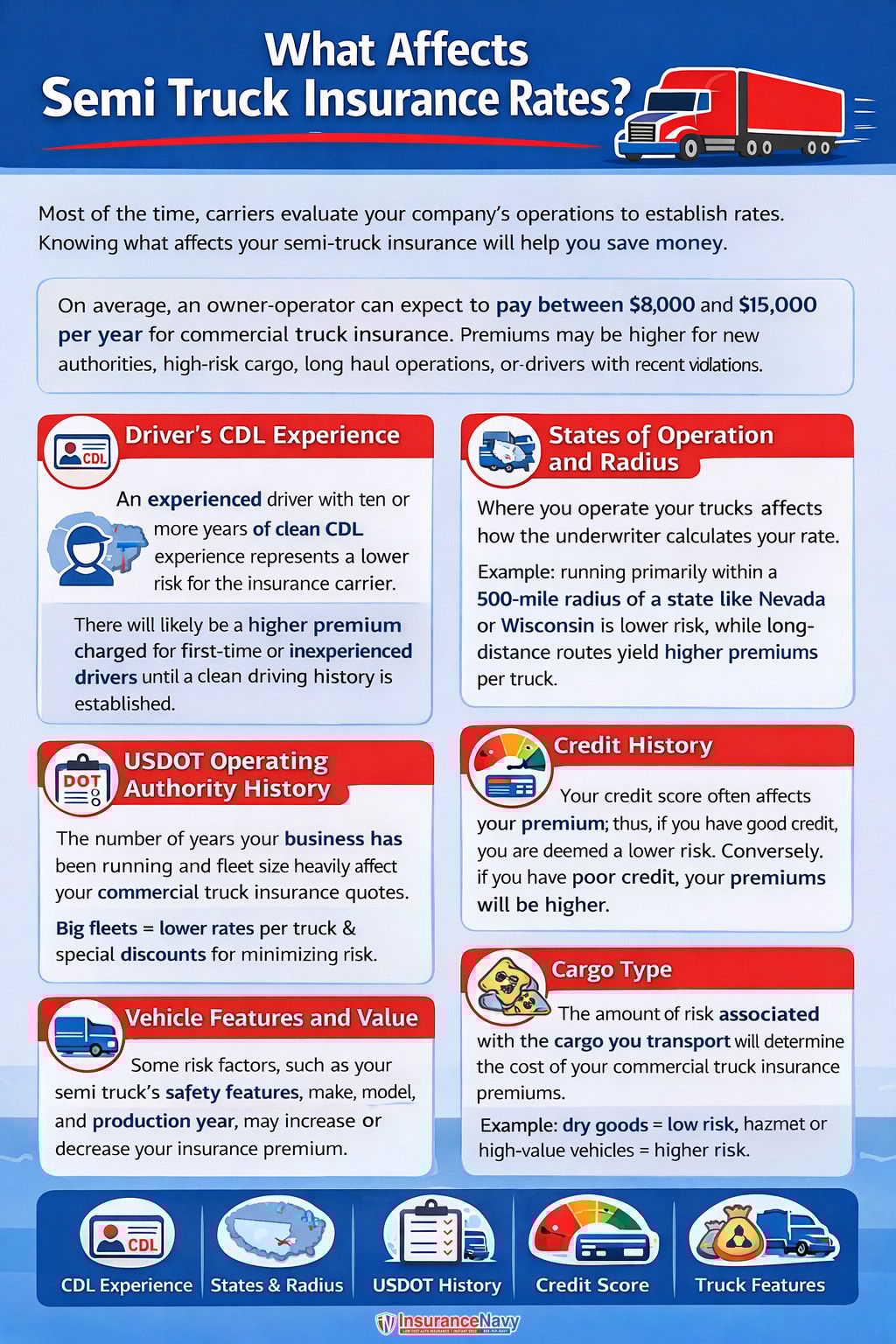
Most of the time, carriers evaluate your company's operations to establish rates. Knowing what affects your semi-truck insurance will help you save money.
Driver’s CDL Experience
An experienced driver with ten or more years of clean CDL experience represents a lower risk for the insurance carrier.
There will likely be a higher premium charged for first-time or inexperienced drivers until a clean driving history is established.
States of Operation and Radius
Where you operate your trucks affects how the underwriter calculates your rate.
For example, if you run primarily within a 500-mile radius of a state such as Nevada or Wisconsin, you’d be considered a lower risk. On the other hand, companies that do long-distance routes are more likely to experience claims. This will be reflected in the cost of coverage for each claim experienced.
USDOT Operating Authority History
The number of years your business has been running and fleet size heavily affect your commercial truck insurance quotes. Larger fleets often benefit from lower insurance rates per truck and specialized discounts.
This is because larger fleets help insurance companies minimize risk, usually with risk management resources and safety programs.
Credit History
Your credit score often affects your premium; thus, if you have good credit, you are deemed a lower risk. Conversely, if you have poor credit, your premiums will be higher until you improve your score.
Vehicle Features and Value
Some risk factors, such as your semi truck's safety features, make, model, and production year, may increase or decrease your insurance premium.
Cargo Type
The amount of risk associated with the cargo you transport will determine the cost of your commercial truck insurance premiums.
For example, dry goods would present a relatively low risk to the insurer, whereas hazardous materials or high-value vehicles would entail a greater potential for loss. Therefore, premiums will be higher to offset the risk of loss from transporting dangerous goods or high-value vehicles.
State Availability & Compliance
Geography plays a huge role in your insurance. The FMCA requires interstate carriers to file proof of financial responsibility forms, such as the BMC-91X.
These filings confirm that your liability coverage meets federal standards and is properly registered before you operate across state lines. Every state has different filing requirements.
Texas and California: Operating in these states may require state specific filings in addition to federal FMCSA requirements, depending on whether you operate interstate or intrastate. California requires commercial vehicles operators to obtain MCP-65 (Motor Carrier Permit) and a Carrier Identification Number. Carriers must ensure all the required proof of financial responsibility filings are submitted correctly before they operate.
Illinois and Indiana: Driving through the Midwest means contending with snow, ice, and other winter conditions. Insurance providers factor in your history when tackling these challenges when calculating premiums. Maintaining a clean record on these routes can give you more leverage to secure a favorable rate.
Georgia and Tennessee: These states are the backbone of regional logistics in the Southeast. If you primarily move loads within this area, you might only need intrastate filings. However, once you cross a state line, you must ensure your BMC-91X is filed with the FMCSA.
How to Get the Right Semi Truck Insurance Coverage
Getting a quote for semi-truck insurance shouldn’t be complicated. You don’t want to spend time explaining the difference between a reefer and a flatbed to someone unfamiliar with your paperwork.
So, you need a partner who understands the road, your equipment, and the risks that come with it. Insurance Navy is the right partner who can customize coverage solutions to your specific trucking business.
A broker can compare rates across multiple insurers, showing you which options balance cost with real protection.
Instead of bouncing between a dozen websites, you see side-by-side how each company views your operation. This reduces the likelihood of hidden fees and helps you choose a policy that meets your shippers' needs, so you can focus on keeping freight moving.
As a licensed insurance agency, Insurance Navy filters through these preferences for you. By matching your equipment and routes with the right carrier's niche, we can often secure lower rates that a general agent simply wouldn't have access to.
Why Work With an Insurance Broker for Your Semi Truck Insurance?
The freight market is volatile. One week, a company may offer a certain premium; the next, recent claims or underwriting changes can push it higher.
That’s why working with an independent broker is important; you don’t have to settle for a fixed “take it or leave it” quote.
At Insurance Navy, we work with a range of carriers. Multiple underwriters review your profile at once, giving you a clearer picture of who is offering the best terms right now.
You save time, avoid chasing individual quotes, and get a more accurate assessment of your options with top notch customer service.
This approach is especially helpful for new authorities or drivers with a minor incident on their record.
Some carriers may be willing to overlook a minor lapse if your overall safety plan appears solid. With a broker, you know where those opportunities exist without doing all the legwork yourself.
Get a Commercial Truck Insurance Quote Today
Finding the right commercial truck insurance policy starts with understanding your operation. Your routes, cargo, authority status, and equipment all influence the type of coverage you need.
Insurance Navy compares rates from multiple commercial truck insurance carriers to help you review options in one place. Our insurance experts assist with required state and federal filings so your policy is compliant and active.
Request a quote today to compare semi truck insurance coverage and choose the policy that fits your business.