
Limo Insurance: Types, Coverage, Premiums, Capacity, State requirements, Cost, Quotes, 2026
Limo insurance keeps limousine businesses safe from expensive lawsuits and vehicle damage. The problem is that regular auto insurance does not cover cars used to carry paying passengers. That gap puts limo companies at serious financial risk. Limousine operators must buy commercial auto insurance built for livery work. The right policy covers drivers, passengers, and business property all at once. Insurance Navy helps operators find limo insurance that fits their needs and their budget. This guide covers everything you need to know about limousine insurance rules, costs, and coverage options across the USA.
Table of contents
- What is limo insurance?
- What types of coverage does limo insurance require?
- How do limo insurance premiums compare to standard auto?
- What liability limits should limo operators carry?
- How does vehicle size affect limo insurance costs?
- How do coverage limits affect limo insurance costs?
- What factors cause limo insurance premiums to increase?
- What commercial use classification applies to limo drivers?
- How does passenger capacity change limo insurance premiums?
- What state regulatory requirements apply to limo insurance?
- How much does commercial auto liability cost for limos?
- Do I need hired and non-owned auto coverage for limos?
- Limo Insurance quotes from Insurance Navy
What is limo insurance?
Limo insurance is a commercial auto policy made for limousine vehicles and their drivers. It covers injuries, vehicle damage, and medical costs that a personal auto policy will not touch. According to the National Limousine Association, about 87% of limo operators buy this coverage from traditional insurance companies. Operators who rely on personal policies instead end up with serious gaps in protection.
Limo insurance covers:
Bodily injuries to passengers and other people involved in an accident
Property damage that happens during a trip
Repair or replacement costs for the limousine itself
Medical bills after a crash
Lost wages for anyone hurt in the accident
What types of coverage does limo insurance require?
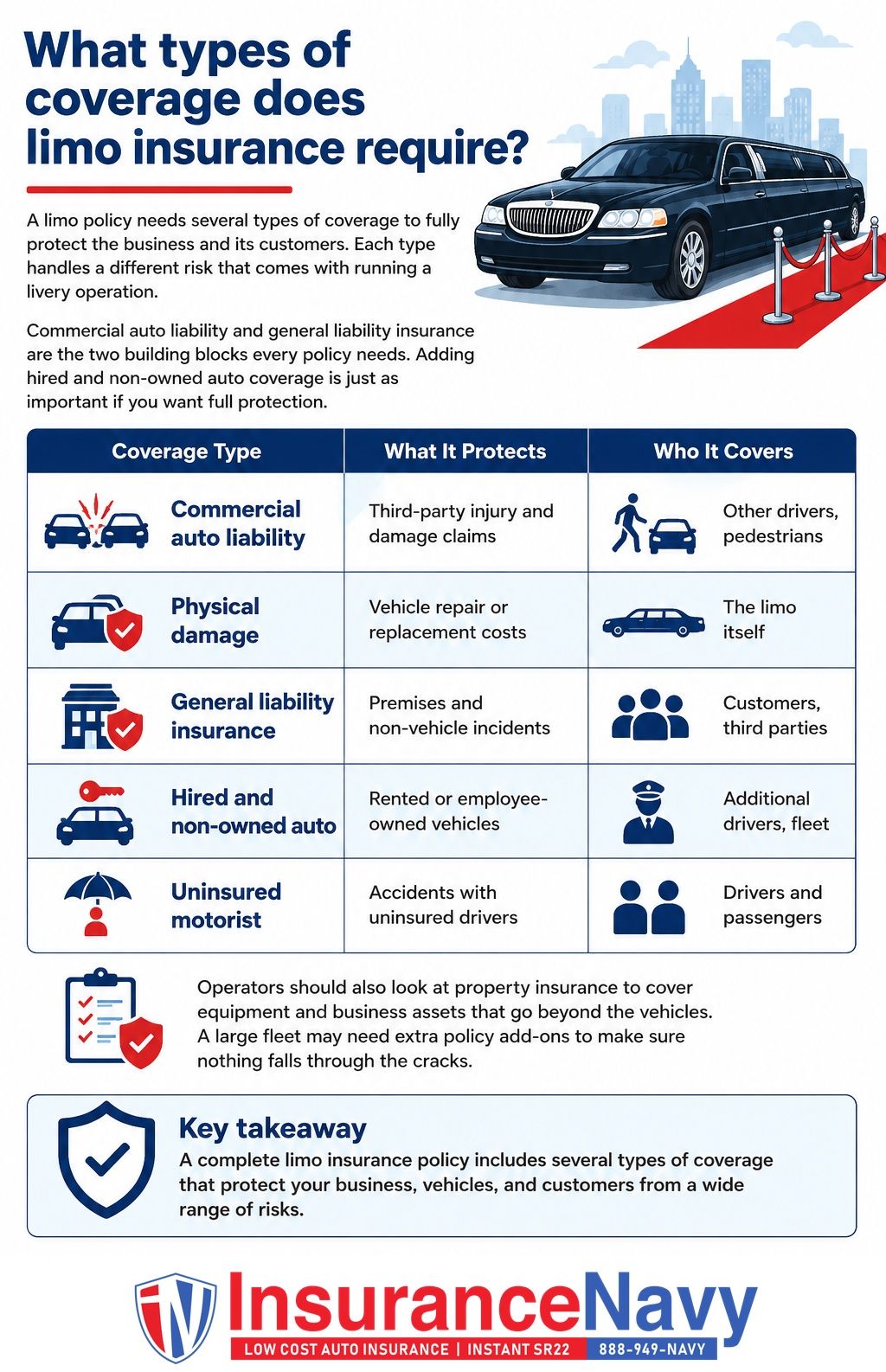
A limo policy needs several types of coverage to fully protect the business and its customers. Each type handles a different risk that comes with running a livery operation. Commercial auto liability and general liability insurance are the two building blocks every policy needs. Adding hired and non-owned auto coverage is just as important if you want full protection.
| Coverage Type | What It Protects | Who It Covers |
|---|---|---|
| Commercial Auto Liability | Third-party injury and damage claims | Other drivers, pedestrians |
| Physical Damage | Vehicle repair or replacement costs | The limo itself |
| General Liability Insurance | Premises and non-vehicle incidents | Customers, third parties |
| Hired and Non-Owned Auto | Rented or employee-owned vehicles | Additional drivers, fleet |
| Uninsured Motorist | Accidents with uninsured drivers | Drivers and passengers |
Operators should also look at property insurance to cover equipment and business assets that go beyond the vehicles. A large fleet may need extra policy add-ons to make sure nothing falls through the cracks.
How do limo insurance premiums compare to standard auto?
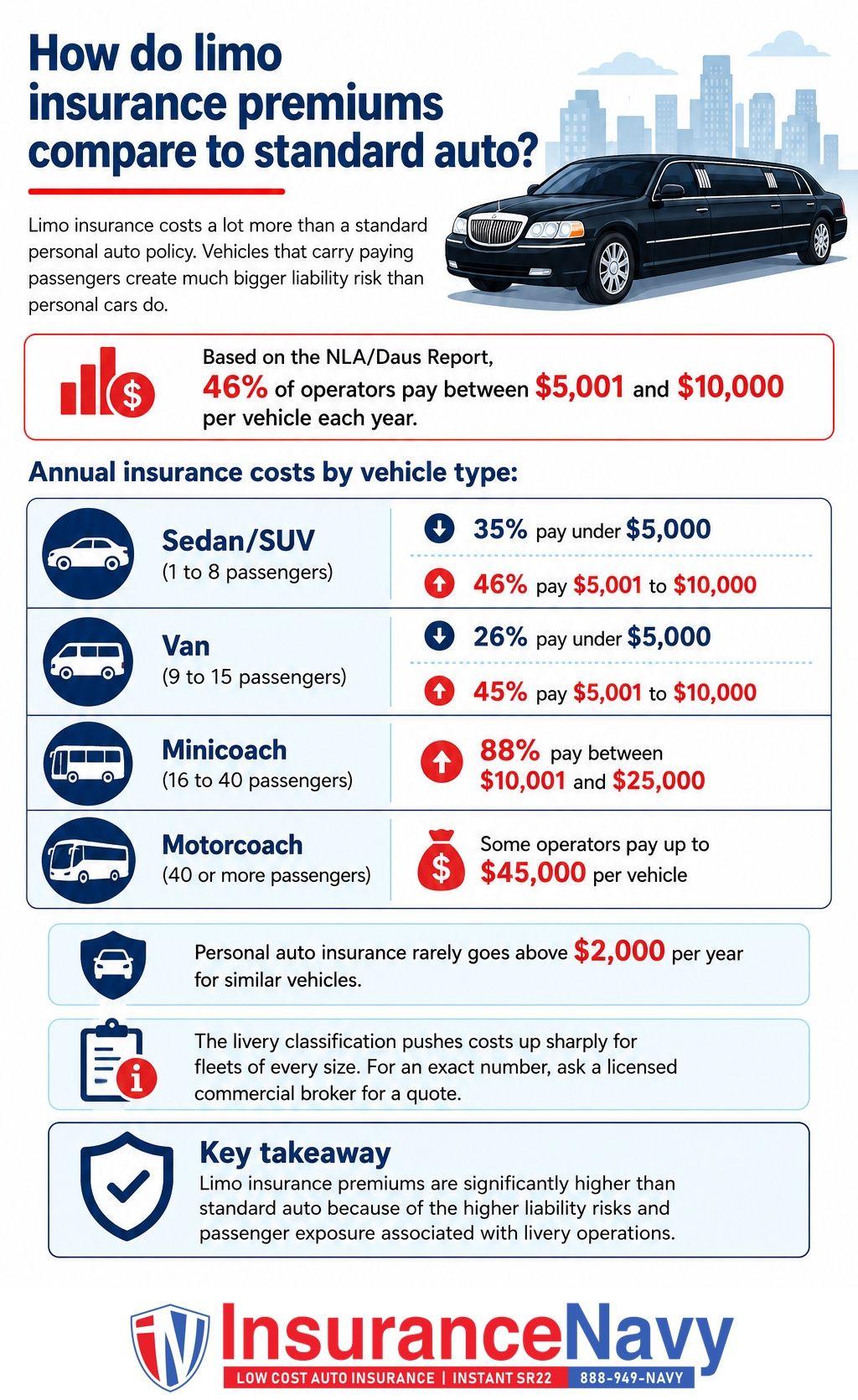
Limo insurance costs a lot more than a standard personal auto policy. Vehicles that carry paying passengers create much bigger liability risk than personal cars do. Based on the NLA/Daus Report, annual costs for sedans and SUVs vary widely, and 46% of operators pay between $5,001 and $10,000 per vehicle each year.
Annual insurance costs by vehicle type:
Sedan/SUV (1 to 8 passengers): 35% pay under $5,000, and 46% pay $5,001 to $10,000
Van (9 to 15 passengers): 26% pay under $5,000, and 45% pay $5,001 to $10,000
Minicoach (16 to 40 passengers): 88% pay between $10,001 and $25,000
Motorcoach (40 or more passengers): some operators pay up to $45,000 per vehicle
Personal auto insurance rarely goes above $2,000 per year for similar vehicles. The livery classification pushes costs up sharply for fleets of every size. For an exact number, ask a licensed commercial broker for a quote.
What liability limits should limo operators carry?
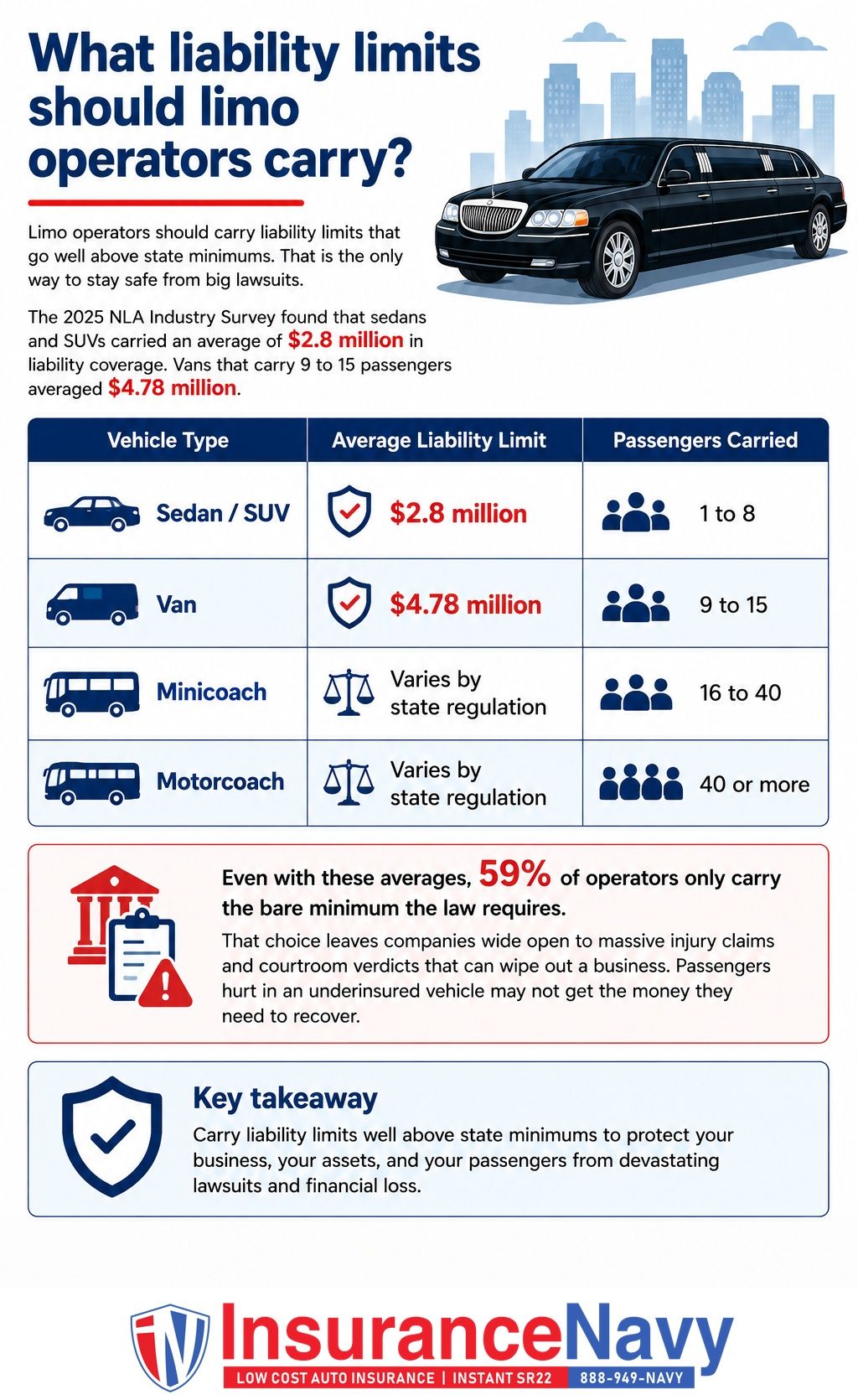
Limo operators should carry liability limits that go well above state minimums. That is the only way to stay safe from big lawsuits. The 2025 NLA Industry Survey found that sedans and SUVs carried an average of $2.8 million in liability coverage. Vans that carry 9 to 15 passengers averaged $4.78 million.
| Vehicle Type | Average Liability Limit | Passengers Carried |
|---|---|---|
| Sedan / SUV | $2.8 million | 1 to 8 |
| Van | $4.78 million | 9 to 15 |
| Minicoach | Varies by state regulation | 16 to 40 |
| Motorcoach | Varies by state regulation | 40 or more |
Even with these averages, 59% of operators only carry the bare minimum the law requires. That choice leaves companies wide open to massive injury claims and courtroom verdicts that can wipe out a business. Passengers hurt in an underinsured vehicle may not get the money they need to recover.
How does vehicle size affect limo insurance costs?
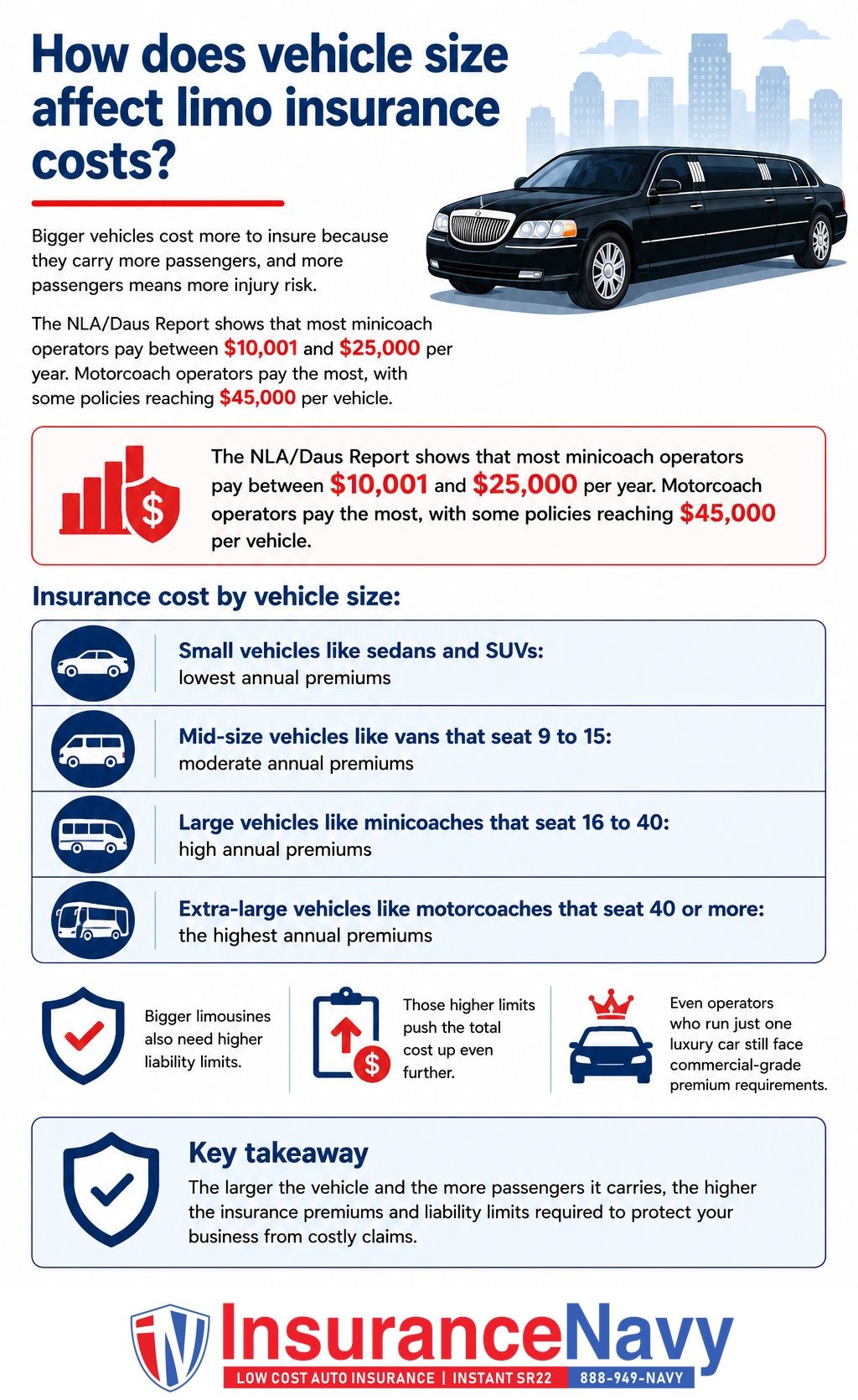
Bigger vehicles cost more to insure because they carry more passengers, and more passengers means more injury risk. The NLA/Daus Report shows that most minicoach operators pay between $10,001 and $25,000 per year. Motorcoach operators pay the most, with some policies reaching $45,000 per vehicle.
Insurance cost by vehicle size:
Small vehicles like sedans and SUVs: lowest annual premiums
Mid-size vehicles like vans that seat 9 to 15: moderate annual premiums
Large vehicles like minicoaches that seat 16 to 40: high annual premiums
Extra-large vehicles like motorcoaches that seat 40 or more: the highest annual premiums
Bigger limousines also need higher liability limits. Those higher limits push the total cost up even further. Even operators who run just one luxury car still face commercial-grade premium requirements.
How do coverage limits affect limo insurance costs?
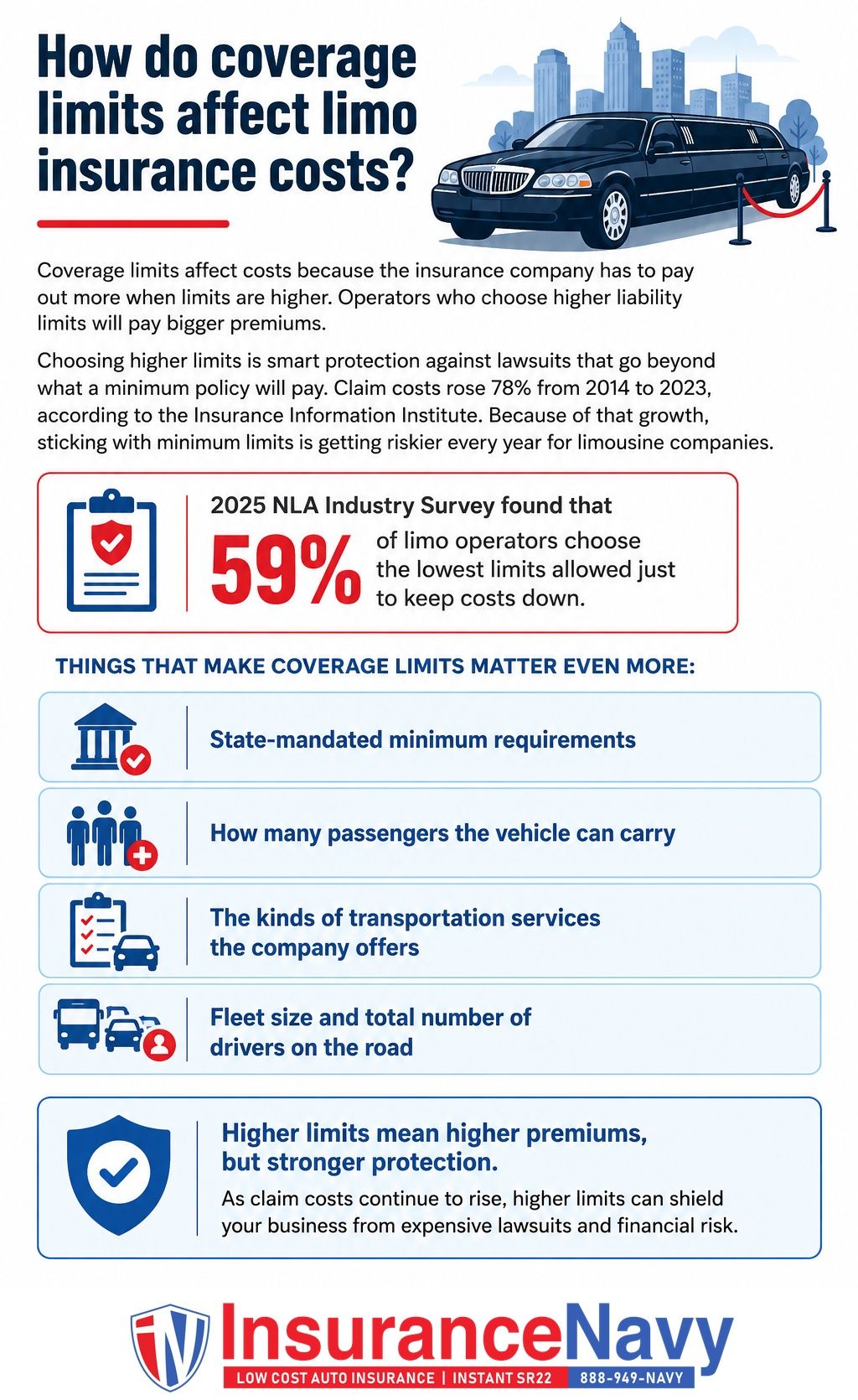
Coverage limits affect costs because the insurance company has to pay out more when limits are higher. Operators who choose higher liability limits will pay bigger premiums. The 2025 NLA Industry Survey found that 59% of limo operators choose the lowest limits allowed just to keep costs down.
Choosing higher limits is smart protection against lawsuits that go beyond what a minimum policy will pay. Claim costs rose 78% from 2014 to 2023, according to the Insurance Information Institute. Because of that growth, sticking with minimum limits is getting riskier every year for limousine companies.
Things that make coverage limits matter even more:
State-mandated minimum requirements
How many passengers the vehicle can carry
The kinds of transportation services the company offers
Fleet size and total number of drivers on the road
What factors cause limo insurance premiums to increase?
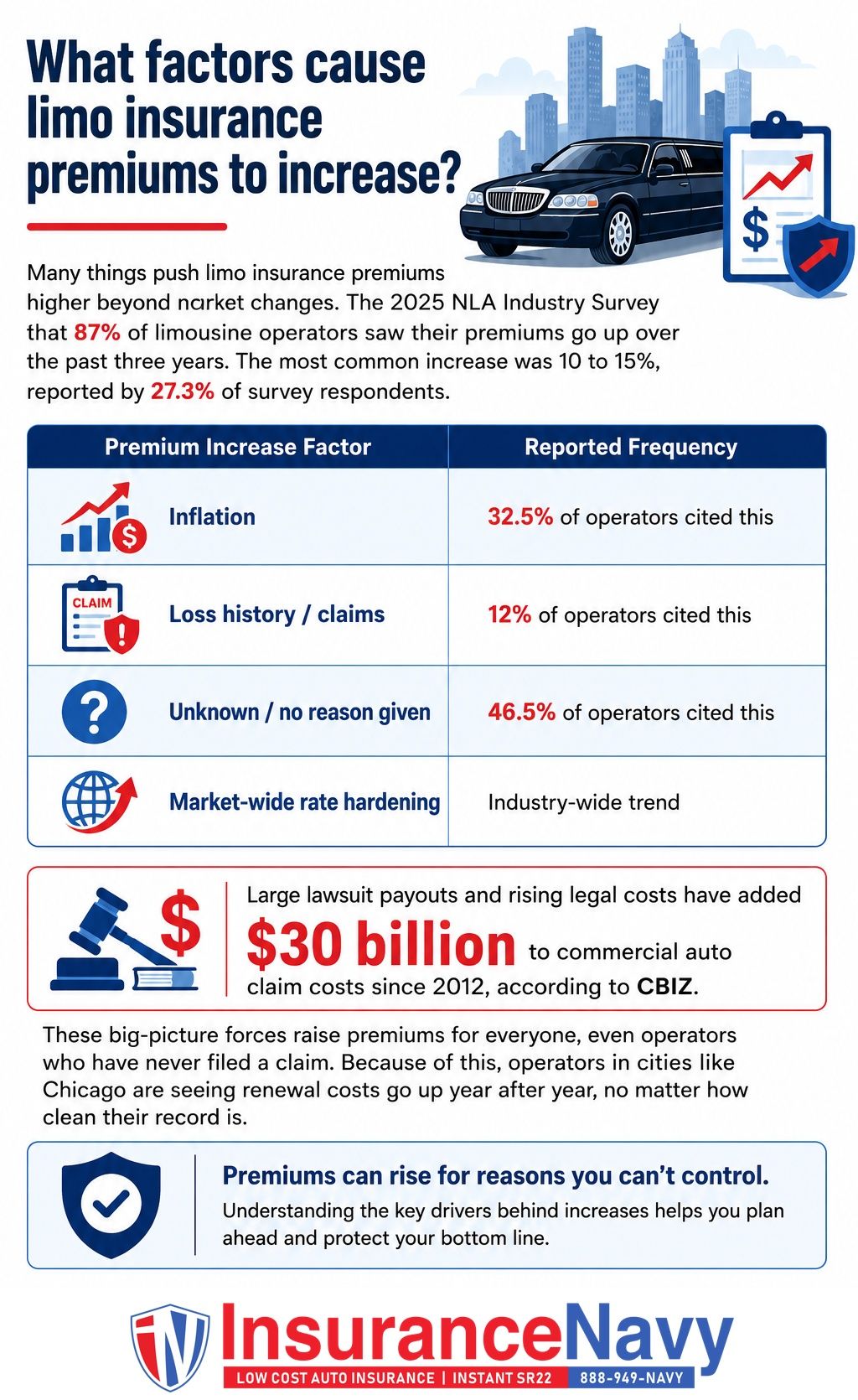
Many things push limo insurance premiums higher beyond normal market changes. The 2025 NLA Industry Survey found that 87% of limousine operators saw their premiums go up over the past three years. The most common increase was 10 to 15%, reported by 27.3% of survey respondents.
| Premium Increase Factor | Reported Frequency |
|---|---|
| Inflation | 32.5% of operators cited this |
| Loss history / claims | 12% of operators cited this |
| Unknown / no reason given | 46.5% of operators cited this |
| Market-wide rate hardening | Industry-wide trend |
Large lawsuit payouts and rising legal costs have added $30 billion to commercial auto claim costs since 2012, according to CBIZ. These big-picture forces raise premiums for everyone, even operators who have never filed a claim. Because of this, operators in cities like Chicago are seeing renewal costs go up year after year, no matter how clean their record is.
What commercial use classification applies to limo drivers?
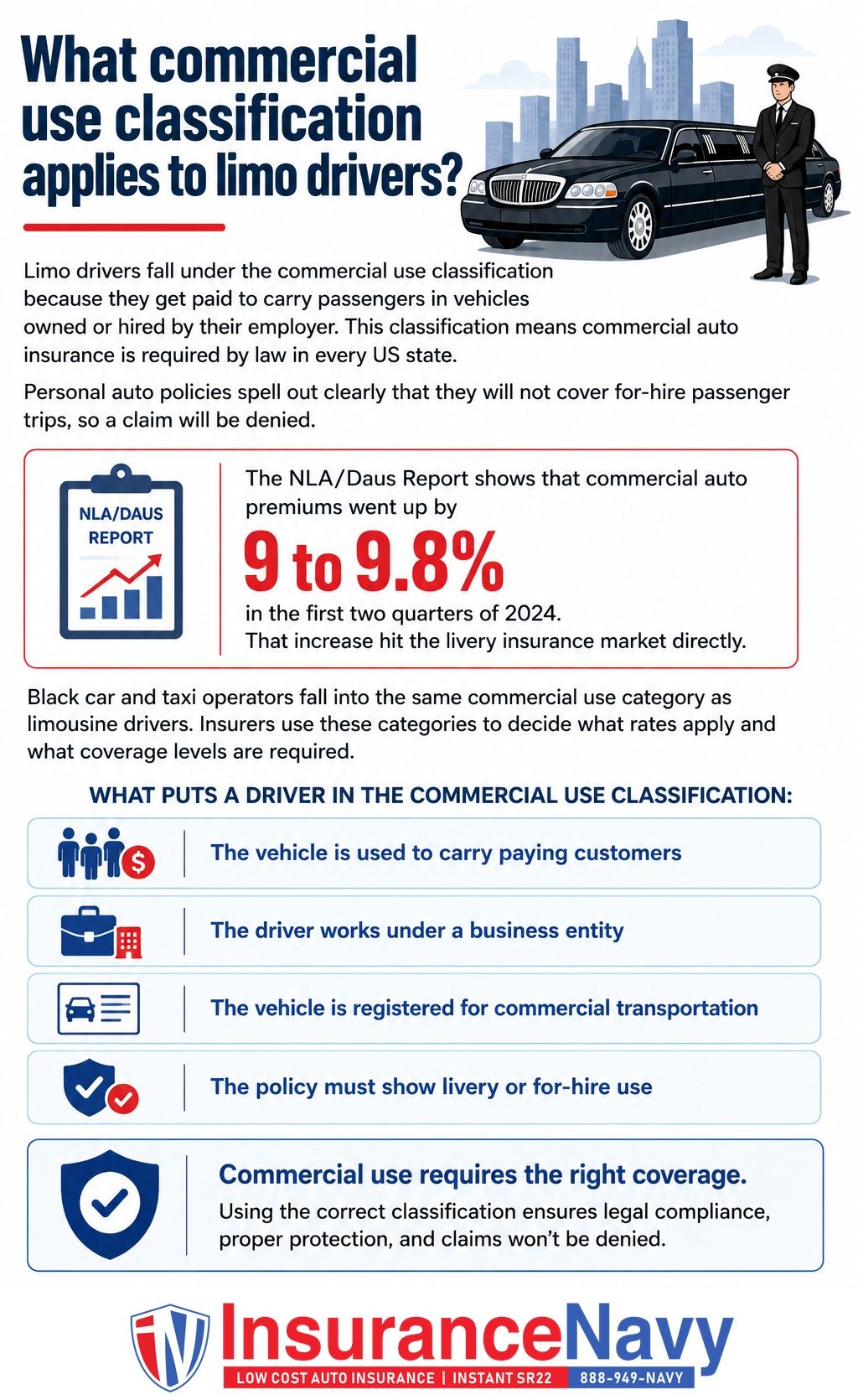
Limo drivers fall under the commercial use classification because they get paid to carry passengers in vehicles owned or hired by their employer. This classification means commercial auto insurance is required by law in every US state. Personal auto policies spell out clearly that they will not cover for-hire passenger trips, so a claim will be denied.
The NLA/Daus Report shows that commercial auto premiums went up by 9 to 9.8% in the first two quarters of 2024. That increase hit the livery insurance market directly. Black car and taxi operators fall into the same commercial use category as limousine drivers. Insurers use these categories to decide what rates apply and what coverage levels are required.
What puts a driver in the commercial use classification:
The vehicle is used to carry paying customers
The driver works under a business entity
The vehicle is registered for commercial transportation
The policy must show livery or for-hire use
How does passenger capacity change limo insurance premiums?
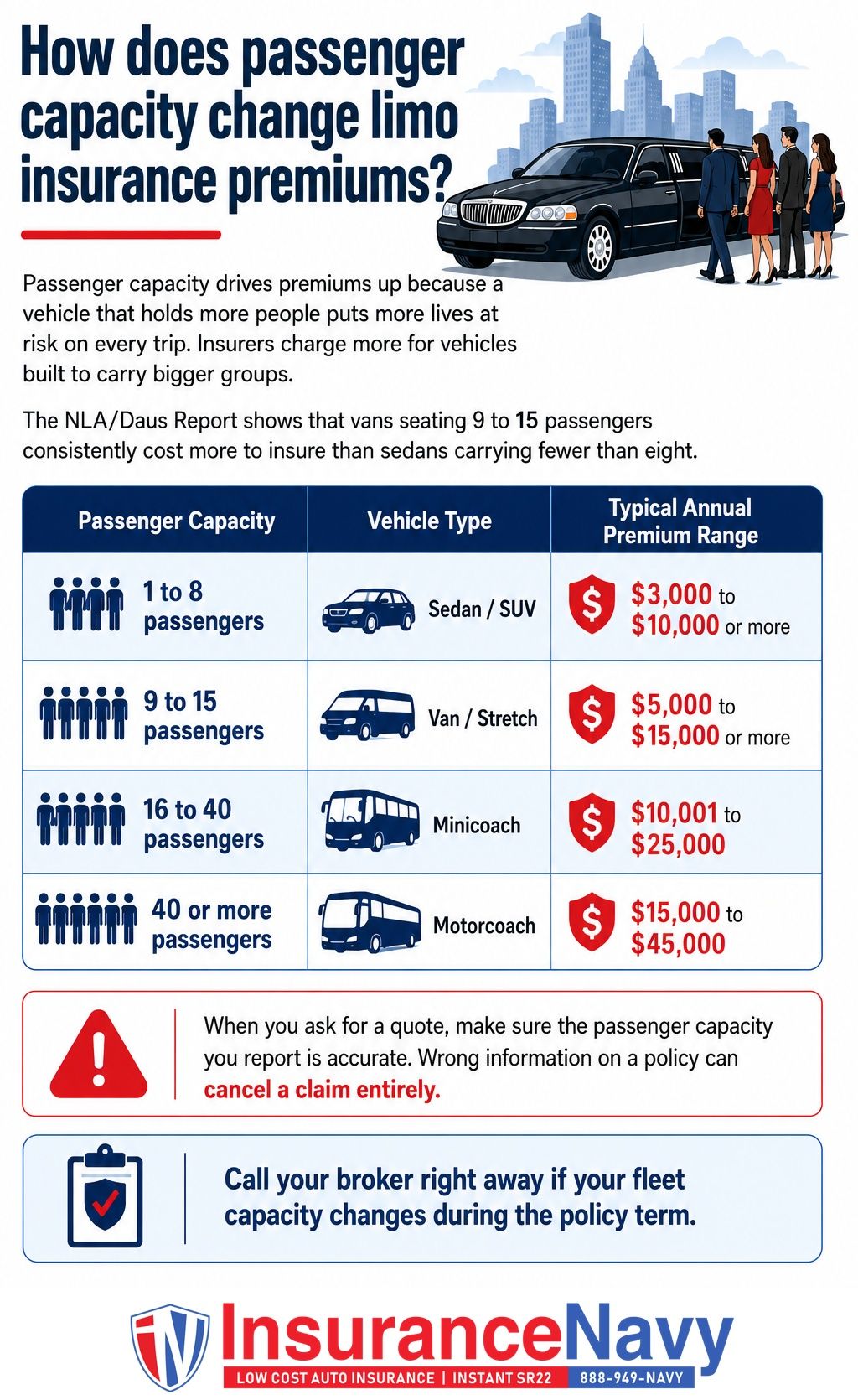
Passenger capacity drives premiums up because a vehicle that holds more people puts more lives at risk on every trip. Insurers charge more for vehicles built to carry bigger groups. The NLA/Daus Report shows that vans seating 9 to 15 passengers consistently cost more to insure than sedans carrying fewer than eight.
| Passenger Capacity | Vehicle Type | Typical Annual Premium Range |
|---|---|---|
| 1 to 8 passengers | Sedan / SUV | $3,000 to $10,000 or more |
| 9 to 15 passengers | Van / Stretch | $5,000 to $15,000 or more |
| 16 to 40 passengers | Minicoach | $10,001 to $25,000 |
| 40 or more passengers | Motorcoach | $15,000 to $45,000 |
When you ask for a quote, make sure the passenger capacity you report is accurate. Wrong information on a policy can cancel a claim entirely. Call your broker right away if your fleet capacity changes during the policy term.
What state regulatory requirements apply to limo insurance?
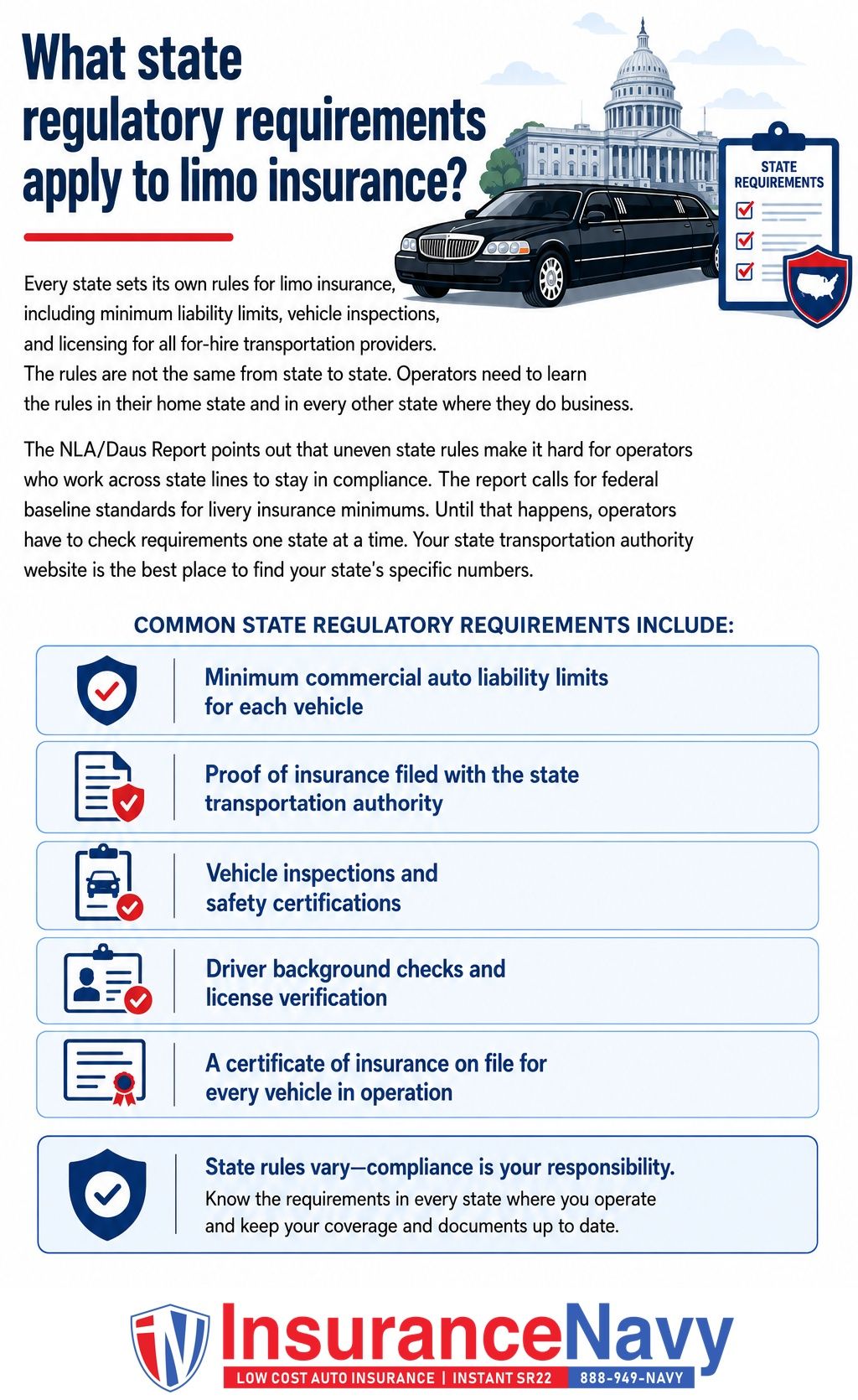
Every state sets its own rules for limo insurance, including minimum liability limits, vehicle inspections, and licensing for all for-hire transportation providers. The rules are not the same from state to state. Operators need to learn the rules in their home state and in every other state where they do business.
The NLA/Daus Report points out that uneven state rules make it hard for operators who work across state lines to stay in compliance. The report calls for federal baseline standards for livery insurance minimums. Until that happens, operators have to check requirements one state at a time. Your state transportation authority website is the best place to find your state's specific numbers.
Common state regulatory requirements include:
Minimum commercial auto liability limits for each vehicle
Proof of insurance filed with the state transportation authority
Vehicle inspections and safety certifications
Driver background checks and license verification
A certificate of insurance on file for every vehicle in operation
How much does commercial auto liability cost for limos?
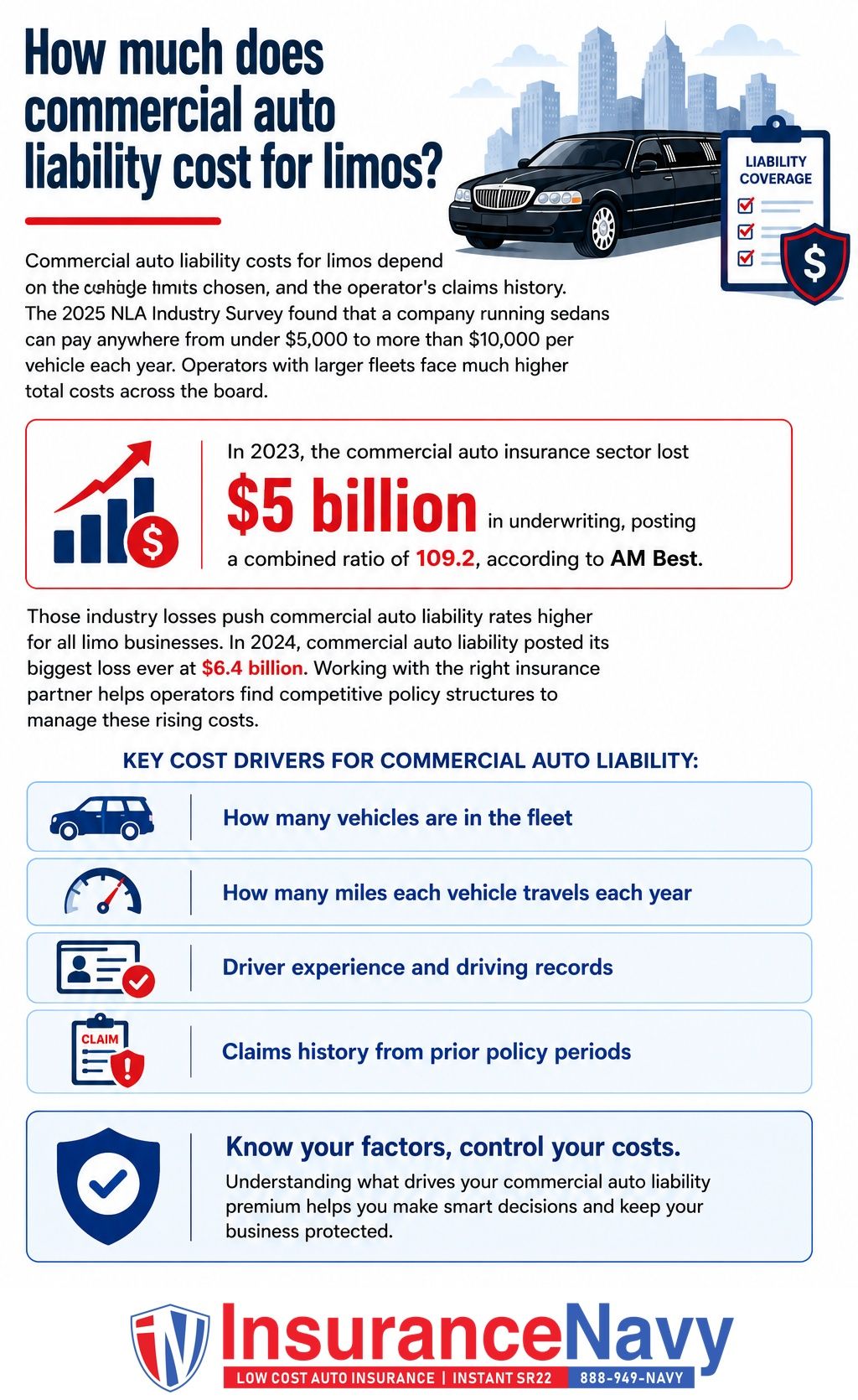
Commercial auto liability costs for limos depend on the vehicle type, the coverage limits chosen, and the operator's claims history. The 2025 NLA Industry Survey found that a company running sedans can pay anywhere from under $5,000 to more than $10,000 per vehicle each year. Operators with larger fleets face much higher total costs across the board.
In 2023, the commercial auto insurance sector lost $5 billion in underwriting, posting a combined ratio of 109.2, according to AM Best. Those industry losses push commercial auto liability rates higher for all limo businesses. In 2024, commercial auto liability posted its biggest loss ever at $6.4 billion. Working with the right insurance partner helps operators find competitive policy structures to manage these rising costs.
Key cost drivers for commercial auto liability:
How many vehicles are in the fleet
How many miles each vehicle travels each year
Driver experience and driving records
Claims history from prior policy periods
Do I need hired and non-owned auto coverage for limos?
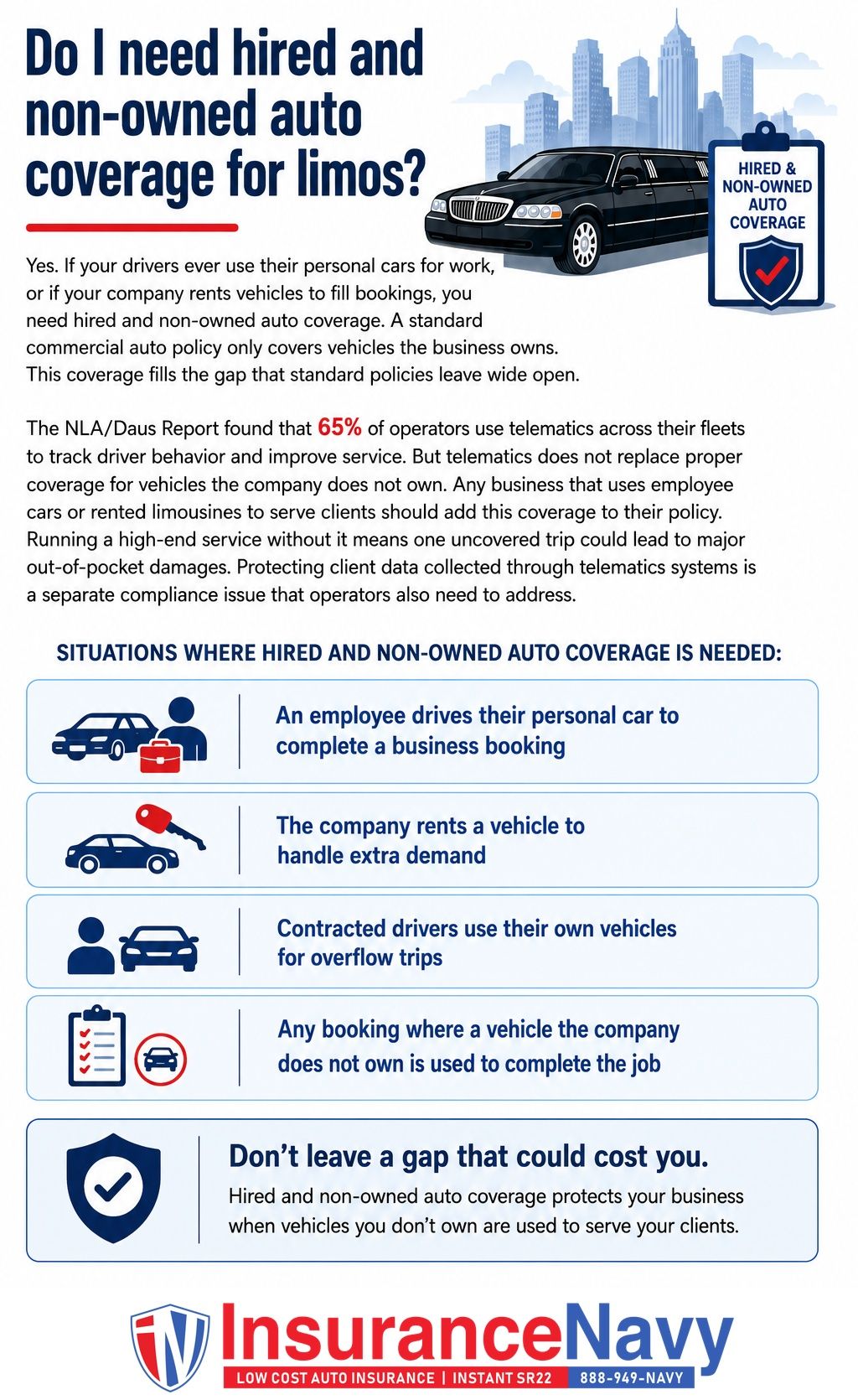
Yes. If your drivers ever use their personal cars for work, or if your company rents vehicles to fill bookings, you need hired and non-owned auto coverage. A standard commercial auto policy only covers vehicles the business owns. This coverage fills the gap that standard policies leave wide open.
The NLA/Daus Report found that 65% of operators use telematics across their fleets to track driver behavior and improve service. But telematics does not replace proper coverage for vehicles the company does not own. Any business that uses employee cars or rented limousines to serve clients should add this coverage to their policy. Running a high-end service without it means one uncovered trip could lead to major out-of-pocket damages. Protecting client data collected through telematics systems is a separate compliance issue that operators also need to address.
Situations where hired and non-owned auto coverage is needed:
An employee drives their personal car to complete a business booking
The company rents a vehicle to handle extra demand
Contracted drivers use their own vehicles for overflow trips
Any booking where a vehicle the company does not own is used to complete the job